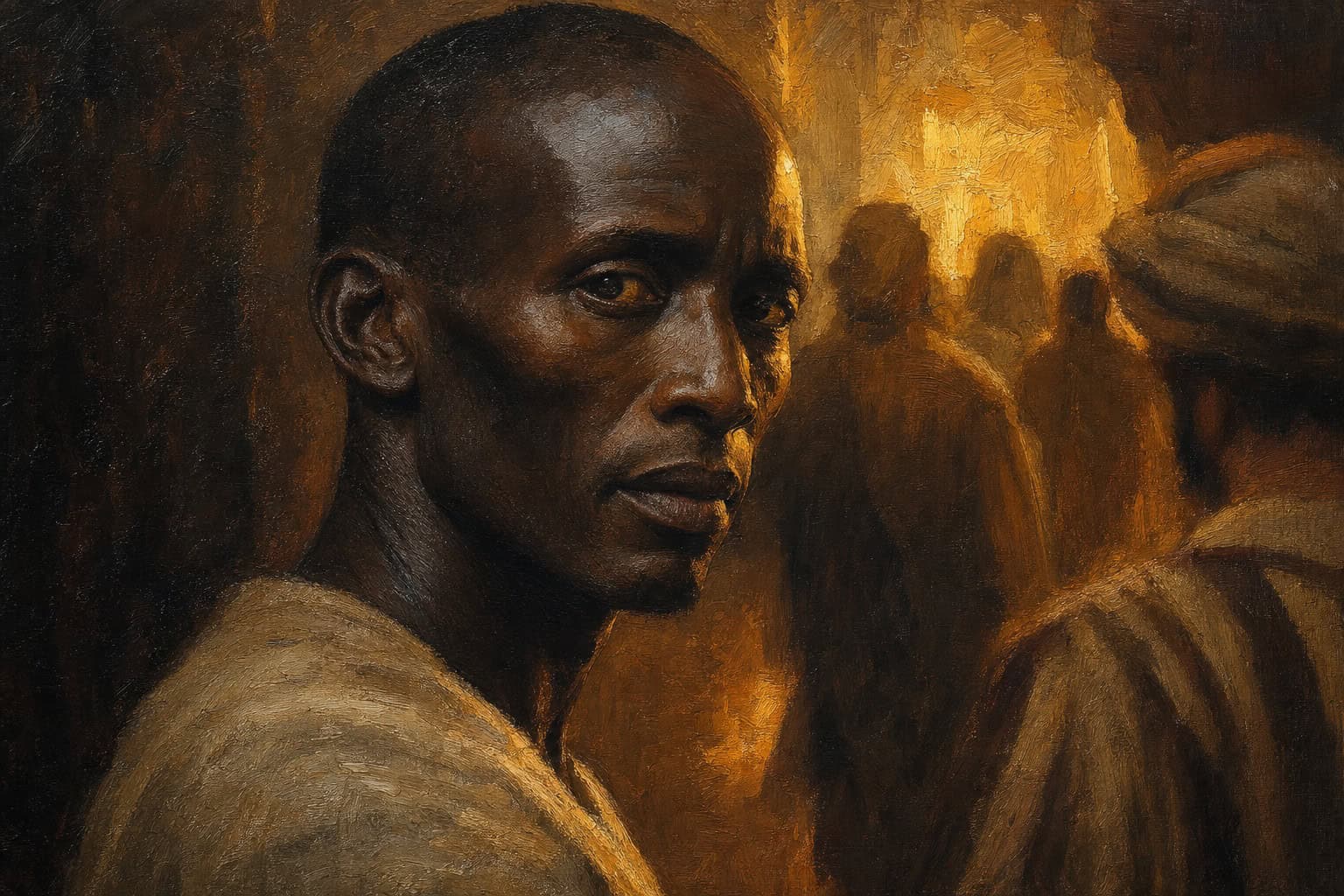
Can sudden desire teach you something spiritual? A reflection on the shock of joy that breaks into a guarded life, and what it might mean.
One Hand Always on the Brake
Can something as ordinary as wanting someone be a lesson from God? That is the question this scene sets down without apology. A man looks back over his years of loving carefully. He measured every word before he let it leave his mouth. He weighed what he could feel and what he should keep sealed behind his teeth. He kept one hand on the emergency brake at all times, ready to slow the car before it ever reached full speed, ready to stop short of the place where a thing might actually happen to him. This was not cowardice, exactly, though it wore the same coat and walked with the same stoop. It was survival, or what he had mistaken for it. He had learned somewhere back in his life that intimacy cost more than he wanted to pay, and he had decided, quietly and long ago, to pay as little as the world would allow. So he lived in a low gear. He gave affection in small, careful portions, the way a man rations water he is afraid to run out of. He let himself be known only up to a certain line drawn in his own chest, and then he pulled back into a fog where nothing could reach him and nothing could cost him anything. In Confessions to the Empty Chair this habit is not confessed as one flaw among many; it is the whole shape of a man’s relational life laid bare on the table. The chapter watches him circle the same guarded ground he has circled for years, wearing a groove into it with his own footsteps. He knows the map of his own caution by touch, in the dark, without looking, the way a man learns the corners of a room he has paced too long. What he does not yet know is that the map is about to be useless to him. He is still convinced that the danger lives out there, in other people, in their motives, behind their pleasant faces. He has not yet turned to the harder question of what his own guardedness has already cost him, what it has quietly starved in him, what tenderness it has refused without a word. The body of this man has been kept on a short leash for a very long time. Desire has become a thing to manage and mistrust, never a thing to follow. So the scene begins in a strange stillness, a man idling at the curb of his own life, engine running, going nowhere, certain that stillness is the same thing as safety. He does not suspect that the ground beneath his careful feet is already beginning to give.
Reading the Board Like a Frightened Chess Player
Before the interruption comes, the narrator does what wounded men so often do; he theorizes. He studies the women he has known and sorts them into patterns, into types, into moves he can see coming. There is the one who keeps a small, patient crowd of admirers circling her, men she names as friends or brothers, held in place while she waits for something inside her to shift and settle. There is the one who lives for the hunt, who chases the arrival of each new man because the arriving itself is the only thing that fills her, however briefly, before the hollow returns. He watches these patterns the way a frightened chess player watches the board, hunting for the trap before it can spring on him. And here the honest thing has to be said plainly, because the book itself is straining toward honesty. This sorting is not only wisdom; it is also armor, and heavy armor at that. A man who can name every pattern in a woman never has to be surprised by one. A man who has the whole game mapped never has to be caught off his guard, never has to risk the small humiliation of wanting someone who does not want him back. So the theorizing wears two faces at once, and the chapter refuses to let him hide the second one. Yes, there are people who feed on the affection of orbiters and never once give themselves away. Yes, there are hollow places in others that no new arrival can fill for longer than a night. But the sharper truth turns the blade inward. The very emptiness he sees in them, the careful distance, the flinch away from real encounter, is his own emptiness wearing a different dress and a softer voice. He recognizes their avoidance so fast because he has perfected the identical craft in his own life. He calls a woman disinterested and half-forgets that he built his whole existence around keeping himself unreachable. The strategist and the frightened man are the same man, breathing the same breath. And a thoughtful reader, woman or man, will feel the tension he cannot resolve; a person is never only a pattern, never only a mechanism to be decoded and filed away. Each of these women is a whole life lived from the inside, with her own hunger, her own history, her own long night. The strategic reading catches one thin layer of the truth and slides right past the person standing in front of him. His theories keep him company and keep him lonely at the very same time. That is the quiet failure the book will not let him off the hook for, and it names it without cruelty, only clarity.
A Doctor Who Did Not Ask Permission
Then it happens, and it happens fast, faster than his defenses can be raised. A woman he calls the doctor steps forward. She does not ask if it is all right. She does not test the water with the tip of one toe. She does not wait for the safe conditions his whole life is built to require before anything is allowed to move. While others are standing there watching, she simply comes toward him, plainly, with a confidence he has no answer for, taking a risk that stuns him precisely because he would never in his life have taken it himself. And this, the narrator senses in his body before his mind can argue, is not merely attraction. It is a shock with something holy folded inside it. He reaches for the old image of mud, of clay pressed against blind eyes to make them see, and he calls what came to him the mud of mercy. But he notices, and the noticing is the whole point, that mercy did not arrive as a soft balm this time. It did not soothe him. It interrupted him. It broke into his ordered, guarded, one-hand-on-the-brake existence with an uninvited grace he did not plan for and could not steer. Here is the turn the whole chapter has been quietly walking toward all along. The moments that save us are so often the ones that violate the very rules we made to keep ourselves safe. He had built a law for his own living, a code of caution, a careful accounting of measured feeling, and grace came to him in the shape of a person who simply refused to obey it.
Sometimes grace does not soothe the wound; it walks up in front of everyone and refuses to ask permission.
What unnerves him is not only that he was wanted, but that he was wanted openly, in the light, without the negotiation and the careful choreography he had come to mistake for love. Her boldness exposes his caution for the small, frightened thing it had always been under its dignified coat. And there is a deeper trembling running underneath all of it. This happened while he stood inside a one-sided relationship, which means the mercy and the disorder arrive tangled tight together, and he cannot pretend for a second that the moment is clean. The shock is real in his chest. So is the guilt that follows it a heartbeat later. So is the strange, disorienting sense that God might be standing inside this confusion with him rather than waiting patiently on the far side of it for things to become tidy again. The book refuses to sort what he feels into neat piles. Desire, mercy, risk, and wrongdoing all press against him at once, from every side, and he is left shaking, unable to name with any certainty what has just happened to him.
Sometimes grace does not soothe the wound; it walks up in front of everyone and refuses to ask permission.
The Guilt and the Gift Refuse to Separate
After the shock comes the reckoning, and it offers him no comfort. He does not walk away purified or lightened. He walks away disturbed, carrying more than he came with. The old caution has been cracked open, but nothing in him has been resolved, and he knows it. He is a man who was seen, wanted, and reached for by someone who did not first stop to ask whether it was safe, and he has no idea what to do with the aliveness this woke in a body he thought he had long ago put to sleep. The body he kept on a short leash for years has suddenly remembered that it can be desired, that it can be chosen, that someone can move toward it without being coaxed. That memory does not fade politely into the background. It presses forward into every hour that follows, insisting on being felt again, refusing to be filed away. And here the honest self-questioning that runs through the whole book comes right to the front of his mind. He has to ask himself the hard things and stay in his own skin while he does. Did he encourage this somehow, with a look, a silence, a leaning? Did his own loneliness call it up out of her? What was he doing inside a relationship he himself calls one-sided, and how much of his own hunger had he been hiding, not only from her but from himself? The chapter does not hand him clean answers, because clean answers would be a lie, and this book is trying not to lie. The gift and the guilt will not come apart in his hands no matter how he turns them. He cannot say this was simply grace, because it happened in a place where it should not have happened. He cannot say it was simply sin, because something in it felt exactly like being interrupted by God in the middle of his sleep. He is left holding both at once, and the holding of them hurts him. There is also the matter of the woman herself, whom he must not shrink down into a lesson he happened to learn. She took a real risk with a real self, in front of others, in the open air. Whatever her motives were, and he admits he cannot fully know them, she gave him something his careful loves never once managed to give, and the least he owes her is to keep seeing her as a whole person rather than a turning point in his private drama. The fallout, then, is neither tidy repentance nor easy gratitude. It is a man learning, slowly and against his will, that his fortress was never holy, only frightened. It is the uncomfortable knowledge settling into him that the life he called safe was a life only half-lived, and that the shock which shamed him may also have been the truest thing to reach him in years. He does not yet know what a man builds on ground like this.
Idling No Longer at the Curb
Where does it settle? Not into a lesson he can frame and hang neatly on the wall of his understanding. That is the mercy and the severity of Confessions to the Empty Chair both working at once, refusing him the ending he might want. The narrator ends this passage more awake than he was when it began and less certain of anything than ever. He has been shown, in his own body, that grace does not always come as a rescue out of the dark. Sometimes it comes as a hand reaching for you inside the dark, in the very middle of your compromise, at a moment you would never have chosen and cannot afterward fully defend. This is a quieter and far stranger idea of God than the one who reaches down and fixes what is broken. It is a God who walks beside a man in his confusion rather than lifting him clear of it, present in the desire and present in the guilt, near even here, even now, even like this. The chapter leaves him understanding, reluctantly, that his years of caution were not the virtue he had told himself they were. They were a way of never being caught, never being surprised, never once risking the fall that real love has always required of everyone who reaches it. And now that someone has fallen toward him openly, in front of witnesses, he can no longer pretend the fall is only danger. It might also be the shape salvation takes for a man who has spent his whole life idling at the curb, engine running, headlights on, going nowhere. What he chooses to do with this is the ache the rest of the book carries forward on its shoulders. There is no bow tied around it. The desire remains, warm and unwelcome. The wrongness of where it happened remains, heavy and undeniable. The nearness of a mercy he did not plan and cannot explain remains too, uninvited and unforgettable. If you have ever wondered whether a sudden, unplanned wanting could carry something spiritual inside it, this chapter will not hand you a rule to obey, but it will sit with you inside the question and refuse to leave. It will show you a man learning, against everything he once believed about himself, that the moments which break our careful codes may be the exact moments God chooses to step through. And it will send you back into your own guarded rooms with one steady, unhurried question walking behind you: whether the safety you have built is protecting your soul or quietly starving it to death.