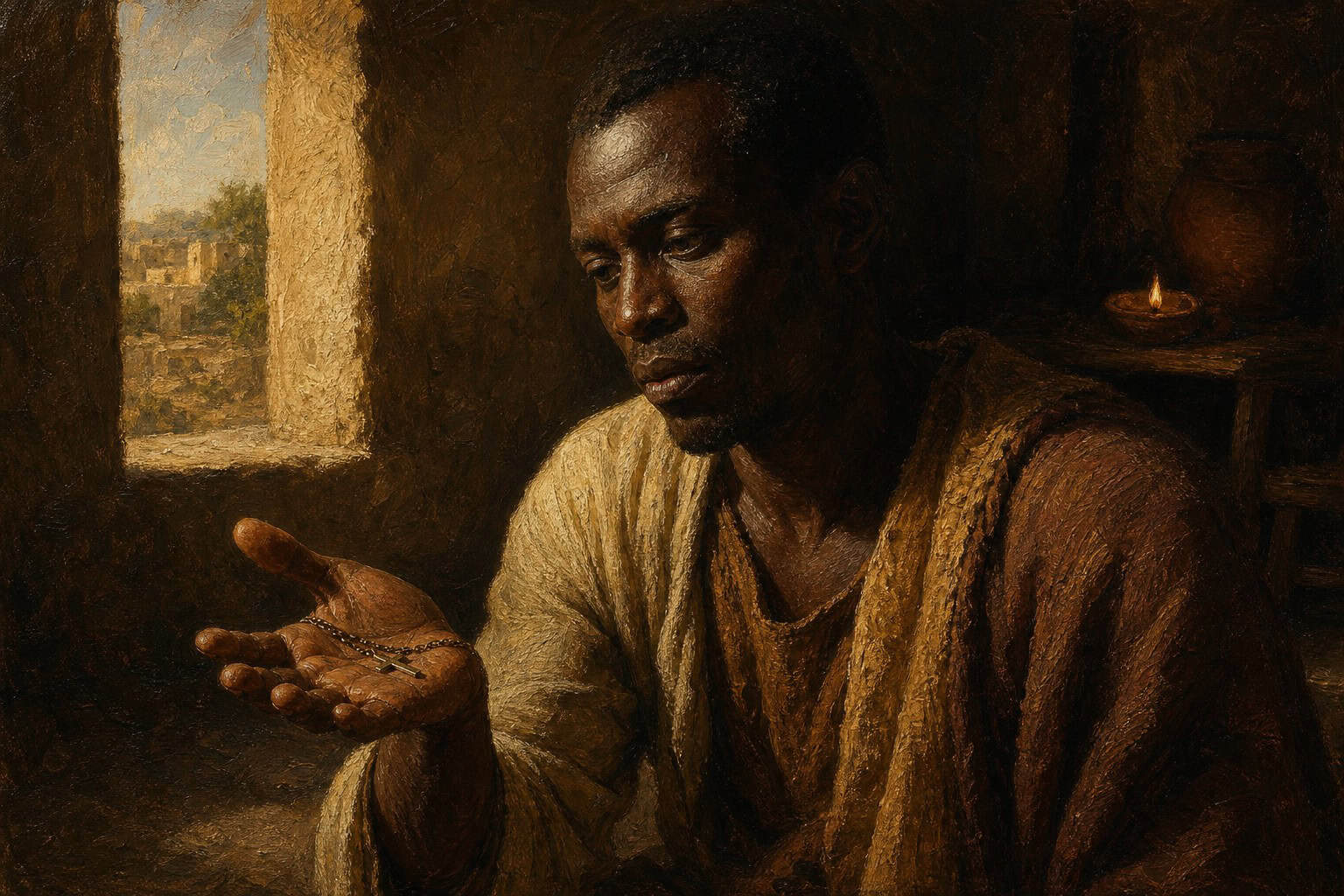
Turning grief into purpose sounds noble until you carry it. A raw, faithful reflection on how ruin becomes a road—without cheap comfort.
The Necklace That Changed Nothing
You want the grief to mean something, so you reach for an object to hold it. Maybe you did what the man in these pages did, and hung a small metal cross on a chain around your neck, believing the pain would loosen its grip if only you wore the right thing. You feel the cool shape of it settle against your chest in the morning. The chain warms slowly to your skin. You wait for the shift. Movies taught you that darkness flees from a glowing symbol, that the right gesture stops the interior noise. But the noise does not stop. The same thoughts come up the stairs of your mind. The same reflexes rise in your body before you can name them. The necklace has no discernible effect, and this is the first honest thing grief teaches you: purpose cannot be bought with a costume. You cannot dress a wound in meaning and expect it to close overnight. And yet you keep the cross on, because taking it off would concede something worse—that even the holy prop is useless, that you are alone with the thing. This is where so many of us actually live who are trying to turn sorrow into direction. We are not chasing triumph. We are begging for proof that the past was not only waste, that something can be built on ground this poisoned. The temptation is to grab the nearest holy object and demand it perform. The harder truth is that grief does not answer props. It answers time, relationship, and a slow, unglamorous walking-alongside you cannot manufacture by trying harder. So you stand there in the ordinary kitchen light with a symbol that failed to work as advertised, fingering the small links, and you have to decide whether faith is only about rescue. If it is, you are already lost, because the rescue is not coming the way you pictured it. What remains is smaller and stranger: a nearness inside the dark instead of a lamp that clears it. The man in this memoir eventually gives the necklace away to someone he loves, hoping it might shelter her more than it sheltered him. She hides it under her shirt, wary of the questions it would raise. That small gesture of hiding tells you everything about how uneasy the symbol sits, even on a believing neck. And that is where the real question of purpose begins—not in the object at all, but in the moment you stop asking the sorrow to vanish and start asking what it might yet be for. You are not there yet. You are still holding the chain, still half-hoping the movie was true, still surprised that the metal is only metal.
Salted Ground and the Question of Use
Grief wants to rot in private, and you have to decide whether to let it. There is a phrase this narrator uses that lodges in the chest: he refuses to let the wisdom of terrible events wither without examination. Read that slowly, because it is not a slogan. It is a labor with sweat in it. To examine what happened to you—to hold the memory up to the light and turn it in your hands—is agonizing precisely because your body would rather bury it whole and salt the grave. The molestation he carries is not a lesson he chose off a shelf. It is a rupture that shaped how he moves through rooms, a memory the body keeps though it never asked to keep it. Your own body knows this. It tenses at a smell, a hallway, a certain angle of light, and you cannot always say why. Here is the tension that makes turning grief into purpose so treacherous: you can dress it up too fast. You can bless what happened, call it a gift, tie a bow on the horror, and in doing so lie about its evil. This narrator will not do that. He says plainly that he does not bless it. Evil is not a thing God fashioned; it is a state of affairs that ought never to have been, a tear in the fabric of how things should go. To pretend otherwise is to insult the child you were, the one who had no protection and no words. But refusing to bless it is not the same as refusing to use it. This is the narrow ledge you must walk, and the two drops fall away on either side. On one side, the false peace that pretends the harm was secretly good all along. On the other, the flat despair that lets the harm mean nothing, that leaves the ground poisoned forever and calls that honesty. Purpose lives in the thin space between—where you say clearly, this should never have happened, and also, I refuse to let it have the last word. That takes a strange, unshowy courage, because examination reopens what you spent years learning to seal. Your hands remember what your mind wants to forget. The room where it happened stays a room in your mind, near and far at the same time, a place you can walk into with your eyes shut and never fully leave. To turn grief into purpose means agreeing to enter that room on purpose, awake and standing, instead of being dragged there in your sleep. It means asking what the darkness taught you about the vulnerable, about who guards a child’s bed, about a God who was somehow present even there without stopping it. You do not want to go in. Nobody wants to go in. But the wisdom withers if you don’t, and you sense that its withering would be its own second, quieter death.
The Wound Site Becomes the Healing Site
Then someone touches the exact place that was broken, and it does not break further. This is the turn no bright self-help book prepares you for, and it is the beating heart of how grief becomes something more than grief. The narrator names it with terrible clarity: what darkness once used to install hatred in him, a woman’s love now used to install its opposite. The same intimate territory that was weaponized becomes the precise ground where he learns, for the first time, to love. Notice what does not happen. Healing does not arrive by going around the wound and finding some clean, untouched part of him to work on. It walks straight into the damaged place—the very body, the very nearness that was once used against him—and does its slow, patient work right there in the ruins. This is why real healing feels so much like danger that your skin knows before your mind does. To let anyone close to the broken place is to risk being broken again in the same spot, and your whole nervous system screams against the risk. Your breath goes shallow. Your muscles brace for a blow that has not come and may never come. And yet this is where restoration happens, if it happens at all: not in a fresh untouched field but in the salted earth, where something impossibly green pushes up through soil that ought to grow nothing but stone. The far and the near collapse into each other. The person who once seemed farthest away—untouchable, because touch itself had been the injury—becomes the one who is suddenly, unbearably nearest. He confides in her the most guarded thing he owns, a hidden experience of God close to his heart, and she does not flinch. She shares the same love. That trust is its own healing, a hinge in the body swinging loose where it had been nailed fast for years. This nearness is the miracle, and it is rare, and it cannot be scheduled, purchased, or earned by good behavior. You can only be found by it, the way you are found by weather. And when it comes, it does not undo the past. The scar is still a scar. But the scar is now a place where a hand has rested gently, where the meaning of touch has begun, quietly, to be rewritten. You did not think that possible. You had filed that whole region of yourself under ruin. And here is love, planting seeds in exactly the ground you fenced off.
Purpose does not erase the wound; it plants a garden where the ground was salted, and the ground remembers both.
When Love Asks the Practical Question
But healing brings its own grief, and this is the part nobody warns you about. Once the broken place can love again, it starts to want things, and wanting has a price tag you cannot see until the bill arrives. The narrator carries a calling. He wants to give his whole life to God, to become a priest, and he says this to the woman who healed him with a kind of shining certainty—the years of seminary waiting in another city, the degrees, the long road of study stretching out ahead of him. He speaks of it lightly, maybe far too lightly, waving off the future’s demand as though it were something distant and harmless. She asks whether priests are not supposed to be celibate. He answers too easily that he is not a priest yet, as if the yet were a wall between now and consequence. And then she asks the smallest question in the world. What about us. Her voice goes small and quiet. It is not an argument. It is not a refusal. It is a reasonable, pragmatic, deeply human question, and it lands like a whole universe dropping into the space between two people. This is how vocations die and how new griefs are born—not in high drama, not in a shattering crisis of faith, but under the tender weight of an ordinary need for a future together. Here is the cruelty folded inside turning grief into purpose: the moment you build something beautiful on your ruin, life sends a second sorrow to test whether the beauty can hold two loves at once. He wants God. He wants her. Both are real. Both are good. And they may not fit inside the same room, the same life, the same set of years. You feel the floor tilt when you sit inside this, because you know the feeling from your own history—the moment your calling and your love looked across at each other and understood, without a word, that one of them might have to be laid down and grieved. He does not resolve it here, and neither will you. What the older narrator sees, looking back with the lens turned on himself, is his own part in it. Did he speak too easily on purpose, to keep from feeling what her question really cost? Did he refuse to feel the future because feeling it would demand something of him now, in the room, with her voice going small? Did the very grief he had converted into purpose become one more clever place to hide from a simple human demand for love? These are not comfortable questions, and he does not answer them with a tidy moral. He sits down inside them and stays. That is the honest falling-away after every real conversion of grief: you discover the meaning you built is not a fortress at all but a road, and roads carry you somewhere you did not plan, past faces you love, toward a cross you did not choose.
Two Coins in an Empty Hand
So this is where it settles, and it is not where you hoped. Turning grief into purpose does not end in triumph or a clean, closing chord. It ends in poverty—the strange, holy poverty of someone who has offered up his darkness and his sadness as the only coins left in his hand, because they are honestly all he has to give. You wanted the grief transformed into something spotless and finished, a story with the wound stitched invisibly shut. What you get instead is grief made useful without being made painless. The wound stays a wound. The reflexes still rise. The room in the mind is still a room. The narrator calls it his cross, the thing he carries until God himself separates what was wrongly joined in him and makes all things new. That day has not come. It may not come in this life, and he does not lie to you about that timeline. What he has, in the long meantime, is not a rescue but a companion—a God who did not lift the darkness away but walked down into it, present in the tears he could not stop, near even inside the sin, quiet in the very room where no protection ever came for the child. That is the whole offer, and it is smaller and far truer than what the movies promised the boy with the necklace. Your grief will not disappear because you gave it a purpose. But it can stop being only waste. It can become the soil, salted as it is, where love slowly learns to grow and where you learn to love a God who did not spare you and did not leave you either. The pull toward this book is the pull toward exactly that honesty—a man who refuses both the lie that his suffering was secretly good and the lie that it was meaningless, who holds both in his bleeding hands and lifts them anyway, like a beggar with two thin coins. Confessions to the Empty Chair does not hand you a method for feeling better. It tells you the truth about carrying what you cannot put down, and about the nearness of grace inside the very dark you kept begging it to clear. You close the chapter poorer and more awake, holding your own two coins, turning them over, wondering what on earth you will do with them. And that wondering is the beginning of the road, not the end of grief but the slow turning of it—toward something you can name but cannot yet hold, a wholeness that keeps its distance and keeps calling your name across it. You reach. Your hand stays open, and the reaching does not stop.