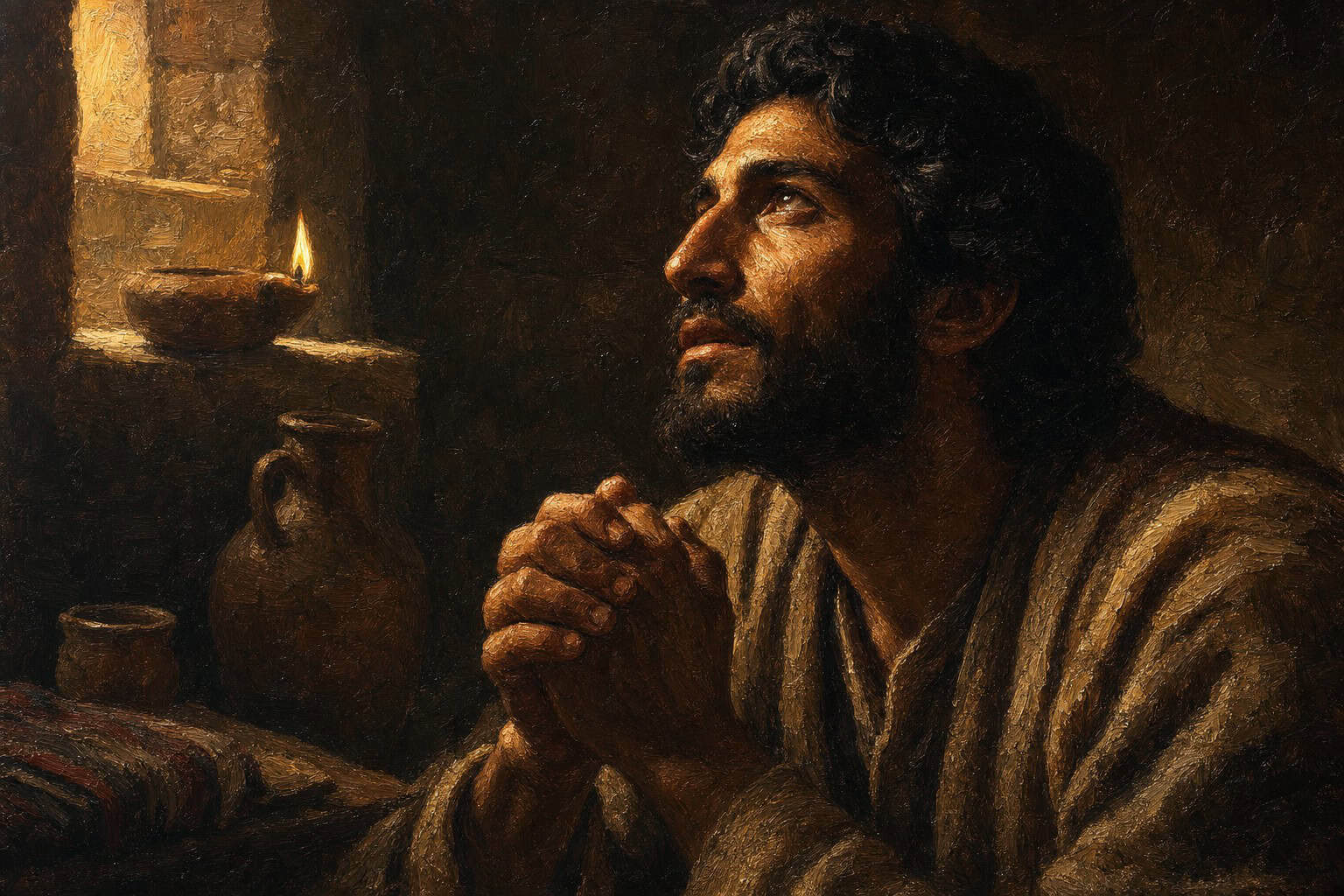
When grown children reject you, the ache is old as Eden. A raw reflection on separation, shame, and the God who stays inside the dark with you.
Two Chairs Pulled Away From the Table
A father learns his children have grown past his reach in the small, unnoticeable shifts of the body. That is where Fractions of the Soul begins its first chapter—not with a fight, not with slammed doors, but with two people at a table who read each other before a single word is spoken. The narrator watches a young man approach a young woman and sees everything the body confesses ahead of speech. Arms that were crossed a moment ago now uncross. Pupils widen. Breath goes shallow and quick. She grazes her neck with her right hand and tucks one side of her long hair behind her ear, letting her earrings catch the low light. She has communicated something without a syllable, and he accepts it with a small, congratulatory smirk that he believes no one can see. I read this scene the way a rejected father reads his own history. Long before my children ever told me anything with words, their bodies had already told me. The way they no longer leaned in when I entered a room. The way conversation went thin and careful and polite, all surface and no weight. The arms that stayed crossed while mine reached. You do not need the announcement; the announcement is old news by the time it finally arrives. The permission a child once gave you to enter their space—that unspoken yes that once made you their whole world—is withdrawn in the very same silent language it was first granted. And you feel it as a cold spot at the table where warmth used to live, a chair that is technically occupied and yet somehow already empty. This is what the scene teaches before it teaches anything else. The most consequential exchanges between people happen in the milliseconds before words, in posture and breath and the angle of a turned shoulder. So when your grown children reject you, the first honest thing to admit is that you knew. Your body knew. You watched them uncross and recross their arms across a hundred ordinary evenings, and you told yourself a kinder story about tiredness, about phases, about time. The chapter opens by refusing that kinder story. It sits you down as an observer of two strangers and, in doing so, makes you look at what your own eyes have been avoiding for years. Then it asks the question every rejected parent dreads to hold: what did I refuse to see while there was still time to see it, while the yes was still on offer, while a warmer breath could still have crossed the table?
The Smirk You Do Not Want To Recognize
The tension gathers the moment I stop watching the young couple and start recognizing myself in the wrong figure. The narrator invites us to become a certain kind of observer—hidden, detached, gathering evidence without anyone’s consent, convinced that people change their behavior the instant they know they are being watched in an information-gathering way. There is something honest in this and something terrible. It is the posture of a man who has decided that understanding matters more than presence, who would rather see clearly than be moved, who trades participation for the cold comfort of clarity. And here is the reckoning I cannot dodge. Is that not exactly how I failed my children? I studied them. I diagnosed them. I stood just outside the spell of their lives and told myself I was protecting my reason against emotion’s pull, when what I was really doing was withholding myself. A father who watches his children the way a scientist watches specimens has already left the room, even while his body stays planted in the chair. The small self-congratulatory smirk in the scene undoes me, because I know that smirk from the inside. It is the private expression of a man who thinks he has won some understanding, who mistakes his own distance for depth. I wore it for years. When my children began to pull away, part of me felt a low, ugly satisfaction, the feeling of being proven right about how the world eventually betrays you. That is a foul thing to write down and a fouler thing to have felt. There is a terrible loneliness in that kind of clarity, and I chose it on purpose, again and again, because it hurt less than the alternative. I preferred the safety of watching to the risk of being wounded a second time. So the question sharpens until it has an edge. Did my children reject me, or did they simply stop offering intimacy to a man who kept observing them from a chair he never really sat in? The scene refuses to let me have it both ways. It holds up the mirror that only another person’s gaze can be, the one truth I cannot manufacture alone in my own head. My own lens is habituated and flawed. I cannot heal my blind spots by staring harder into myself, no matter how long I sit with my own reasoning. I needed their eyes to show me who I had quietly become. And by the time I was finally willing to be looked at like that, they had already turned those eyes away from me. The rising ache here is not that they left. It is the fear that they left something I had abandoned first. The tightening arrives in the chest before the thought—withdrawal, hardening, a hand already reaching to shield itself. I recognize the motion. I made it years ago and called it love.
Eden Beginning Again With New Faces
The turn comes when the scene finally names what it has been watching all along: the story of Adam and Eve beginning again with new characters cast in the old parts. The ritual feels brand new to everyone seated at that table, and yet the human heart never changes. Every reaching of one person toward another repeats the first meeting in the garden, and every separation repeats the first exile from it. This is the revelation that reframed my grief and would not let me set it back down. My children’s rejection was not a private catastrophe unique to my particular failures. It was the oldest wound wearing my family’s faces. Adam and Eve did not become ashamed because they had sinned in the abstract. They became ashamed because they were suddenly aware of being separate, of standing alone in their own skin, and no love reached across the gap to cover them where they stood exposed. Shame, guilt, and anxiety are precisely what grow in the space between people when the reunion of love does not come. That is exactly the space I had been standing in without a name for it. My children and I had grown aware of our separateness, and I had let the reunion fail to arrive, evening after evening, until the failing became the habit and the habit became the house. I had reasons. I always have reasons; a watching man collects them like evidence. But the scene strips the reasons away and shows me the bare structure underneath. Two people who once shared a whole world now stand in the cold of their separate solitudes, each hiding the missing threads in the fabric of their days, each terrified to be seen fallen and unfinished. What the young couple in the scene are reaching toward with such hope, I had let go slack and gray in my own home. The distance between the observer and the observed is the same distance between a father and the children he studies instead of holds. Here is what I underlined in my own soul, in ink that does not wash out.
Separation without a reunion in love is the oldest wound, and it does not care how many years you spent trying to be worth keeping.
Sitting In The Cold Spot Where Warmth Lived
What follows the revelation is not relief. It is the slow, unglamorous work of living inside a loss that will not resolve on schedule. My children did not come back because I had finally understood the theology of separation, because I could finally name Eden in my own kitchen. That is not how this book works, and it is not how God worked in my life. Grace, when it came, did not lift me up and out of the dark. It sat down in the dark beside me and stayed. This is the hardest thing to explain to another rejected parent, because everyone hungers for the version where the phone rings on a Tuesday, where the door opens, where the lost years fold shut like they never happened. Sometimes that does happen. It is rare, and it is real, and I will not pretend it never breaks in like weather that clears without warning. But far more often God does not clear the empty chairs from your table. He simply refuses to leave you alone with them. I would sit in the cold spot where my children’s warmth used to live, and I would feel a Presence there that did not scold me and did not fix anything. It only stayed. It let me weep without correcting the weeping into something more useful. It let me hold the honest accounting—what I had done, what I had left undone, the smirk I had worn at the table, the endless watching I had chosen over the risk of open arms—without letting that accounting drown me. The reckoning is severe and I do not get to soften it. I did not get to keep my treasured self-image as the wronged and misunderstood father. I had to face my own withdrawal, my own hardening, the years of small lessons in which I taught my children that closeness to me was a risk they should manage carefully, from a distance, with their own arms crossed. And still, sitting inside that severity with no exit, I was accompanied. The felt tone of those years was grief, a grief that colored the whole sky the way heavy weather colors an afternoon and refuses to lift. But it was not a solitary grief anymore. Something walked inside it with me, matching my pace, not hurrying me toward a resolution I had not earned. The cold observer in the scene, the man who watches from outside the spell of every living thing, slowly learned that he could not observe his own redemption from a safe remove. He had to be met, close, without the glass between. And being met did not mean being rescued from the empty chairs. It meant discovering that even those chairs were not the last word, because the One sitting with me had been there before I ever noticed, patient, already, refusing the smirk I had wedged between myself and everyone I loved.
A Table Still Set For Someone Who May Not Come
Where this settles is not reconciliation but a stubborn, chastened readiness. I keep the table set. Not as a quiet manipulation, not to lay guilt across my children’s plates like an extra course, but because I have finally learned the difference between observing love and offering it across an open space. The first chapter of Fractions of the Soul taught me that I spent far too long as the hidden watcher, collecting evidence, guarding my reason, mistaking my distance for a kind of wisdom I never actually had. That posture cost me the very people I thought I was studying so carefully. So the accounting continues, and it is not finished, and I have made a strange peace with its not being finished. I still ask the hard questions and refuse the cheap answers that would let me sleep. Did I lose my children, or did I hand them a father who was already gone before they left? Can a man who spent decades hardening himself learn to sit at a table with his arms uncrossed, his breath slowed, his gaze soft and unguarded, genuinely willing to be wounded again by the people he loves? I do not know. I am not tying this off with a moral like a ribbon on a package. What I know is that the readiness itself has become a kind of wordless prayer. Every time I feel the old smirk beginning to rise, that ugly satisfaction of being proven right about betrayal, I set it down like a stone I am tired of carrying. Every time I want to withdraw into clever understanding, into the safety of watching, I stay in the room instead, uncomfortable and present. This is small work. It does not always bear fruit; some evenings the chair stays cold and no key turns in any lock. But it is done in company now, and that alone has changed the taste of the grief. The book does not promise your children will come back. It does something braver and harder. It teaches you to see the exact moment your own arms crossed first, the exact silence you allowed to grow between two chairs, the exact reunion of love you declined to offer while there was still time to offer it. And it insists, without once flinching, that even there, in the cold spot where warmth used to live, you are not abandoned. If your grown children have turned from you, this chapter will not comfort you cheaply or quickly. It will make you an honest observer of your own part in the silence. And then, without announcement, it will point you toward the One who never once left the table—still seated in the dark, still there in the tears, waiting to teach you the language your body forgot how to speak.