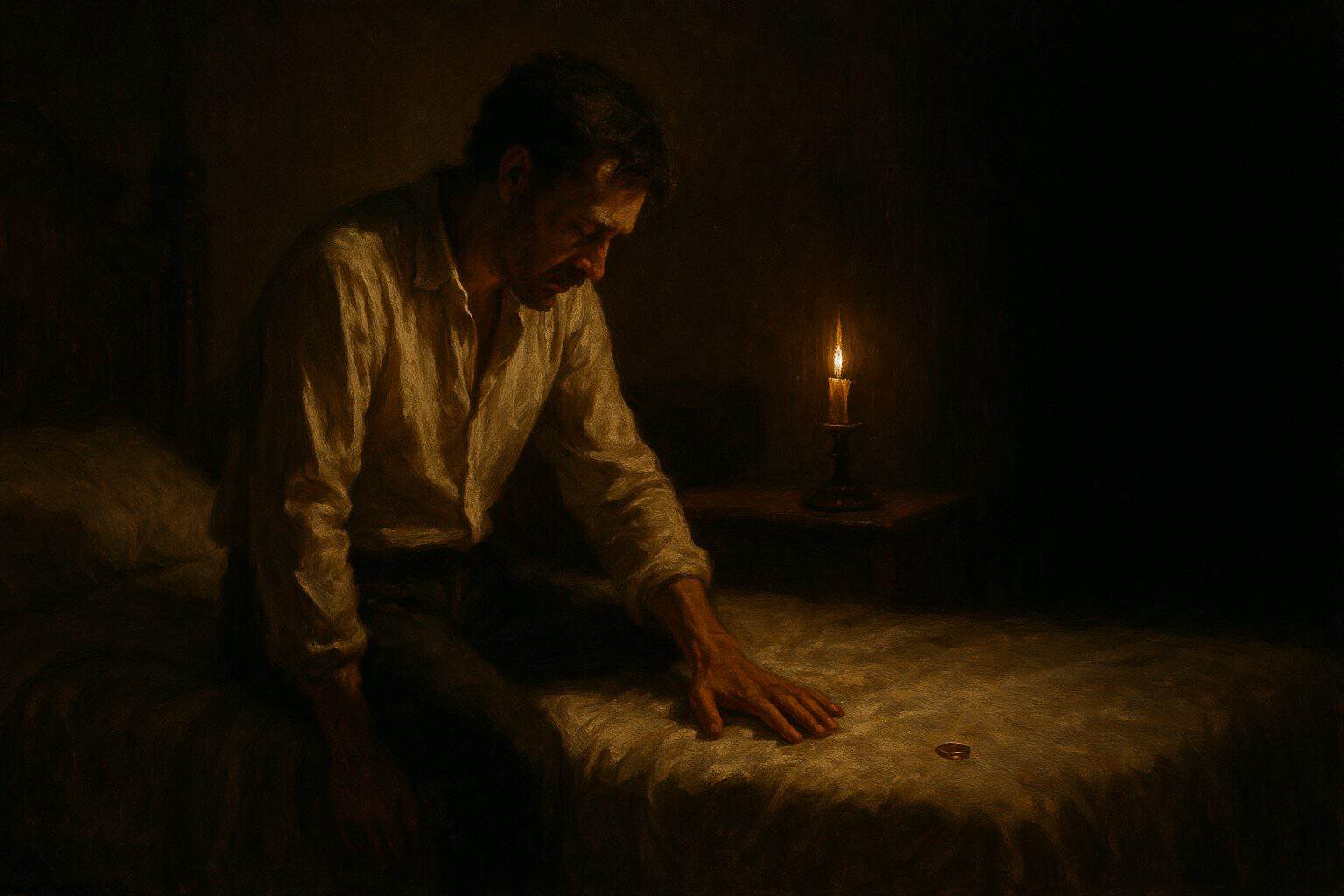
How the flesh becomes its own morphine, dulling what it cannot heal
The Empty Chair
There is a particular quality to the space left by absence—not merely empty but charged with what once filled it. Anthony Adoré knows this terrain intimately: “I stood where I used to stand and counted the empty.” The counting itself becomes a kind of touching, fingers extended toward what is no longer there, the gesture completing itself in air.
This is how eros begins its work as anesthetic—not through presence but through the ache of absence that demands to be filled. The empty chair across from him, the vacant side of the bed where Jeannètte once lay, the space behind his eyes where she continues to sit “as a ghost I could not exorcise”—these voids pulse with their own gravity, drawing everything toward them.
The phenomenology here is precise: absence has weight. It presses. What Heidegger might call the not-there becomes more present than presence itself. The empty chair doesn’t simply lack an occupant; it insists on its emptiness, makes that emptiness the organizing principle of the room.
The Hunger That Teaches
“He allowed my soul to hunger in my youth so that hunger itself would force me to look for Him again.” This is the divine pedagogy Adoré discovers—that deprivation becomes its own instruction, that the wound teaches what wholeness cannot.
But notice the slippage: the hunger meant to drive toward God becomes redirected toward flesh. The same emptiness that should open vertically toward transcendence bends horizontally toward bodies. This is the essential structure of eros as anesthesia—it promises to fill the God-shaped void with something more immediate, more tangible, more here.
The lived experience knows this substitution intimately. The ache that wakes you at 3 AM, that formless longing that has no proper object—how quickly it attaches itself to a face, a touch, a possibility of skin against skin. “For the first time, my hunger made sense. I was not lost; I was arriving.” But arriving where? The flesh offers itself as destination, as homeland, as final answer to the question the soul keeps asking.
The Mathematics of Erasure
“Erasure stung worse than hate because hate still points at you.”
There is a phenomenology of being overlooked that Adoré maps with devastating precision. Hate at least acknowledges; it points, even if in rejection. But erasure—that peculiar dissolution where you stand in your usual place and find you’ve become transparent, where others’ gazes pass through rather than land—this is the deeper wound.
Watch how eros emerges as response to this erasure. The flesh becomes the site where one can be seen, even if that seeing is purely tactile. In the sexual encounter, at least for those moments, one cannot be erased. The body insists on its reality through contact, through pressure, through the undeniable fact of skin meeting skin.
Yet this solution carries its own anesthesia. “Holding a conversation, an exchange, while on top of her required as much effort as standing in front of her. It was like pulling teeth.” The very act meant to confirm presence becomes another form of absence. The bodies touch but the souls remain in separate rooms.
The Sedative Properties of Skin
Adoré describes collecting affections “like one interrupts their walk to bend down and pick up loose change on the ground.” The image is precise—these encounters are found money, unexpected windfalls that promise to add up to something substantial but never quite do.
This is how the flesh works as sedative: through accumulation without satisfaction. Each encounter numbs the previous emptiness while creating new hollows. Carol arrives, then Elizabeth, each filling the “vacated space” left by the previous absence, but the space itself never closes. It only learns to expect its next temporary occupant.
The phenomenology reveals itself through the body’s own wisdom. After the divine encounter, “the soreness in my back had vanished,” but the absence of pain becomes its own affliction. “One would expect that I would be happier after His visit, but I was not: my sadness amplified.” The body, touched by transcendence, now knows what it lacks. Every subsequent touch becomes both reminder and forgetting—reminder of what real presence feels like, forgetting in the temporary oblivion of flesh against flesh.
The Ghost Behind the Eyes
“She sat opposite me—not in a room, but as a ghost I could not exorcise, living behind my eyes.” This is the crucial phenomenological insight: the beloved becomes an internal presence more real than external reality. Jeannètte, even in absence—especially in absence—organizes Adoré’s entire perceptual field.
What Sartre might recognize as the regard of the Other here becomes internalized, a permanent witness that makes all subsequent encounters into performances for an audience that isn’t there. Every new lover is measured against this ghost, every touch compared to a memory that grows more perfect in its distance.
The flesh offers itself as exorcism—surely enough new bodies can crowd out one ghost. But the mathematics don’t work that way. “She manufactured distance through long absences, leaving me to wake up in an empty bed.” The pattern repeats because it must; we seek in others the wound we know, the familiar absence that feels like home.
The Contamination
“I opened my spirit to her during the act, fanning the flames of a silent love… The sourness of that night was a contamination…” Here Adoré names the precise moment when eros fails as anesthetic—when the spirit, seeking communion, finds only collision.
The phenomenology is exact: in opening oneself during the sexual act, expecting reciprocal opening, one sometimes finds only surface. The body goes through its motions but the soul remains locked. This sourness, this contamination, is the taste of anesthesia wearing off while the wound remains untreated.
What makes this particularly acute is the confusion of registers. The body speaks one language, the soul another, and in the act they become tragically mistranslated. What the soul reads as invitation to depth, the body might experience as mere friction. What the body offers as comfort, the soul receives as mockery of its real hunger.
The Paradox of Healing Through Harm
“What Lilith had used to damage me, Jeannètte now used to heal me. If Lilith made it possible for me to hate, Jeannètte made it possible for me to love.”
This is the strangest property of eros as anesthesia—it uses the same channels carved by wound to deliver its numbing agent. The very pathways opened by damage become the routes for what promises itself as cure.
But notice the progression: damage makes hate possible, which makes love possible, which makes a deeper damage possible. Each iteration deepens the groove, makes the channel more established, more natural. The anesthetic doesn’t heal; it simply makes the wound bearable enough to keep reopening.
“Confidence in loneliness and pride in solitude resurged, overtaking any aspiration of my being human again.” This is the final station—when the anesthetic becomes preferred to feeling, when the numbness becomes more reliable than the dangerous possibility of actual contact.
The Divine Displacement
“He was not fixing me; He was simply filling the empty chair.” The divine encounter reveals the true structure: God doesn’t repair the wound but occupies it. The emptiness remains but finds its proper occupant.
This exposes eros as anesthesia for what it is—a displacement, a substitution of the immediate for the ultimate. The flesh offers itself as surrogate for the divine presence, promising to fill the same empty chair, to satisfy the same fundamental hunger. But flesh can only numb what it cannot fill; it can only defer what it cannot answer.
The lived experience knows this in the morning after, in the moment when bodies separate and souls realize they never actually touched. “Everything here reminded me of all that was—the sights, the smells—like nothing had changed during my absence.” The encounter passes but the absence remains, now doubled—the original emptiness plus the fresh absence of what just failed to fill it.
The Melancholy Veil
“His perceived absence after that encounter brought tears to my heart, casting a melancholy veil through which I now viewed the world.” This is the final phenomenology—not the wound itself but the veil it casts over all subsequent experience.
The melancholy veil is precisely what eros promises to lift, if only temporarily. In the rush of desire, in the obliteration of climax, the veil seems to part. But it always descends again, often heavier than before. The anesthetic wears off but leaves the nerves more sensitive, more exposed.
What Adoré discovers is that “desire is not meant to be an end in itself… but instead requires an object outside of itself, ‘knowing,’ to pursue in order to actualize its purpose.” But when desire becomes its own object, when the seeking becomes circular, when flesh seeks flesh seeking flesh—then eros becomes not a path toward knowing but an endless deferral of it.
The empty chair remains empty, no matter how many bodies temporarily occupy it. The ghost behind the eyes continues her vigil, unmoved by the parade of substitutes. The hunger that was meant to teach instead learns only to feed on itself, mistaking consumption for satisfaction, mistaking anesthesia for cure.
This is the lived world that “Eros as Anesthesia” names—not a moral failing but a structural confusion, not a weakness but a misdirection of strength. The very intensity with which we seek to fill the absence ensures that absence remains the governing principle. The flesh, promising presence, delivers only a more sophisticated form of emptiness—one that numbs even as it deepens what it promised to heal.