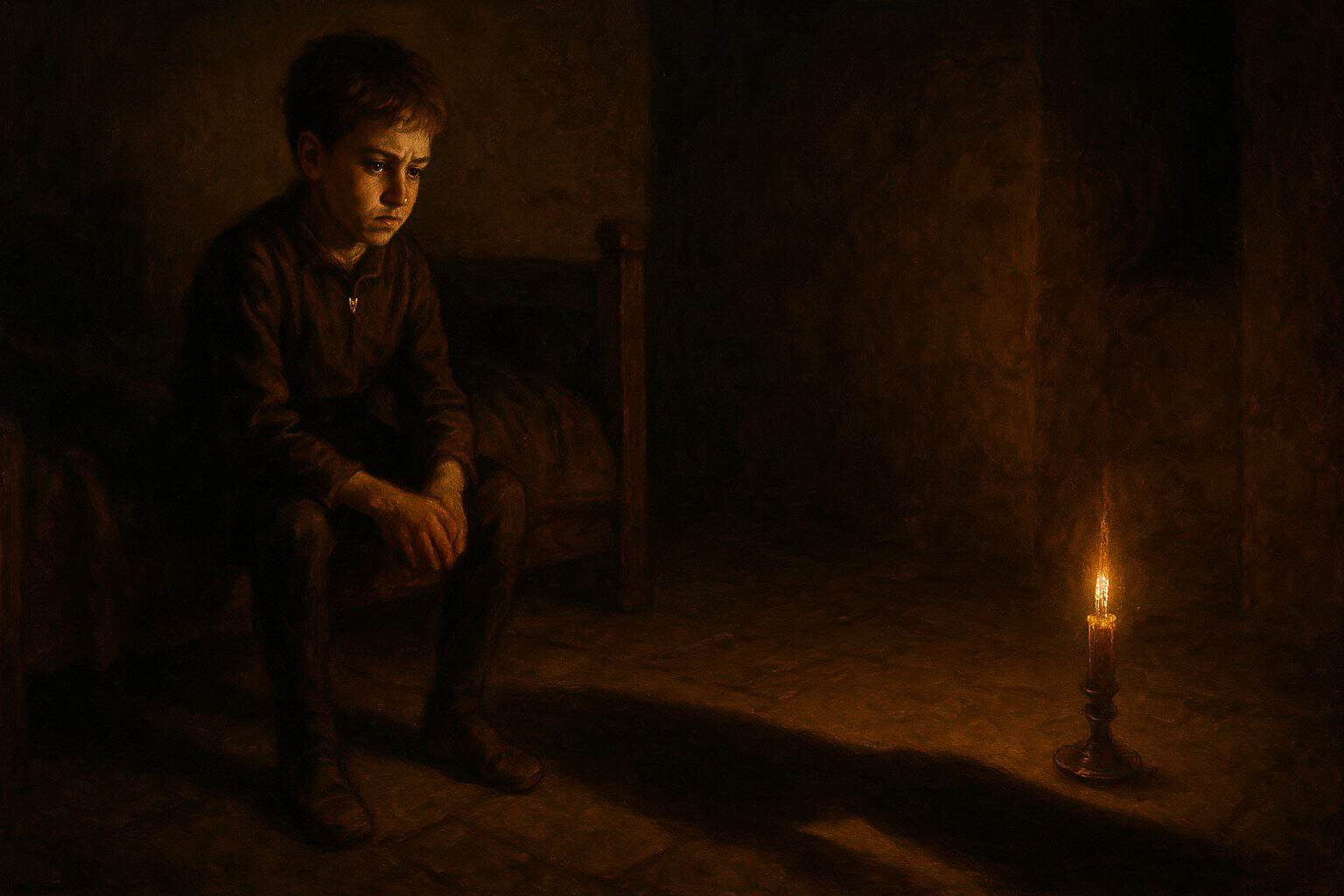
Where desire lives as both wound and inheritance, passed through blood like a dark sacrament.
The Shadow That Blends
The phenomenon announces itself first as companionship—not the warm presence of a friend but the persistent shadow that moves when you move, turns when you turn. In Anthony’s memoirs, this shadow bears a name: Lilith’s contamination, the lust planted since childhood that “took root and grew into a force I still wrestle.” The shadow blends with his own until distinguishing where self ends and inheritance begins becomes impossible.
This is how poisoned desire lives in the body: not as foreign invasion but as native tongue. The young child does not learn lust; it rises from within like sap through wood, following channels carved by generations. What Augustine knew as concupiscentia—that restless dispersal among temporal things—here takes specific form as erotic fixation, the eye that cannot look away, the mind that returns obsessively to images it claims to reject.
The Customized Whisper
“Beginning not with horror and terror, but with beauty, curiosity, and seduction, he whispers temptations customized to the movement and shape of each person”
The phenomenology of temptation reveals itself through this customization—how desire knows precisely which door to knock upon. For Anthony, it arrives wearing the mask of care, the “unexpected desire to go back in time and somehow care for them and sleep with them in a proper manner.” The poison transforms even violation into occasion for fantasy, twisting protection into possession.
This customization operates through what Nancy Friday understood as the archaeological layers of the psyche, where adult sexuality encrypts childhood wounds. The whisper knows which wounds to probe, which absences to fill with counterfeit presence. It speaks in the native dialect of each soul’s particular hunger.
The Double Passion
A strange doubling inhabits this contaminated eros: “Driven by a passionate eagerness to experience lust, yet with an equal passion to suppress and control it.” The phenomenon presents itself as civil war, the self split against itself in what Anthony names his pon farr—that Star Trek reference to irresistible mating drive that nevertheless must be resisted.
Here lives the peculiar torment of religious desire: the simultaneous pull toward and away from the object, the yes and no spoken in the same breath. The body leans forward while the spirit pulls back. Images flood the mind—”Lilith’s mark”—while the will struggles to look away. This is not simple hypocrisy but the lived experience of inhabiting two kingdoms at once, citizen of both flesh and spirit.
The Inherited Instinct
“I thought I could master millennia of evolved instinct that I inherited from my bloodline, that my mind could chain the hellish lust budding within me.” The phenomenon of inherited desire shows itself here not as personal failing but as species burden. What David Buss maps through evolutionary psychology—those millions of years of sexual selection—lives in the body as immediate compulsion.
The bloodline carries more than genes; it transmits appetite, orientation, the particular shape of hunger. Anthony’s struggle reveals how this inheritance operates: not as abstract tendency but as specific images, particular fantasies, the customized form temptation takes in each generation. The son inherits not just the father’s eyes but his way of looking.
The Hollow Window
The digital age transforms this inherited poison, revealing new dimensions of its operation. “Locking eyes with their picture in search for the fire behind their window to the soul reveals only the hollowness of pixels and the want for something more.” The screen becomes the perfect medium for contaminated desire—offering endless images while denying real presence, feeding hunger while ensuring it can never be satisfied.
This hollowness marks our contemporary Stimmung, the mood through which eros now moves. The inherited poison finds new channels—swipe, click, scroll—but the structure remains: the reaching toward what withdraws, the grasping that closes on emptiness.
The Battle in Silence
“The lust planted in me since childhood took root and grew into a force I still wrestle. It is a lifelong companion whose shadow blends with mine, a battle fought in a silence others cannot comprehend.”
The phenomenology of this battle reveals itself through its hiddenness. “Most have never heard Lilith’s voice, never endured her image”—the contamination remains invisible to those not similarly marked. The struggle happens in interior darkness, in the space between thought and thought, in the moment before the eye moves or the hand reaches.
This silence creates its own torment. The one who wrestles cannot speak of the wrestling; the marked cannot show the mark. The battle rages in a privacy so absolute it becomes isolation. Even confession cannot fully bridge this gap—words fail to convey the specific texture of temptation, the particular weight of this inheritance.
The Holy Fire Disguised
Yet within this contamination pulses something unexpected: “The very fire I, at the time, perceived as Stickman’s ‘black flame’ of sorrow, depression, and masochism, was a holy fire all along.” The phenomenon of poisoned desire reveals itself finally as crucible, the very contamination becoming the means of purification.
This is what John of the Cross knew as the dark night—not the absence of God but presence experienced as absence, not abandonment but transformation so radical it feels like death. The inherited poison becomes the medicine, the wound the doorway. “He allowed my soul to hunger in my youth so that hunger itself would force me to look for Him again.”
The Greater Sin Beneath
“God’s warning against lust focused less on the sexual act itself and more on the idolatry and greater sin that the underlying desire bred.” The phenomenon shows itself ultimately as misdirection—not the surface expression but the deeper replacement, not the symptom but the disease.
The contaminated eros reveals itself as fundamentally religious—the infinite desire of the soul attached to finite objects, the God-shaped hunger trying to feed on creation. What presents as sexual compulsion unveils itself as spiritual misdirection, the soul’s movement toward the Absolute arrested at the level of flesh.
The Common Battle
“Wrestling with an appetite for women is their temptation for me, a common battle for men who have what women want.” The phenomenon refuses purely individual interpretation. This is collective inheritance, shared contamination, the poison that runs through the male bloodline like a dark river.
Yet even in this commonality lives isolation. Each man wrestles alone with his particular manifestation of the universal hunger. The shape of temptation customizes itself so perfectly that no two battles are identical, even as the war remains the same. The poison is both utterly personal and completely universal, as intimate as breath and as common as death.
The inherited poison continues its work, passing from generation to generation, each son receiving from his fathers not just life but the specific shape of desire’s distortion. And in each generation, the wrestling continues—that strange dance between eagerness and suppression, between the hunger planted and the hunger transformed, between Lilith’s mark and the holy fire that burns within the burning.