Neon skates along the rim of her drink while his wrist still remembers the week’s tools, and he does not yet see the shape of it: his labor quietly paying for a freedom that was never meant to include him.
Neon Reflected in the Rim of Her Glass
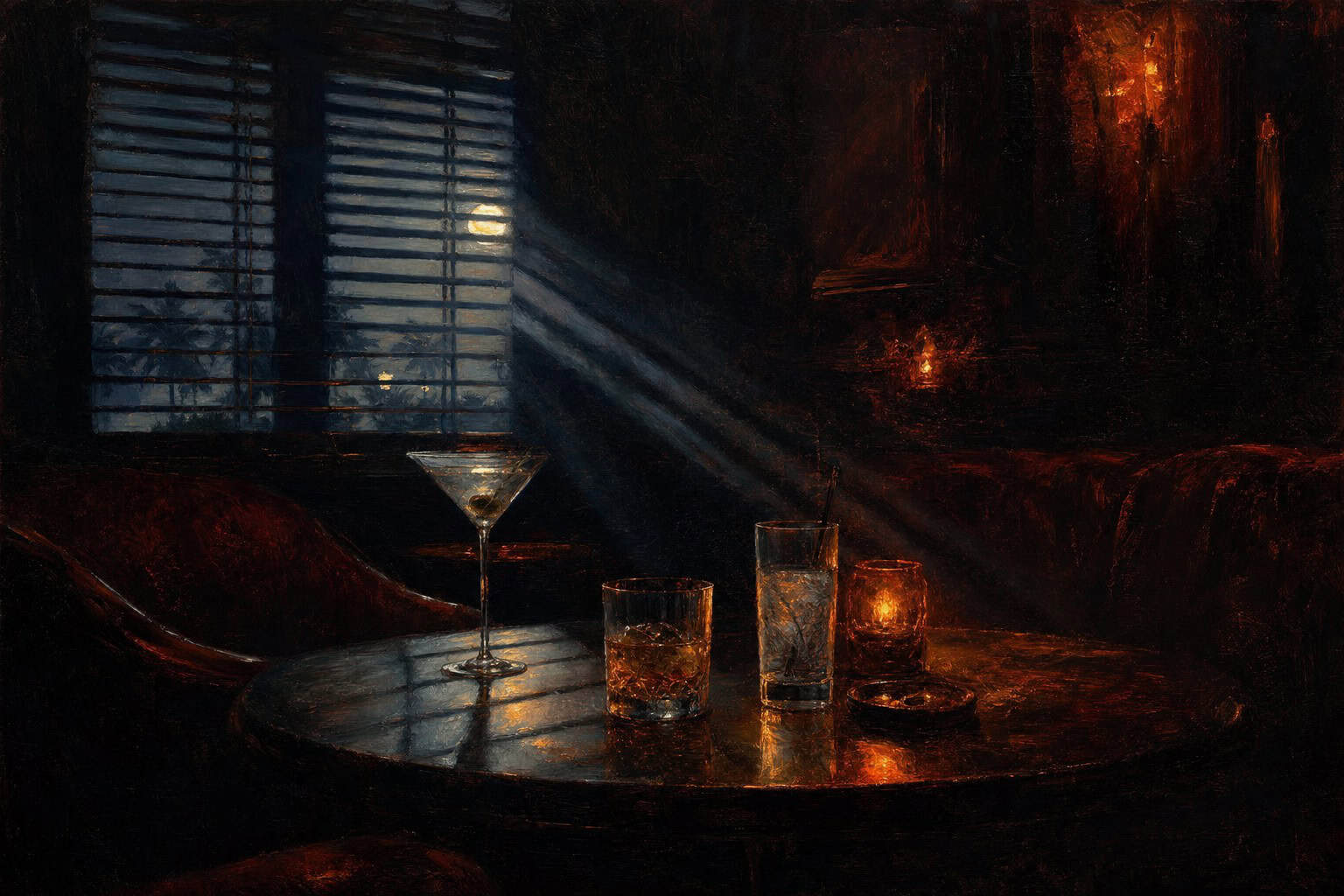
Neon light skates along the rim of her drink while his wrist still remembers the weight of the tools he held all week. He sits across from her at the small nightclub table, shoulders tired in a way no chair can fix, watching her eyes drift past his face toward some invisible gallery of men who came before. Father, grandfather, the first boy who vanished after promising forever—each of them flickers behind her gaze so strongly that she cannot really see the man whose debit card opened this tab. The table holds sweating glasses, damp napkins, a small black folder with a printed bill, and between all that, the silent fact that his hours at work have liquefied into the drink in her hand. She sips without malice, the way lungs take in air, unaware of the cost of each swallow. This is their liturgy tonight: his fatigue turned into alcohol, her attention offered not to him but to the ghost whose absence keeps her heart awake.
Crumbs on the Cocktail Napkin
Her hand brushes his forearm, light as dust, and she thinks she has done something generous. A late-night text, a half-listened story, a promise to “try more” tomorrow—she spreads these gestures like crumbs on a cocktail napkin and calls it dinner. Inside, she needs to believe this is enough, that warmth every few days can answer a man who spends himself daily. Admitting the gap between her small offerings and his steady outpouring would mean naming herself a taker, not a lover, and the word would burn. Across from her, he gathers these crumbs with both hands, telling himself that small signs mean hidden depth, that the few hours she offers are proof of something waiting to grow. The illusion of reciprocity keeps them both from seeing the ledger: his weeks against her moments, his steady presence against her convenient appearances. They cling to the story that intention counts as much as sacrifice because the truth would empty this table faster than the waiter ever could.
Bread Broken for an Invisible Guest
The same money that pays for this round of drinks has already bought another man’s nearness, though that man never shows his face here. Her phone, screen down on the table, holds the real sanctuary. Every vibration is a possible visitation from the one who costs her nothing but attention and repays her with thrilling uncertainty. She uses the comfort funded by the man in front of her to keep herself available for the man who never pays, never drives, never sits through her silences over cheap club speakers. His hours at work become her emotional insurance policy: full tank of gas to go where the other man is, new dress to catch his eye, cover charge at another bar where this same scene will play with different casting. The man across from her feels the shape of this triangle like a pebble in his shoe, irritating but deniable. He cannot prove that his labor is feeding someone else’s hunger; he can only watch the check arrive and understand that the price on the paper is smaller than the one written across his week.
When one person’s labor quietly funds another’s freedom, love has curdled into a parasitical economy, and devotion becomes the currency of the harvested.
The Taste of Your Own Overtime in Someone Else’s Mouth
Anyone who has ever stared at a bill and thought of their own knotted shoulders knows this story in their body. Maybe you were the one whose extra shift paid for dinners that made someone brave enough to leave you for a more exciting life. Maybe you were the one who let others foot the bill—financially, emotionally, spiritually—while you kept your heart available for a fantasy that required no real cost. This passage names that quiet theft: the way a person’s steady labor can become the staging ground for another’s experiments in desire. It isn’t limited to lovers; it lives in friendships where one always drives across town, in families where one sibling becomes the unpaid therapist while another pursues their “real” dreams. Once you see the pattern, it tastes metallic, like biting your tongue. The hard question is not whether you have been used—that answer is already printed in your muscles—but whether you are still telling someone else that your scattered attention equals the currency of their spent life.
Unpaid Hours Hanging in the Smoke
No spreadsheet will ever show what hangs in the smoky air above their table: the uncounted hours he traded for this brief, glittering scene and the untaken responsibility resting in her relaxed shoulders. The arithmetic here refuses to stay on paper. How many nights of his weary body turning up, wallet open, equal one genuine act of choosing from her side? How many paychecks convert into the right to be seen as he is, not as a placeholder for the next, more magnetic man? Neither of them calculates this. He hides from the answer because it might expose how much of himself he has bet on a story that never promised him return. She avoids it because to see the imbalance would strip away her claim to innocence. The club lights cycle from blue to red while their untouched ice melts into the liquor, thinning what was once strong. Somewhere inside each of them, a different drink waits to be poured—one measured not in proof but in truth, still sealed, still unchosen on the shelf.