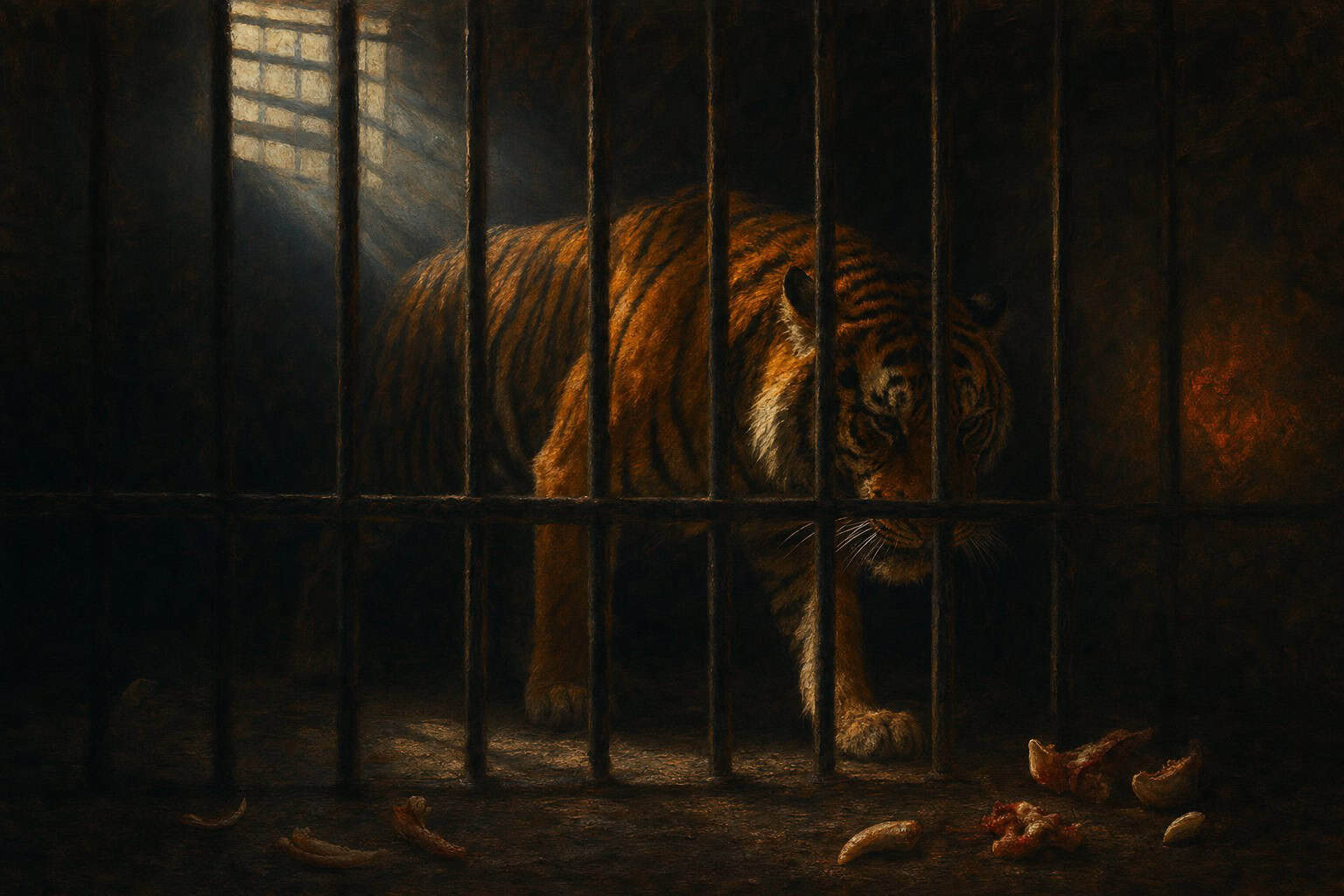
Another crisis has ended and he stands wrung out, phone still warm from her panic — a tiger who has ground his own teeth to nothing for a gentleness that keeps not arriving, and calls it love.
A Tiger Padding Through His Own Blood
A man stands at the end of yet another emergency, hands still shaking, shirt stained, phone buzzing with her latest panic only minutes ago. He has driven across town, missed sleep, spent money he doesn’t have, argued with strangers on her behalf, patched together the chaos she set in motion. Now the dust settles. Her crisis has been contained, her tears wiped, her breathing steady. The reward is small and painfully clean: a soft word, a quick squeeze of his arm, a light in her eyes that feels almost like hunger but never fully breaks into yes. Then she turns back to her life as if he were roadside assistance. He walks to his car through the wet night, feeling the stick of sweat and iron on his skin, realizing his blood has become currency for a future that never arrives. Each rescue leaves him a little duller, like a tiger padding circles in its own dried trail.
Meat Hung Just Out of Reach
The passage stares straight at the invisible leash: the promise of touch that governs him more surely than chains. Her warmth appears in flashes—a long lean on his shoulder, a confession of loneliness at 2 a.m., the way her hand lingers on his when she laughs too hard at his jokes. Each gesture tastes like meat held just above his open mouth. His strength, the very thing that first drew her, begins to dissolve into errands: rides to the airport, late-night talks, fixing passwords, lifting boxes, bearing secrets. The wild energy that could have built a life is rerouted into constant availability. He tells himself he is being noble, patient, understanding. Underneath, his body knows it is being trained. The more he obeys the signal, the more his original force softens into dependence. One day he notices that he no longer roars; he only waits for the bell and the raised hand.
Classroom on One Side of the Cage
The imbalance does not begin in adulthood; this passage traces its roots back to the first schoolyards and sleepovers. Girls compare notes in bathrooms, reenact conversations, test which phrases pull boys closer and which make them chase harder. They learn early how a certain tilt of the head or delayed text creates a reaction. Boys, by contrast, trade statistics, game scores, bits of the outer world, never realizing that the most important battlefield of their life is already being mapped without them. By the time the man in this scene is hauling furniture and answering midnight calls, the woman has years of practiced intuition. She reads him like a familiar script: knows when to offer sympathy, when to withdraw, when to mention another man’s name to sharpen his hunger. He feels unique, singled out, specially chosen. She moves with the quiet skill of someone who has studied this animal for a very long time, clipboard in hand just beyond the bars.
A man will file down his own teeth for the promise of a tenderness that may never come, and call the surrender love.
Roaring on the Stage, Judged from the Dark
His value must be proven under bright lights. In this world, a man is only as real as what others can see: the job title spoken aloud, the heavy thing lifted, the joke that lands in a group. He drags his strength into daylight where anyone may laugh or dismiss it, because if he does not, no eyes will turn toward him at all. She, meanwhile, can keep her influence behind curtains—quiet messages, private stories, a field of ambiguity that lets her deny and confess in the same breath. The asymmetry cuts deep. Every display he makes to be noticed doubles as a vulnerability for her to measure and use. When he picks up her calls while others sleep, when he defends her name in rooms she will never enter, he imagines he is winning ground. In truth, his whole body is on the stage, panting, while she sits in the shadows, choosing when to clap and when to look at her phone.
Learning to Taste Blood Without Calling It Love
What this passage names with brutal clarity is not a strategy but a sickness of habit: the way a man can learn to confuse his own bleeding with proof that he is worthy. If sacrifice has always been the price of affection, he will keep paying even when affection never comes. The text refuses to soothe him with easy blame or quick fixes. It hints that walking away from this role will cost more than staying in it, because his identity has grown around the bars. Yet it also suggests that no spiritual calling can coexist forever with this quiet slavery. For an ordinary reader, the question in the air is not how to outplay women, but how to stop offering the throat for inspection. The scene does not show him free. It leaves him standing there, tasting metal at the back of his tongue, finally able to say that the flavor is blood and not devotion, and still not yet ready to spit.