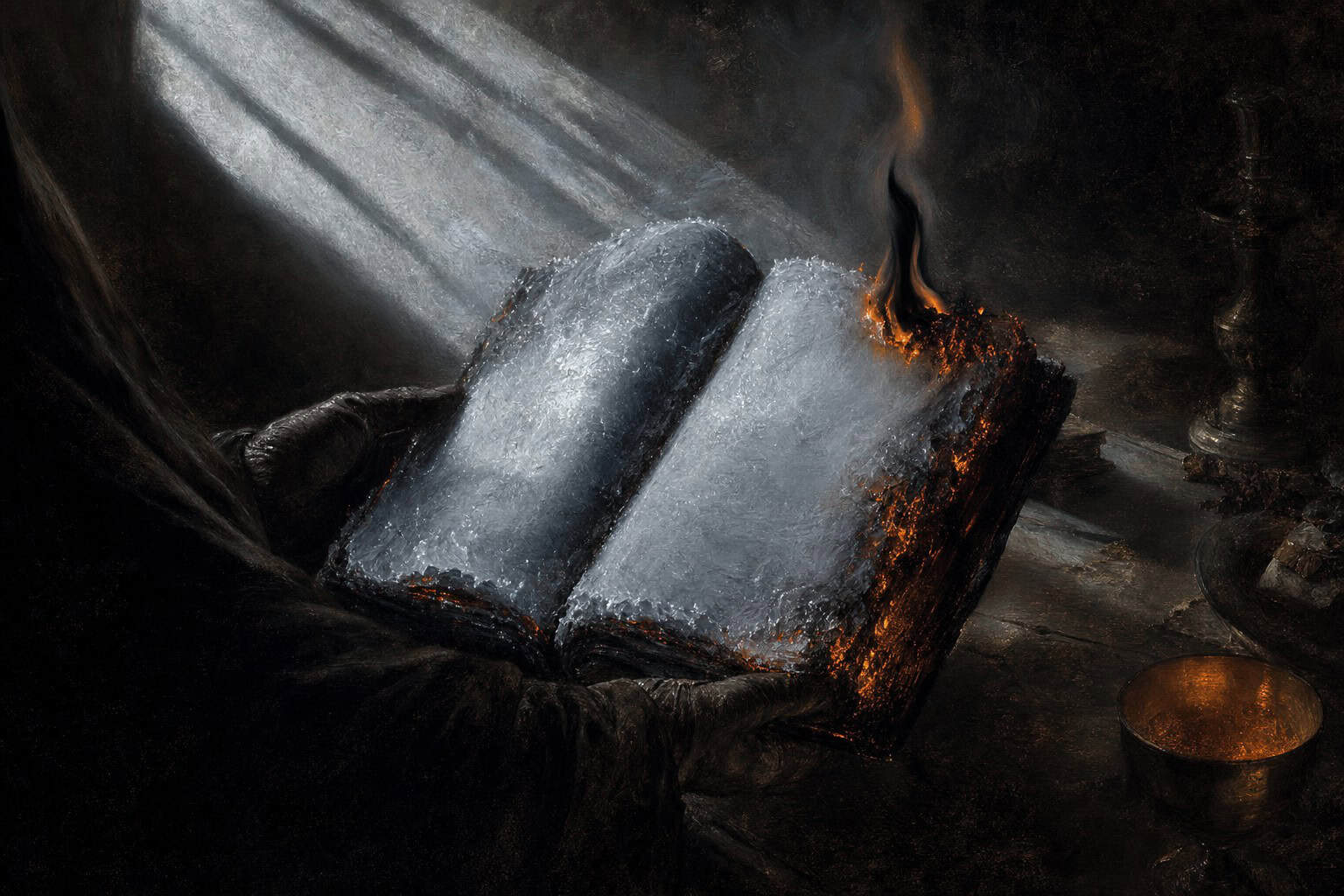
The blow lands not as a slap but as a syllable — his child, quietly carrying another man’s name — and the old black music in him rises to meet the wound, as if it too wanted him back.
A Child’s Name Carved Like Graffiti on the Soul
The bruise lands not with a slap but with a syllable: a child, his child, secretly bearing another man’s name. No shouting, no courtroom, just the quiet violence of paperwork and whispered uses of a word that erases him while his own blood runs in the veins. The woman has not only shared her body with a rival; she has surrendered the right to name, to bless, to claim. In a few letters on a form, the narrator is recast from father to donor, from vowed partner to accidental biology. Each time that hidden name is spoken, somewhere he cannot hear, the wound reopens—an invisible cut that never scabs. The child becomes a walking contradiction: his face, perhaps, carrying echoes of the narrator, while his identity answers to another man’s ghost. This is where the passage lives: inside that split, where genetics stand on one side of a glass wall and the spoken word stands on the other, refusing to recognize what the flesh proclaims.
A Ledger of Lovers Etched in Frost
Standing in that erasure, he does not collapse; he hardens. The mind reaches for categories the way a freezing man reaches for coats, building a codex of types and tells, of patterns that promise never to be blindsided again. Women become entries in a ledger, cross-referenced by gesture, tone, delay in answering texts, the slight turn of a shoulder in bed. He studies them like case files, as if enough data could guarantee that the next name on a birth certificate will never again make him a stranger to his own child. But the more he writes in this internal book, the colder it becomes. Intimacy is observed from a distance, as if behind thick glass, every smile and tear recorded, none of them trusted. The codex feels like safety, yet it locks him into a climate where nothing truly grows—where love is not received but interrogated, and every answer is marked in red.
A Black Flame Licking the Scaffold of the Body
From that frozen ledger, he gives himself permission to burn. He speaks of a dark release, a sense that heaven itself has signed off on the unleashing of his shadow, as if righteousness now lies in refusing restraint. Sex turns into scaffolding, a structure thrown up quickly to hold his collapsed heart in place. Each body he enters is another support beam, another brace against remembering that original hidden name. The black flame here is not a metaphor he applies from afar; it is felt along the nerves, a hot rush that leaves the chest emptier after every conquest. Pleasure is granted, even intense, but immediately filed as data: How fast did she yield? What did she hide? Which lie will she choose when cornered? Instead of dissolving the codex, each encounter adds a new layer of soot. The body, meant to be a bridge, becomes a burning trellis—beautiful for a moment, then ash in his hands.
Every man marked by darkness meets the hour when he must choose between the love that would heal him and the dissonant music that made him who he is.
A Laugh That Doesn’t Know the Script
Into this careful system walks someone whose very lightness short-circuits the machinery. Her laugh does not match any column in his columns, her joy does not seem manic or fake, and her questions do not feel like quiet note-taking for later leverage. She speaks easily, without the practiced pauses he has learned to mistrust, and looks at him as if nothing about him needs to be managed or minimized. It’s not that she is perfect; it’s that her hope does not seem hard-won, weaponized, or purchased at another man’s expense. Faced with this, his codex falters. The black flame, so sure of its purpose, flickers in the presence of someone who has not bartered her soul for survival. Instead of comfort, he feels disorientation, even anger, at this alien way of being. Her lightness exposes how much of his own darkness has become home furniture—functional, familiar, ugly, and very hard to imagine living without.
An X‑Ray Held Up to a Sky He Doesn’t Trust
By now, the feminine appears to him as a series of projections: the wild girl for one man, the dutiful wife for another, the efficient colleague for the world, each version sealed off from the others. He pictures the “second man,” the future husband, inheriting only the edited file while some prior lover holds an uncensored cut of her passion and truth. This suspicion corrodes every ordinary kindness he receives. A text, a kiss, a shared grocery list all become evidence boards where he searches for the missing file that proves he is the one being managed, the safe option, the man after the real story ended. In this passage, he lifts that X‑ray of his own heart against what he calls God’s light and does not see sweetness or excuse; he sees fractures, metal pins, old breaks that never set right. The question tightening around him is brutal and simple: if divine love lingers over this ruined image, can he let it? Or will he tighten his grip on the black flame, and walk on with his pocket full of ash?