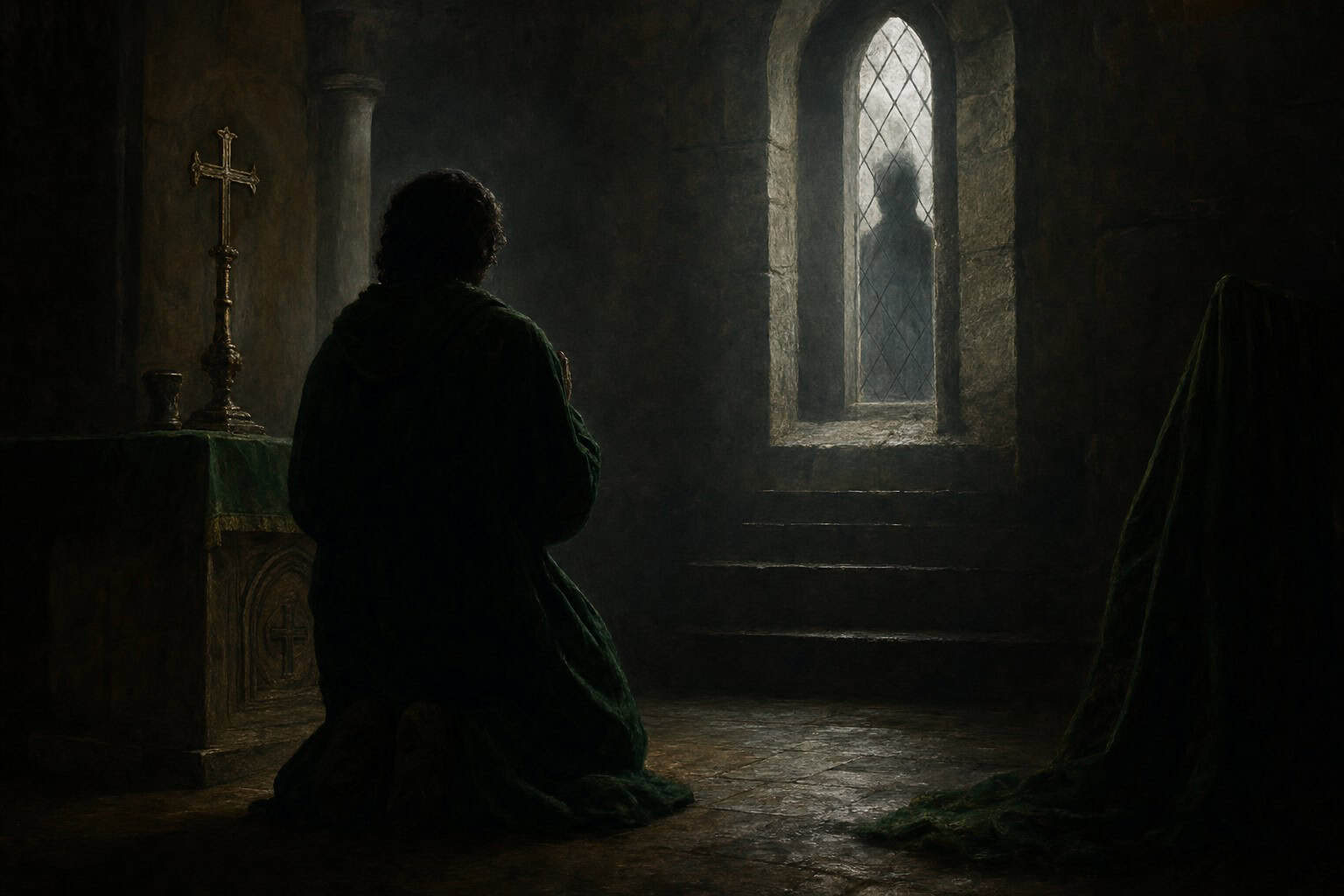
Knees pressed to old stone, he is not performing piety but trying to breathe inside a wordless ache, holding himself back from the altar as if his nearness might stain it.
A Face in the Glass During Kneeling Prayer
Knees pressed into old stone, the narrator is not performing piety but simply trying to breathe inside a wordless ache. Shoulders slope, spine curls, hands hang loose instead of folding with any dignity. The body has given up its posture and slipped into that unguarded angle only reached in private sorrow. In that loosened shape, while whispers rise toward a God who may or may not be listening, a face appears in the narrow pane of glass. No knock, no warning—just another human gaze breaking into the little sanctuary he thought he had carved out between himself and the altar. Muscles seize, breath catches; it feels like being caught half undressed. The window turns from decoration into a sudden mirror that reflects not his image, but the fact that someone else is looking straight into his rawness. Before a single word can be assembled, the moment names him: this is what you look like when you stop pretending to be all right.
The Tender Terror of Protecting What Is Still Clean
What makes that face at the glass unbearable is not judgment but its strange, unscarred light. The narrator reads it as someone who has not yet been dragged through the same gutters, whose smile in other settings has not learned to flinch. His first instinct is not conquest or even welcome—it is retreat. There is a twisted mercy in him that says: if I stay back here, if I remain on this side of the glass, your brightness has a chance. He has watched his own habits cloud other lives before, seen jokes pull people toward filth, watched boredom grow into shared sin. So the heart that calls itself depraved makes its clumsiest act of care by withholding itself. Distance becomes a strange kind of offering: I will keep my storm out here so you can keep your weather. This is not self-pity; it is the grim calculation of someone who believes his touch carries a stain.
Old Stone That Drinks the Weight of Prayers
This exchange through glass does not happen in a bright, carpeted hall but in a church that has known centuries of winter. The floor is uneven, the air carries the faint mineral scent of damp stone, votive smoke clings to the arches. You can feel under your knees the grooves carved by other bodies that have knelt here long before, begging for their own impossible mercies. It is not a beautiful space in the modern sense; it is worn, chipped, dark in the corners. That is why the narrator chose it. Glossy sanctuaries tied to salaries and screens could never hold the weight of what lives in his chest. He seeks a place where the walls already know about failure, where saints and drunks and widows have all poured the same salt water into the same cracks. Here, matter itself seems to say: your ruin does not scare me. The stone stays, receives, and does not shatter.
The soul that guards its own corruption will exile itself rather than risk staining what is pure, mistaking distance for reverence.
A Body That Won’t Swallow Its Assigned Story
Under the skin, another drama is already running. The narrator has tried to make himself acceptable—to God, to others, to the person in the glass—by editing his story into something more stable and sane. Pills level the spikes, routines polish the edges, explanations rehearse how he is now better, safer, almost fixed. Yet his body keeps betraying him: sleep sabotaged, stomach tight, jaw clenched even while he jokes. Kneeling here, every twitch and tremor testifies that the memorized script does not match the lived script in his muscles. Then that gaze arrives, and with it the panic that all the labor of control might be undone by one honest encounter. If this person has seen the way his shoulders sag, the way his face crumples when he speaks to God, then the whole presentation is cracked. The body leans toward the glass in a tiny, involuntary shift even as the mind screams for distance, torn between the relief of being known and the terror of losing control.
Holding the Prayer in the Throat Like Mixed Water
So the air between kneeler and window grows thick, crowded with choices that cannot yet be made. He knows that if he rises and moves closer, something in him will have to answer for all the years of hiding, all the rehearsed villainy he clings to as proof that he does not deserve gentleness. He also knows that if he stays frozen, if he turns his face back to the altar and pretends no one has seen him, he will be choosing a kind of exile that confirms his own worst story about himself. The prayer that had been spilling easily now jams in his throat, tasting like two currents at once—desire and dread, confession and refusal. He is not negotiating doctrine; he is deciding whether to let his darkness be touched by a love he cannot control. The glass holds their reflections for another second, two lives pressed against opposite sides, while inside him the waters churn without yet choosing their course.