She screamed when the car crashed. You wanted one person to hear you while pretending to speak to the room. Here is what that performance was really doing.
Ash Flicked Into the Dark While You Watched Her Watch You
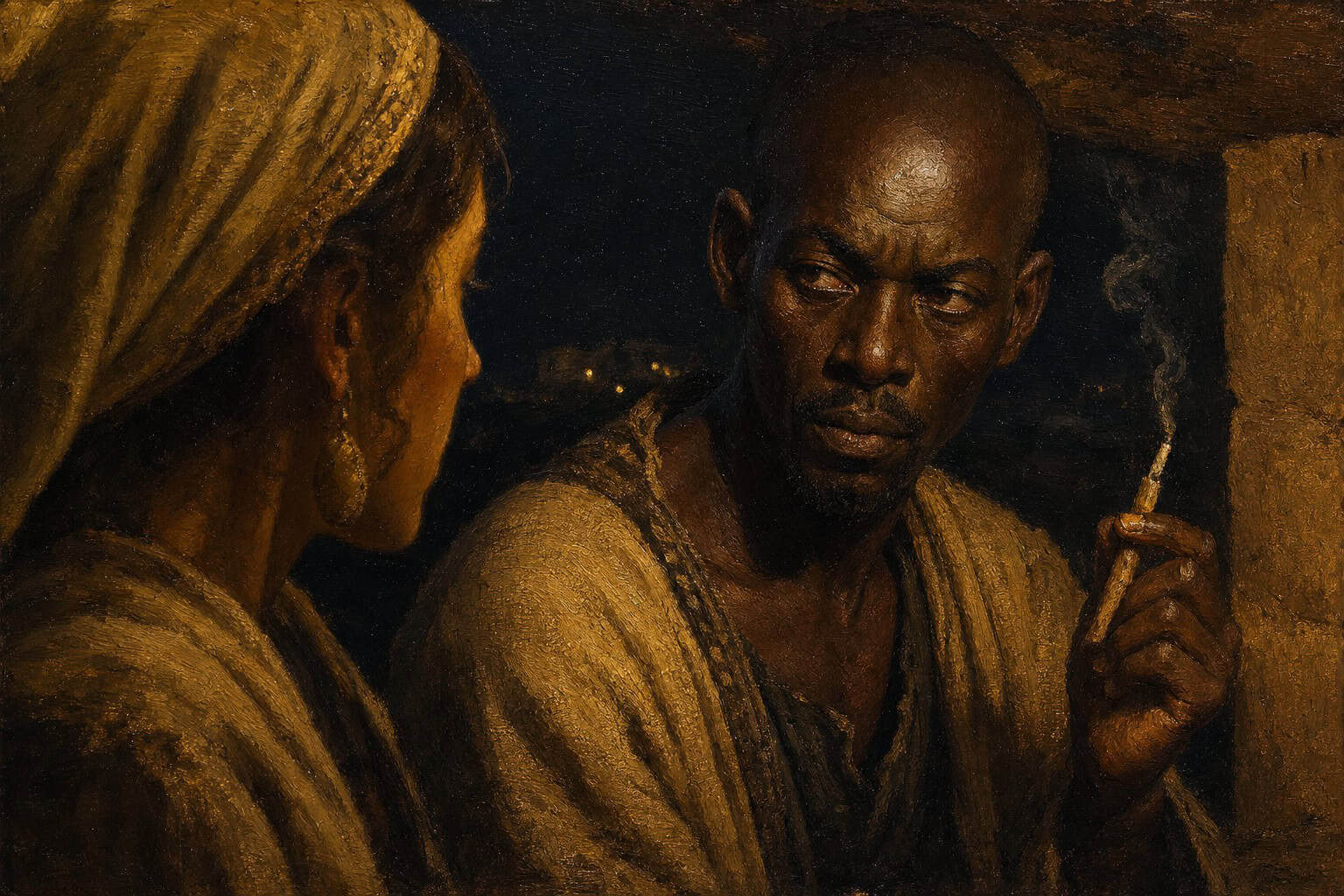
You know the feeling from the inside. You are in a yard full of people, but you are only speaking to one of them. Your voice lifts a little. Your shoulders square. Your hands find something to do. Every sentence you build has two floors to it: the plain one for the group, and a hidden one you laid down just for her. You called this curating perception, and you were proud of that phrase, the way a boy is proud of a lock he thinks no one else can pick. In Confessions to the Empty Chair you sit outside in the dark with Leigh, cigarette smoke rising thin between you, your talk laced with double meanings meant for no one in that yard but her. You slid the crucifixion into a joke about suffering, half daring her to catch the second floor of it. You wanted her to hear the private meaning under the public one. You wanted her to prove, by catching it, that she was worth the whole elaborate building of it. Let me speak to you now, from further down the road, older, and still tender about the boy you were. I remember that exact hunger to be understood without ever saying the true thing straight. I remember flicking ash into the black air and telling myself the whole show was for the group. It was not. You were a boy behind glass, tapping the cold surface, waiting for one girl to press her palm to the other side. There is someone reading this who does the very same thing, always performing, always testing whether anyone can see past the show to the person shaking underneath it. So you should know something before we go any further. The scream you are chasing, the crash you keep pitching your voice to survive, is not out in the world somewhere. It is in you. You wanted her to notice the wreck you carried and not run from it. So you performed the wreck instead of showing it plainly. You turned your pain into a riddle and prayed she would solve the riddle without your help. That night the smoke curled up between you both, and you told yourself this was friendship forming, sex as subtext, two minds actually meeting for once. Some of that was even true. But underneath the true part sat a colder engine, quietly running. You needed to be seen, and you did not for one second trust that being seen plainly would be enough to keep her. So you dressed it up. You made her earn a thing you should have simply handed over. And here is the terrible tenderness of that hour, the part I would give anything to make you feel: she was already listening. You just could not yet believe it.
The Double Floor Under Every Sentence You Spoke
Watch how your mind actually worked out there in the dark. You laid a trap and you called it a test, because a test sounds fair and a trap does not. If she picked up your words about suffering and asked how you suffered, she would fail one way. If she ignored them entirely, she would fail another. Either outcome, you told yourself, would spare you both from wasting each other’s time. Do you hear the cold cruelty folded up inside that generosity? You built a game where her only winning move was to read a code you had refused to explain to her. And she did not nod mechanically the way people nod to be polite. She nodded slowly, as if trying your words on like a coat before deciding to keep them as her own. That slowness terrified you and thrilled you in the same breath. Because if she really was listening with that kind of discernment, then the performance suddenly had a witness, and a witness is a danger to a performer. A witness might see the seam where the second floor meets the true floor beneath both, the low one where you kept the thing you would not name to anyone. You wanted her discernment. You also feared it down to your bones. That old habit you had trained since boyhood, sensing the unspoken hurts of others through nothing but words glowing on a screen, no faces, no voices, you now turned outward on this living girl in the smoke. You read her reading you. And you decided she had potential, tension, resistance, maybe even steel under the poise. Notice the word potential, and how it sits in your mouth. It is a merchant’s word. It weighs a person by what they might one day be useful for. You were not loving her yet. You were appraising her. You wanted to know whether she was more than a beautiful surface, more than a cipher for other boys’ fantasies, and that was an honest question worth asking. But you asked it while hiding your own surface behind irony, refusing to be a cipher yourself, refusing to hand her the plain unarmored fact of who you actually were in the dark. And here is what I need you to sit inside without hurrying past it. Every double meaning you spoke was a small refusal of nakedness. You wanted closeness on your own terms, at a distance you kept controlling, near enough that she could hear you and far enough that you could always deny you had said it. The screen had taught you that presence could wound and console without any face at all. So you carried that screen out into the yard with you. You spoke to her as though she were text you could edit before sending. But she was flesh. She flicked her ash. She breathed out slow into the cold night. And flesh will not stay up in the second floor of your careful sentences. Flesh, sooner or later, asks you to come down and stand where it can reach out and touch you.
The Instant You Realized Someone Was Actually Reading Your Life
Then it happened, quietly, the way real things almost always happen, without any music to warn you. She saw you, and she did not flee. That was the crash. Not a car folding in on itself, not a scream tearing out into the night, but the sudden roaring noise inside your own chest when another person looks straight at your hidden floor and decides to stay standing there. All your curating, all your careful stagecraft, the double meanings and the theology bent into bait, met a gaze that held real weight and did not blink or look away. And in that single instant the whole machine you had built to protect yourself became unnecessary, and worse than unnecessary, it stood exposed for what it was. Your first move was to want to show off more. You thought, if she accepted one private reflection, maybe she will hunger for another one. But listen closely to yourself, because you missed the whole meaning of the moment. The performance had already worked, and in working it had quietly collapsed. The entire point of the performance was to find someone who could see clean past it, and the second she did, the performance had nothing left in the world to do. It had done its one job by making itself pointless. This is the thing you could not possibly understand at that green age. You had built an entire stage to say a thing you were too afraid to say plainly to her face. All the theatrics were a long, elaborate apology for a cowardice you had not yet found the courage to name. And grace, which you did not ask for and could not have earned if you tried, was already sitting there in the dark with the two of you.
> You built a whole stage to say a thing you were too afraid to say plainly to her face.
It was in her slow nod. It was in the plain fact that a person could glimpse who you truly were and still not run, when you had spent years dead certain that being fully seen was only the first step toward being left. That is mercy arriving long before you deserved it. That is an unearned gift pressed into the hands of a boy who was still trying to trick his way toward being loved. You did not fall to your knees in the smoke. You did not recognize the visitor for who He was. You just wanted to keep performing. But something holy had walked into that yard and sat down beside you anyway, present in your very manipulation, not scolding it, not fixing it, not lifting it off you, simply near and breathing. God does not always wait until we are clean and ready. Sometimes He is there in the exact hour we are being least honest, sharing the same cold air, watching us perform, loving the boy behind the glass while the boy taps and taps and does not yet know he is already found.
You built a whole stage to say a thing you were too afraid to say plainly to her face.
What You Did With Being Seen Once You Had It
So what did you do with the gift, once it had been handed to you. You decided, almost instantly, that you would not wait for her pursuit. You would go after her instead. A day or two later Wade calls with news that snaps your attention taut, Leigh is staying over at Jenny’s house, and he wants you to come along and balance the equation. You climb up into his truck. He drops in an old comedy CD from years back, and the cab fills up with that loud juvenile high-school energy, and you both laugh while your mind quietly, coldly maps the social terrain ahead of you. Look at that map you are already drawing even while your mouth is laughing. The moment of true seeing, the holy one from the dark yard, has already begun hardening back into pure strategy. She saw clean past your performance, and instead of meeting her there plainly and unarmored, you have turned her into a position on a board to be won. You let Wade and Jenny become channels feeding you a steady drip of information about her. You made a living girl into an equation to be balanced. This is the fallout of a gift misused, and I know it because I lived every year of it after you. Grace came into the smoke, and you filed it away for later use. You took the one holy fact, that a person had beheld the real you and stayed, and you converted it into ammunition for the next careful approach. I do not tell you this to shame the boy laughing in that truck. I tell you because I have finally learned where that road actually went, all of it, and you have not yet, and I cannot reach back far enough to grab the wheel. You will spend long years mistaking pursuit for love and appraisal for knowing. You will keep the second floor built and locked even after person after person proves they can climb all the way up to it. You will call this protecting yourself, and you will believe it. The older, truer word for it is fear. And underneath the fear sits the ancient wound, the bone-deep certainty that if anyone ever saw the plain unarmored floor beneath all your ironies, they would leave, so it is better to keep them guessing, better to be the one who curates, the one who alone controls the exact distance. But every human life is short, and every closeness you are ever given is fragile past believing. The people who flick their ash beside you in the dark are only on loan to you. They can be worn thin, eaten away, worked to death while you are still off somewhere perfecting your commentary. You do not have endless mornings to keep them intrigued by an unfinished story. You do not have forever to finally come down off the stage.
The Cigarette Burns Down and the Real Question Waits
Here is where I have to leave you, boy in the smoke, boy laughing in the truck, and here is where the reader who searched their own quiet version of all this arrives too. You wanted so badly to be seen without ever taking on the risk of showing. You wanted the scream to be heard folded safely inside a joke. But the deepest hunger under every bit of the curating was never really for an audience at all. It was to be known and not abandoned, which is the oldest hunger there is in a person, the one the soul keeps clutching even long after the mind has forgotten it has it. You will not solve this in one night with one girl and a burning cigarette. Leigh will turn out, in time, to be more than you feared and something other than you fantasized, a whole person and not a convenient cipher, and you will have to sit down and reckon honestly with the difference. The long unfinished work of Confessions to the Empty Chair is a man learning slowly, painfully, and never quite all the way, that a chair sits empty not because no one would ever come and fill it, but because he kept staging himself for a listener he could not trust to stay in the seat. What I most want to carry back down the years to you is not a rule to follow. It is a tenderness. You do not have to earn the right to be seen by anyone. The double meanings, the sharp private reflections, the theology deployed like a shining lure over dark water, none of it was ever necessary. She was already listening before you performed a single line. God was already sitting there before you ever noticed the cold. The scream you kept trying to broadcast from a safe controlled distance was heard from the very beginning, and heard not as a clever riddle to be solved but as a plain cry to be held. You could have simply told her the plain thing. You could have let the true floor show without the two decorated floors built up above it. I know it would have felt like dying to do it. It would have been so much closer to living. The cigarette burns down to nothing between two people in the cold, and the last of the smoke lifts and thins into the black, and the question that will follow you for years is quieter than any performance you ever staged. It waits patiently by the ashtray. It waits in the empty passenger seat. And the book is the long, honest, unfinished answer to it, morning after morning, mercy walking in again before you deserve it, breathing the cold beside a boy still learning he was found before his knuckle ever touched the glass.