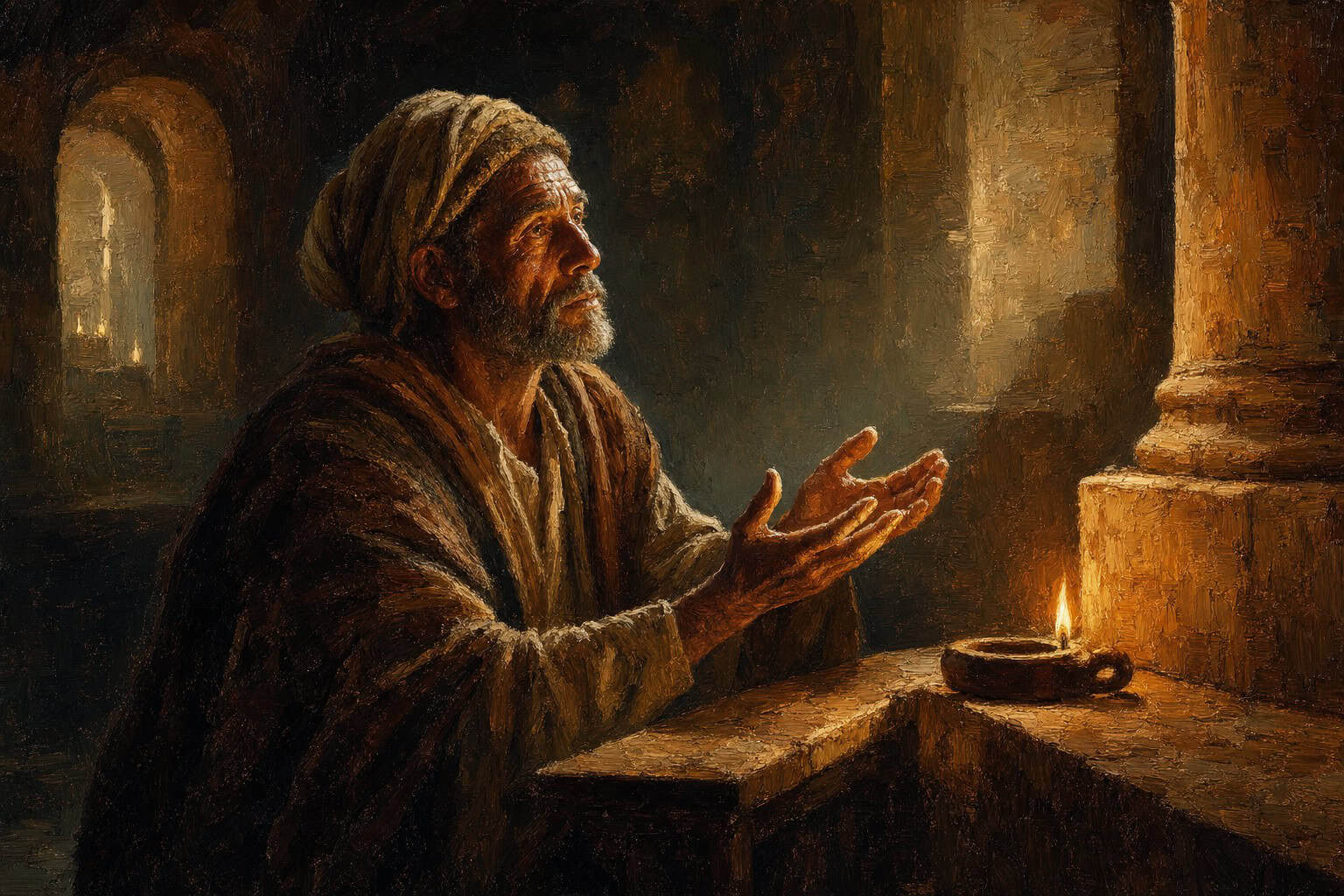
You take communion feeling broken and unworthy. Here is why the reason for communion holds you exactly there – in the damage, not despite it.
The Only Lens You Had
Why do you keep coming to the rail when you cannot even see straight? I have watched you ask it for decades, boy, from the far side of a life you have not yet lived. You walked into that new school in the fall of 1984 carrying a way of seeing that had already been scratched and warped. Mockery ground it. A stranger and earlier intrusion, the kind you had no words for, ground it further. By the time you crossed into the magnet program, the glass was already clouded, and it was the only glass you owned. You did not choose it. It was worn into you the way a riverbed is worn by water that never asks the stone’s permission. And now, underneath the whole matter, sits the harder question that has followed you into churches and up to altar rails your entire life: why receive communion at all, when the eyes you bring are damaged, when you cannot look at God without the smudge in the way. You think the smudge disqualifies you. You think you must first polish the glass clean, arrive with clear sight, prove the eye is worthy, and only then approach the bread. Let me say it plainly, because no one said it to you then. The reason for communion was never that your seeing had become pure. The Body is given to you precisely because your seeing is not pure and cannot be made pure by any effort of yours. You do not trade God a clean lens for His presence. You bring the scratched one, the only one you have, and you let Him look through it beside you. There is an awe in this that I could not hold at your age. The vastness that could refuse a damaged eye instead leans down toward it. He does not stand at the top of some high place, arms folded, demanding a perfect view before He will come down. He comes down into the fog of your ruined sight and stays inside it. And here is the strange mercy: your body understood this before your mind would allow it. Your hands knew, opening at the rail while your thoughts still argued you were unfit. The knees bent before the intelligence gave permission. That is not a small thing. The flesh remembers what the mind keeps disputing. Trust, boy, was living in your body long before it reached your head, and the kneeling itself was a kind of faith you did not know you were making. You came broken. You were fed anyway.
An Archivist of Slights
You became a collector that year, though you would not have named it. Every contradiction, every quick look, every silence that did not add up, you filed it away, storing it for the day you would need to decide whom to trust. I have watched you do this your whole life, in classrooms, in hallways, at dinner tables where the professionals’ children spoke of things you had never owned. You told yourself it was wisdom, and it was, in part, because children carry a fierce attentiveness to power, a survival instinct that reads who can hurt them and how with something close to prophecy. That was your first theology, learned in the body before any catechism reached your ears. The school felt like a battlefield, quieter than the one in your bedroom years before but no less real, and you decoded it the way a soldier reads terrain. But here is the harder thing I must set before you, and I say it without contempt, because I am you and have earned the right. The same eye that guarded you also sentenced you to loneliness. You read every executive’s son as a threat before he opened his mouth. Some of them were exactly the threat you feared; the district had gathered you by merit, by effort, by test scores, and never accounted for the invisible inheritance those children carried, the quiet contempt for the working poor passed down like a family name. Some of them, though, were not the threat you feared. And you could not tell the difference, because the lens flattened everyone into the same menacing shape. This is the wound that follows the wounded. We grow so skilled at reading danger that we lose the ability to read grace. When you knelt for communion in those years, you carried the whole cabinet of filed slights up to the altar with you. You treated the sacrament as one more transaction in an economy of reputation where you were always short of currency. You thought you had to earn your place at the rail the way you had earned your place in the program, through performance, through being good enough, through never slipping. Boy, listen to me. The reason for communion is the opposite of merit. It is the one place in the whole grinding day where nothing is being calculated against you, where your record is not read aloud, where the currency you never had is simply not required. You walked in owing everyone. You knelt down owing nothing and were given everything regardless. Your body, so practiced at bracing, did not know what to do with an open hand that asked for no payment. Neither did I, for years. The bracing settles into the flesh like sediment. Even now I catch myself flinching before the host, as if it might mock me the way the schoolyard did. It never has. Not once.
He Comes Into the Fog, Not Around It
Here is the turn, and it cost me most of my life to reach it, so I will place it in your young hands while you can still carry it a while. You believed communion required clear sight. You believed the sacrament was a reward handed only to those who had already healed. But the reason for communion is that God enters the damaged eye rather than waiting for you to hand Him a clean one. He does not stand outside your wounded seeing, refusing to step in until the glass is polished to His liking. He comes into the fog itself. He walks with you inside the very distortion that mockery and intrusion ground into you, along the corridors of that school, through the contradictions you filed away, present in the loneliness you took for proof of your unworthiness. This is the awe that finally cracked me open: not that God removed my ruined sight, but that He was willing to be seen through it, to remain in the tears and the flinching and the endless bracing, to stay when everything in me expected Him to leave the way the others left. He did not fix the eye. He inhabited it. And the fog that I hated became the very room where He chose to sit down beside me and wait.
You do not come to the table because your eyes are clear; you come because they are not, and He knows it.
After the Rail, the Old Habits Return
Do not expect the fog to lift when you rise from the altar. This is the part no one warns you about, and I will not lie to you the way easy comfort lies. You will receive the Body, you will feel, for one held moment, gathered up and safe, and then you will walk back to your pew and the old lens will be waiting exactly where you set it down. The archivist will pick up his files again. The battlefield of the school will still be a battlefield come Monday morning. The executives’ children will look at you the way they always looked at you, and you will read their looks through the same scratched glass, decoding contempt in a glance that may or may not have carried it. Communion does not clean the lens. I need you to understand this now, so you do not fall into despair when the sacrament fails to perform the miracle you keep demanding of it. Direct rescue is rare. It breaks in sometimes, real and undeniable, a genuine deliverance you could never manufacture, but it is the exception and never the rule, and you must not build your whole faith on the expectation of it. What communion gives you instead is quieter and, I have come to believe, larger. It gives you a companion inside the unchanged fog. You go back to the same wound, but you go back accompanied. You brace against the same slights, but Someone braces beside you now, shoulder to shoulder in the trench you thought was yours alone. The loneliness of that school does not vanish; it becomes a loneliness in which you are no longer entirely alone, and that difference, small as a mustard seed, is not nothing. This is the hard grace, the grace that refuses to tie things off with a tidy moral or a lesson learned. You will still misread kindness as a threat. You will still fear the warmth of anyone who once watched you burn and then, impossibly, offered friendship, because kindness terrifies more than cruelty when your lens was ground by contempt. Cruelty confirms what you already expect and asks nothing of you. Kindness asks you to hope, and hope can resurrect the very tenderness you buried alive in order to survive. So you will keep coming to the rail, damaged eye and all, and the fog will keep waiting for you on the walk back, and He will keep being present within it, patient past all your suspicion. That is not failure, boy. That is the shape of a real life lived with God, and I would not trade it now for the clean lens I once believed I needed to deserve. The bread on the tongue does not repair you. It stays with you through the day. There is a difference between those two things, and the difference is the whole of it.
What the Kneeling Body Knew
So let me leave you with what I have finally learned, standing in a place you cannot yet reach. The reason for communion was never your worthiness, never your clear sight, never a lens repaired enough to earn the gift. The reason was that you were loved inside the damage, met in the distortion, fed at the exact spot where your eyes failed and kept failing. You entered that school in 1984 with the only lens you had, and you have carried it every single day since, up every aisle, and I am telling you that God has been looking through it with you the whole while, not despising the scratches but abiding within them, tender toward the very blur that made you feel unfit. This is the awe that dwarfs me and still, somehow, makes room for me: that a vastness beyond all my broken seeing chose to enter my broken seeing and remain there. Your body knew it before your mind ever consented. The knees that bent at the rail were wiser than the intelligence that insisted you did not belong. The hands that opened were braver than the archivist who wanted his proof first, his guarantees signed. Trust the kneeling body. It remembers what the frightened mind forgets. It receives what the calculating heart keeps refusing at the counter of its own accounting. When you cannot see straight, kneel anyway. When you feel too broken to approach, approach anyway, because the brokenness is not the barrier you imagine it to be. It is the very opening through which He reached you. I cannot promise the fog will clear. I will not cheapen your suffering with that lie. But I can promise the nearness. I can promise you that the same God who noticed one small human detail long ago, the younger man outrunning the older toward an empty tomb, who saw fit to remember something so tender and slight, notices you too at the rail, in your loneliness, in your survival instinct, in your terror of a hope you cannot afford. He notices, and He comes near, and He does not leave. If you want to understand how a damaged lens becomes the very place where grace is met, how the wounded eye is welcomed rather than turned away, this is the long and unflinching reckoning I set down in Confessions to the Empty Chair, not a healing that erases the dark but a Presence that walks within it. Come to the table with the eyes you have. They are enough, because He is.