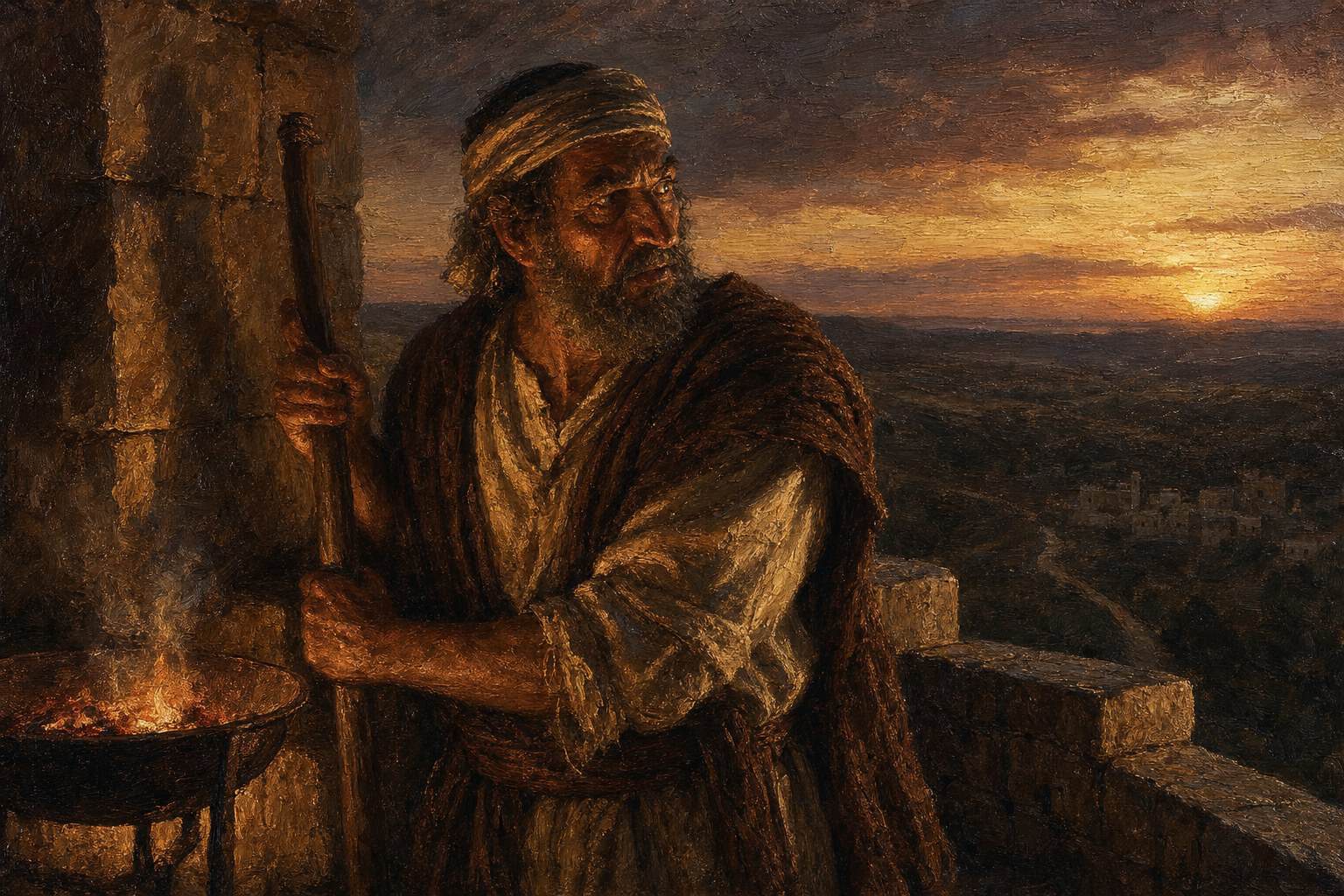
What does hate do to a person? It hollows you into a shape defined by an enemy. A hard, honest look at the prison hate builds inside its keeper.
The Bruise That Learns Before the Mind Does
You know the moment before you can name it. Someone walks toward you down a corridor, and your shoulders climb toward your ears without your permission. Your stomach draws itself into a fist. Your face arranges itself into something flat and careful, a mask you did not choose but have worn so long it fits like skin. This is what happens after enough cruelty: the body learns faster than the mind can catch up. Your body keeps a ledger the mind cannot read, and it settles accounts before you have finished the thought. Long after the actual wounds close, the flinch remains. You brace against a hand reaching toward you the same way you once braced against the hand that struck you, because your nerves cannot tell the two apart anymore. Someone offers you a small mercy and you feel a trap tighten somewhere behind your ribs. Not because they mean harm, but because kindness once arrived wearing the disguise of an ambush, and you memorized the costume. Hate begins here, in this crouch, this refusal to be caught off guard again. It feels like protection. It feels, at first, like the only sane response to a world that taught you attention means impending pain. So you build a watchtower inside yourself and stand the night shift every hour. You read faces for threat, count exits, rehearse the cruel thing before anyone can say it, so at least the blow will not surprise you. And for a while this works. You stop bleeding in front of people. You stop breaking down where someone might use it against you. But something happens to a person who never once stands down from the wall. You become an instrument tuned only to danger, deaf to every other note. The tenderness you cannot receive, you slowly cannot give. The suspicion meant to guard your softness begins hardening the softness itself, until there is nothing left inside worth guarding. This is the first and quietest thing hate does. Before it makes you cruel, it makes you unreachable. It walls you in with your own excellent reasons. And the terrible part is how reasonable it all feels, how justified, how much like plain survival. You are not wrong about the danger. The threat was real; the humiliation happened; the flinch was earned honestly. You are only wrong about how long you must keep standing there, and about what the standing quietly costs the one who stands. The tower was meant to keep the enemy out. Somewhere along the way it became the place you live, and you forgot there was ever a way down.
When the Enemy Starts Writing Your Days
Watch what happens to your attention once hate takes hold of you. The person you despise begins to occupy more of your mind than the people you love. You lie in bed at night and rehearse arguments you will never deliver, sharpen comebacks against a scene that is already over, replay the offense until every angle of it is worn smooth as a stone in a pocket. You wake thinking of them before you think of anything else. You drive to work composing the thing you should have said. Your enemy, without lifting a finger, without knowing your name anymore, has become the busiest tenant in your head, and you pay the rent in sleep and peace and the small ordinary joys that go untasted because you are too occupied to taste them. This is the strange accounting of hate: it binds you to the very person you most want to be free of. You cannot let them go, because letting go feels like surrender, and surrender feels like proving them right. So you hold on. You feed the resentment like a fire you are afraid will go out, because the fire, at least, is yours, and it warms you with the illusion of righteousness. But notice who you are becoming while you tend it. You start defining yourself against them. You know who you are only by contrast—not cruel like that, not shallow like that, not one of them. Your whole identity narrows into a negative shape, a silhouette cut out of someone else’s darkness. And here is the cruelest turn. You have made yourself dependent on their existence. You need them to stay awful so you can keep being the wronged one, the one with the clean case, the one whose bitterness is fully paid for. Without the villain, who are you? The part you have played for years has no lines left once the other actor exits the stage. So a hidden corner of you, one you would never confess, keeps them alive, keeps the wound freshly salted, because the wound has quietly become your address. You live at the site of the injury. You give tours of it. You are fluent in the grammar of your own damage and can speak of little else with the same conviction. The shield you raised against them has become a mirror in which you see only them—and yourself, always, only in relation to them. This is what hate does with your days. It does not merely darken them. It hands the pen to the one who hurt you and lets that hand go on writing your life, page after page, while you call the ink your own.
The Face You Made to Match Theirs
Here is the accounting most people who hate never reach, and I did not reach it easily. Hate does not keep you separate from what you despise. It slowly makes you into it. Look closely at the ones who wound others—the ones who perform their power, who need a weaker body in the room to feel large. Their cruelty is not strength. It is a costume stitched from fear. They mirror one another so exactly, dress alike, mock alike, laugh at the same signal, that you could not tell them apart if you tried; their sameness is the toll they pay for belonging. Personality has been traded for uniformity. They have surrendered their souls to a closed loop of mutual approval, and the surrender has left them interchangeable, hollow, indistinguishable even to themselves. They are prisoners of the very dominance they parade down the hall. Now here is the question that should stop you where you stand. When you hate them back, when you build your entire self around opposing them, are you not also handing your soul to an outside power? Are you not also letting someone else set the terms of who you are? The one who hates and the one who is hated are locked in the same cell, facing each other, each convinced the other holds the key. You spend so long studying your enemy that you begin, without meaning to, to be shaped by the study. Their gestures find their way into your mouth. Their contempt learns to live behind your eyes. You wanted to be nothing like them, and in the wanting you gave them the power to design you by inversion, to build you as their negative and call it your character. This is the reckoning I had to make, and it went down hard, like swallowing something with edges. I had to ask what I did with the cruelty done to me. Did I keep it clean, a grief I simply carried? Or did I forge it into a blade and turn it, in the end, on someone gentler than myself, someone who had done nothing but stand too near me at the wrong hour? The honest answer does not flatter me. Hate is patient. It waits inside you until you have your own moment of power, your own weaker soul in the room, and then it leans close and asks whether you will do the very thing that was done to you. Most of us, given the chance, do it. We tell ourselves we are different, that our cruelty is justified where theirs was not, that we are only defending what is ours. But the defense has grown teeth now, and the teeth do not care whose throat they close on. Hate accomplishes the one thing it swore it would prevent. It makes you into the very face you could not forgive.
Hate is the one appetite that eats the plate before the meal—it consumes the hater long before it reaches the hated.
What Is Left When the Fire Finally Cools
So you have carried it, this hate, and now you begin to read the cost written across your own body. Your jaw aches from a clench you never fully release. Your friendships have thinned because you cannot stop rehearsing the injury, and even the people who love you have grown quietly tired of the same story told at the same temperature. You have become predictable to yourself, a person who walks into every room already armed. And somewhere beneath the exhaustion of it, a different grief begins to surface, one that has nothing to do with your enemy at all. It is the grief of the years you gave away. The days you never tasted because you were too busy defending against a threat that, half the time, was not even in the room with you. Hate promised to protect what was tender in you, and instead it starved that tenderness slowly, the way a plant dies not from an axe but from a curtain drawn too long across the only window. You realize you have forgotten how to receive. Someone reaches toward you with real gentleness and you still flinch, still scan the offered hand for the hidden knife, and you understand that your tormentors are long gone but you have kept their work running, unpaid, faithful, doing to yourself what they no longer trouble to do. There is a particular loneliness in this that has no bruise to point to. It is the loneliness of being so guarded that you have become invisible even to the people who genuinely want to know you. Once you only wanted to matter enough to be worth someone’s cruelty—to at least appear in their field of vision, to exist enough to be struck at. Now you wonder if you have made yourself unable to matter to anyone at all, a shape too flat to be seen. And this is exactly where the false comfort would rush in—the tidy word about forgiveness, the clean release, the moral bow tied off at the end. I will not lie to you. The fire does not go out because someone tells you it should. It cools the way a body cools after death, slowly, and you go on feeling the ghost of its warmth for a long time afterward. What surprises you, when it finally comes, is not deliverance. It is company. Somewhere in the middle of the bitterness, in the exact spot where you were most certain you were alone, you sense that you are not. Not rescued. Not repaired. Just accompanied. A presence that does not require you to stop hating first, that does not wait outside until you are decent enough to enter, but walks beside you inside the very sin, present in each tear without demand. It is a small thing and it changes everything and it changes nothing about the facts. The hate is still there. But you are no longer alone in the cell with it, and that alters what the cell is.
The Long Walk Down From the Watchtower
You do not set hate down in a single clean decision. Anyone who promises otherwise has never truly hated. You set it down the way you unlearn a mother tongue, one worn phrase at a time, catching yourself mid-sentence, choosing the harder silence over the easy old word. And most days you fail. You wake with the old flinch already in your shoulders, rehearse the old argument before your feet touch the floor, feel the familiar warmth of righteousness rising and lean into it because it is simpler than the cold, honest work of letting it cool. But here and there, less often than you would like, something loosens. You pass someone in a corridor and your shoulders do not climb. You receive a kindness and, for once, you do not search it for the blade. These moments do not announce themselves. They are quiet and undramatic and, in their smallness, they are almost everything. What you learn, if you learn anything at all, is that freedom from hate does not arrive by winning against your enemy. It arrives by refusing to let the enemy keep writing you. It arrives by taking back the pen, one line at a time, and discovering that your self was never meant to be a silhouette cut from another person’s dark. You are allowed to exist without a villain to give you shape. That is far harder than it sounds. The villain lent your suffering a story with a beginning and a wrong to be righted, and letting the villain fade means letting the story become simply your own—unexplained, un-avenged, carried without an audience into whatever comes next. Yet there is a strange mercy folded into that solitude, because it is the first time you have belonged to yourself. This is the ground that Confessions to the Empty Chair walks—not a book that hands you release like a tablet dissolved in water, but one that sits with you in the honest ledger of what hate does, what it takes, and what you did with it when it was finally your turn to hold the power in the room. It does not flatter you. It does not let you off. It stays, and in the staying there is a grace that does not clear away the dark so much as refuse to leave you in it alone. Hate does this to a person: it hollows you, it isolates you, and it slowly remakes you into the image of the thing you swore to stand against. And yet even there, in the hollowed place, in the crouch you cannot fully unbend, something reaches for you that asks for no proof, no cleaned soul, no victory won in advance. It only asks that you notice, at last, you were never quite as alone up on that cold platform as you had spent all those years believing.