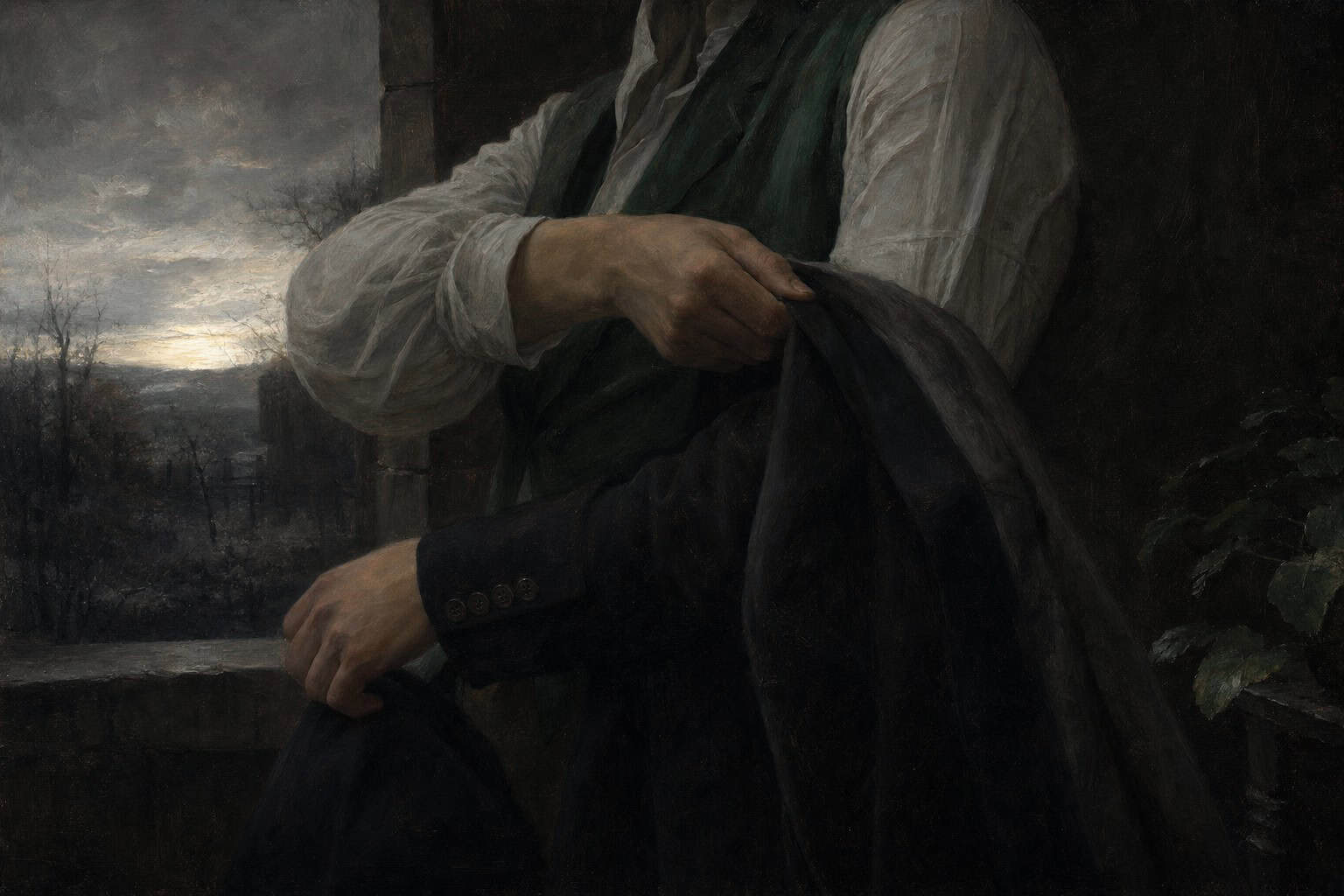
A borrowed, hulking car squats among the polished sedans, and he is about to meet a confidence that works like weather, stripping his practiced disruptions clean off him.
A Borrowed Car Under Floodlights
Metal gleams before any face does. A hulking borrowed Pontiac squats under the floodlights while slim German sedans and careful coupes line the drive like polished sentences. Its weight, its dull paint, the way it sits a little crooked on the gravel—this is how his history arrives ahead of him. He steps out with the stale smell of old upholstery still in his lungs, already braced, already rehearsing the small ways he might chip their glass. Inside, the party hums along its practiced lines: white wine, soft laughter, the low confidence of people whose bills always clear. He walks in knowing the Pontiac has spoken for him, marked him as the interruption. He wants that mark. He wears it like dark clothing in summer, an act of stubbornness that still leaves sweat on his back. Every glance at the window where that heavy car waits keeps his edge intact, even as the room offers him warmth he swears he does not need.
Fingers Hooked in the Jacket Seam
Her approach cuts across his rehearsed distance like a straight line through fog. A German woman, precise and unhurried, steps into his orbit with the calm of someone who has never had to ask permission to be in a room. Before he can shore up another layer of irony, her fingers are already at his jacket seam, feeling for the edge, tightening with an easy claim. The fabric catches for a second on his shoulder, a small resistance that mirrors the way his body stiffens, unused to being handled without warning. He has called this jacket his comfort, his shield, his proof that he is not like them. Now it hangs half off his frame, ridiculous and suddenly heavy. Her voice, light but firm, names dancing as a fact, not a negotiation. In that tug at his sleeve, every story he tells about being the dark one in the corner wavers. She is not asking for his performance. She is simply taking his arm as if it were always meant to be taken.
Weight Shifted Toward the Music
His mind sprints through escape routes, but his feet have already betrayed him. One step toward the hallway where the music thickens, another that matches her stride, and the old pattern of hovering at the edges begins to crack. The jacket, now bunched in her hand, swings between them like a pendulum marking out a new time. Each swing measures the distance between his control and her certainty. He can feel the heat of the room rising as they near the living room, bass notes pressing faintly through the floorboards into his soles. He wanted to remain a problem at this party, an unanswered question leaning against a wall. Instead, his body is being drafted into something as simple as a beat. There is no altar call, no dramatic conversion, only this slow yielding of weight in his hips and shoulders as she pulls him into a space he swore was not for him.
There is a confidence that works like gravity, pulling away every defense you built, until your practiced disruption simply fails to hold.
What Happens When Your Armor Stains Your Skin
Most of us have our own version of that jacket. The tone we use, the jokes we make, the way we stand just outside the circle, all stitched together to prove we are not fooled by anyone’s comfort. It feels holy, almost, to guard that distance, to protect the sore places early poverty or early shame pressed into us. But there comes a night when the armor feels less like steel and more like grease, coating the same skin it promised to defend. Someone’s hand lands on your shoulder, not as conquest but as invitation, and suddenly you hear how tired you sound explaining yourself. The body leans before the mind approves. You realize you are less afraid of them than of what happens if you stop curating your own loneliness. In that small pull toward shared movement, the question sharpens: is your darkness a truth you are stewarding, or a costume you’ve forgotten how to take off?
A Jacket Folded Over Someone Else’s Arm
He arrives at the edge of the living room with his history draped over her forearm instead of his own shoulders. The jacket hangs there, lifeless, stripped of its power now that it is only cotton and thread and not his chosen distance. The music is ordinary—no anthem of revolt, no hymn—just a steady pattern asking knees and ribs to answer. He can feel the old dissonant song in him vibrating against this simple beat, unsure whether to quiet down or sing louder. She waits, not as a savior, not as a judge, but as a woman standing barefoot on hardwood, expecting him to join her. The Pontiac still rests outside among the cars that will never carry his name on a title. That will not change. What remains undecided is who will carry the weight of his darkness tonight—the fabric folded over her arm, or the man standing one breath away from letting his body move in time with hers.