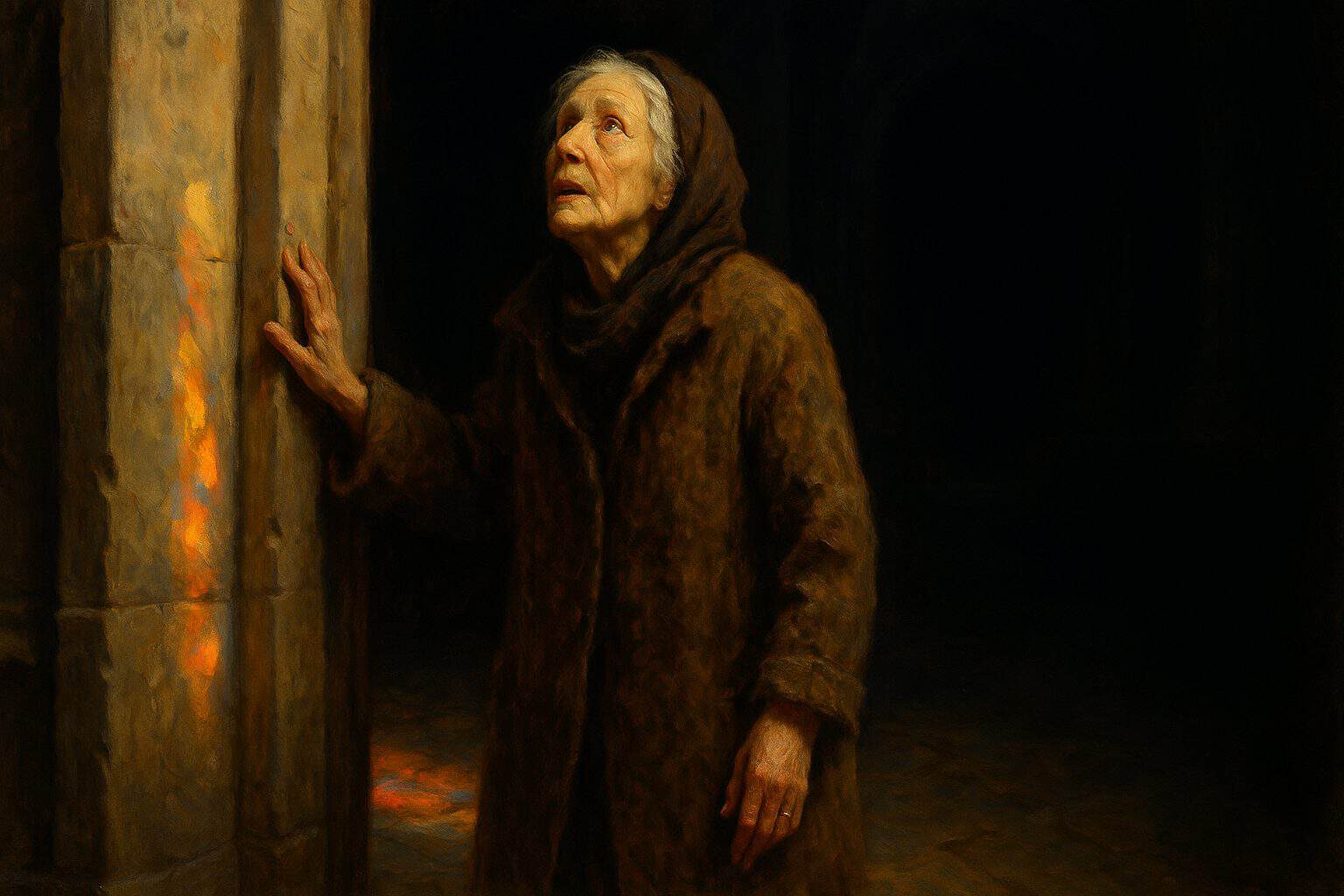
Where the familiar world suddenly opens onto depths that both summon and exceed us
The church door closes behind you with its particular weight—not heavy, but substantial, a sound that seals you into different air. The street noise doesn’t vanish so much as recede into another order of being. You’ve entered this space a hundred times, yet today something catches. Perhaps it’s the way afternoon light angles through stained glass, casting colors that shouldn’t exist in nature across the stone floor. Perhaps it’s the quality of silence, not empty but full, pregnant with a presence you cannot name. Your body knows before your mind does: the slight catch in your breath, the involuntary slowing of your step, the way your shoulders drop as if relieved of a burden you didn’t know you carried.
The Architecture of Approach
The solitude of an empty church, the nocturnal wanderings through Deep Ellum—these still comfort me. But comfort is too small a word for what happens when sacred space receives us. The body learns its own liturgy of approach. Those intimidating older classmates whose sheer physicality once made you shrink—here their swagger would dissolve. Here, everyone’s body learns to take up less space, not from fear but from a kind of ontological courtesy, a recognition that we stand in the presence of That which exceeds all our taking-up of room.
Watch how people enter holy ground. The tourist with camera ready suddenly pockets it. The businessman on his phone ends the call mid-sentence. The child who was running stops, looks up, whispers to her mother. These are not learned behaviors, not social conventions merely. The body knows. Before any catechism, before any theology, the lived body recognizes when it has crossed from ordinary space into something else—what Bernd Jager might call the vertical dimension breaking through our horizontal wanderings.
“Adam’s loneliness was pure, without evil, and that it was something woven into the human soul by God.”
This loneliness that God wove into us—perhaps it’s what makes us capable of recognizing the holy when we encounter it. A kind of incompleteness that becomes, paradoxically, our opening. The tunnel long hidden inside the perimeter of one’s mind suddenly reveals itself not as escape route but as portal.
The Weight of Seeing
Standing before an icon, a crucifix, an empty tabernacle—the phenomenon is not one of looking but of being seen. You become, as Jeannètte writes, both the person standing in front and behind the mirror, herself and her replicant, and her shadow and its source. The holy gaze doesn’t judge; it simply sees, and in seeing, reveals you to yourself in ways that make you simultaneously want to hide and to finally, finally be known.
This is not the paranoid visibility of surveillance, nor the aggressive exposure of interrogation. It’s more like what happens when someone who loves you catches you in an unguarded moment of genuine feeling—grief, wonder, tenderness—and instead of looking away, holds your gaze with infinite gentleness. You are beheld, and in being beheld, you discover depths in yourself you didn’t know existed.
The contemplative becomes a version of Grendel observing—with both envy and disgust—Hrothgar’s feasting hall from the shadows. But here the shadows are not outside the feast; they’re within us, and what we observe with such complicated longing is our own capacity for transcendence. We stand at the threshold between what we are and what we’re called to become.
The Grammar of Response
Faith is something that cannot be proven; it is something that either one has or one does not have. Yet in these moments of encounter, faith reveals itself not as possession but as response. The body knows how to kneel before the mind understands why. The hands fold themselves without decision. The head bows as if remembering an ancient courtesy.
Ellen Benswanger’s insight into space as the primordial condition where subject and world meet finds its most radical expression here. Sacred space doesn’t contain the holy; it is the meeting, the place where our horizontal existence suddenly admits its vertical dimension. We are not in the space; we are the space where human and divine regard each other.
Watch someone light a candle in an empty church. The gesture carries more than intention—it carries the whole person into visibility. Experience carves out their presence in the world, announcing itself to others, revealing a particular situatedness or attunement. The small flame they kindle becomes their prayer made visible, their hope given form, their grief offered up. They become, for that moment, transparent to themselves.
The Wound as Window
He allowed my soul to hunger in my youth so that hunger itself would force me to look for Him again. The holy doesn’t arrive to satisfied souls. It comes through the cracks, the places where we’re broken open. Every genuine encounter with the sacred begins in poverty—not economic poverty, though that too can be an opening—but the poverty of recognizing our own insufficiency.
This is why death easily shakes years of faith, decades of attending church, and calls into question all those private walks with God. The holy is not a possession we can secure, not a territory we can map. It’s an encounter that must be renewed, again and again, through the very wounds that make us doubt its existence.
“These things dwell within permeable reach only to those who first believe with faith the size of a mustard seed that they are able to reach it.”
The mustard seed—so small it’s almost nothing, yet containing within itself the pattern of the whole tree. This is how faith works in the moment of encounter: not as certainty but as the tiniest openness, the slightest willingness to let the phenomenon show itself on its own terms.
The Terrible Freedom
Standing before the holy, we discover what Sartre called the anguish of freedom, but transformed. We could turn away. We could reduce this moment to psychology, to aesthetics, to cultural conditioning. Each of us chooses a narrative that provides a framework in which to process meaning, interpretation, and understanding in life. The holy doesn’t compel; it invites.
This is the most terrifying aspect of the encounter: realizing that one without faith from this perspective might interpret following the divine as an abdication of personal responsibility, when in fact it’s the assumption of ultimate responsibility. To say yes to what exceeds you, to allow yourself to be claimed by what you cannot fully comprehend—this requires a courage that no mere submission ever could.
The lived body knows this courage. It’s written in the way someone’s entire posture changes when they finally stop fighting and allow themselves to be held by something larger. Not collapse but surrender—the difference between falling and letting yourself be caught.
The Patience of Presence
In the empty church, time moves differently. Not slower exactly, but thicker, more substantial. Each moment seems to contain more moment. You could sit in this pew for five minutes or five hours—the clock becomes irrelevant. What matters is the quality of presence, the way you’re held in a regard that neither judges nor abandons.
This is what Merleau-Ponty might recognize as the pre-personal life of the body meeting something that addresses it at a level deeper than consciousness. Before you think about God, before you decide what you believe, your body is already in conversation with presence. The slight elevation of heartbeat, the deepening of breath, the way your hands want to open—these are not symptoms but participations.
Fractions of herself reveal themselves through each of her unique involvements with others, and she finds her voice across an interior landscape. But here, in the presence of the holy, these fractions gather. Not into unity—that would be too simple—but into a kind of constellation where each fragment finds its place in a larger pattern.
The Return
Eventually, you must leave. The door that sealed you in now releases you back to the street, the noise, the horizontal urgencies of daily life. But you carry something with you—not an answer, not a certainty, but a quality of having been touched. Your body remembers even when your mind forgets.
To me, faith and reason are two wings on the same bird; each enriches the other and makes flying anywhere possible. The encounter with the holy doesn’t resolve the tension between faith and reason; it reveals them as two ways of approaching the same mystery. Reason maps the approach; faith makes the leap. Both are necessary. Neither is sufficient.
Walking back into the ordinary world, you understand why tunnels and permeability exist, by definition, outside the perceptual awareness of the one bound to the familiar. The holy hasn’t gone anywhere. It’s we who oscillate between openness and closure, between porosity and defense. The threshold remains, waiting for our next approach, our next willingness to be struck still before what exceeds us.
The phenomenon of awe before the holy is not about God proving himself to us. It’s about us discovering, again and again, that we are the kind of beings who can be addressed by transcendence, who carry within ourselves a capacity for encounter that no amount of explaining can exhaust. We are the place where finite and infinite meet, where time opens onto eternity, where the familiar world suddenly reveals its sacred depths.
In the end, we return to the street changed not because we’ve acquired new information but because we’ve been seen, held, known in a way that reminds us who we really are: creatures capable of transcendence, wounded in ways that become windows, carrying within ourselves tunnels long hidden that open onto light.