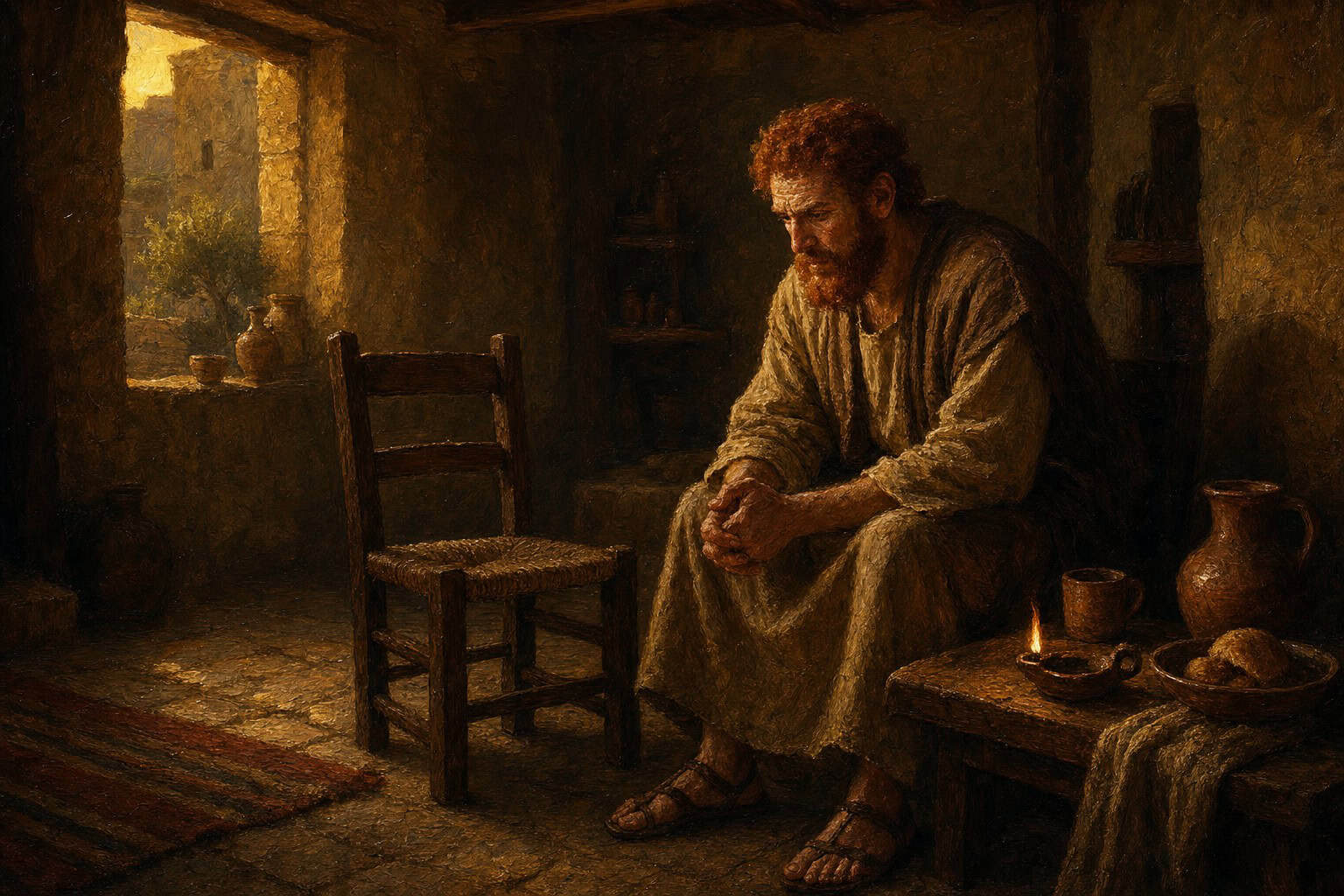
How to deal with grandparents when their minds and bodies fail: a Catholic reflection on presence, shame, and staying when nothing can be fixed.
The Hand That Once Lifted You Shakes for a Cup
You dread the door before your hand touches it. The old smell reaches you first, medicine and something sweet gone stale, and you already know the person inside is smaller than the one you have been carrying in your mind. Grandparents are the first proof most of us ever get that a body is a thing that ends. When you were small they were the fixed ceiling of the world, the ones who lifted you onto their laps and pressed folded money into your palm and laughed at nothing at all. Now the same hand trembles when it reaches for a cup, and the water spills, and neither of you says anything about it. There is a cruelty here nobody warned you about. The world keeps its casual, indifferent grip, lifting one year and dropping the next, and you stand in the doorway watching it strip your grandmother of the very things that made her herself. You wanted them permanent. You built your whole childhood on the belief that they were, that behind you there would always be this warm and steady wall. That belief is being taken from you slowly now, in the doctor’s visits, in the question asked for the fourth time in an hour, in the growing distance behind their eyes when they look at you and almost, not quite, arrive. Part of the dread that meets you at that door is the dread of your own ending, glimpsed too early and too plainly, wearing a face you love. What repulses you most in that stale room is not really them. It is the reminder pressed into your chest that you too are on the wheel, that this chair is waiting somewhere for you. Every diversion you reach for on the drive home, the phone, the radio turned up, the crowded weekend you plan, only sharpens how loud the silence in that room was. You cannot argue your way out of it. You cannot study or accomplish or organize your way out of it. The plain fact of an ending sits there in the recliner, in a person you love, wearing a half-familiar face, and it asks something of you that no cleverness on earth can answer. This is where dealing with grandparents actually begins, not with a plan but with the honest admission that you are afraid, and that the fear is partly for them and partly, shamefully, for yourself. Naming that is not a betrayal of your love for them. It is the first true thing you have said in the whole long ordeal, and saying it costs you something you did not expect to pay.
The Grid of Pills You Build to Stay Out of the Chair
So you make systems instead of showing up. You research the condition until you can recite the stages like a catechism. You sort their pills into a plastic grid, color-coded, alphabetized, seven days across, and you tell yourself this is love. You schedule the visits and keep them short. You arrive with a task in your hands so there is always a reason to be moving, always a reason to leave. You forge an elaborate machinery for managing them, and every gear in it is built to spare you the one thing you cannot bear, which is sitting still in that room with nothing to do but be seen and to see them. We build these structures not to navigate love but to survive the terror of being left, and the exact shape of the structure always betrays the exact shape of the wound underneath. You handle the paperwork because paperwork cannot look back at you. You correct their slipping memory, gently at first and then with an edge in your voice, because correcting them is easier than grieving them while they are still breathing in front of you. There is a particular self-deception here that deserves to be named out loud. You call your competence devotion. You call your avoidance efficiency. You tell the rest of the family how much you are doing, and it is true, you are doing a great deal, and none of it is the thing actually being asked of you. The hard question is the one you keep refusing to sit inside. What are you so busy protecting yourself from? Not the smell. Not the labor. You are protecting yourself from the sight of your own face in theirs, from the plain knowledge that you will one day be the one in the chair who cannot follow the conversation, who reaches for a familiar name and closes on air. Their decline shames you because it exposes you. It shows you finite, breakable, headed down the same road, and you cover yourself with schedules and errands the way you have always covered yourself when you felt too exposed, too naked, too clearly seen. The intellectual solving, the neat categories, the forecasted timelines, they only multiply the noise and sharpen the sense of absence. You leave their house more tired than when you came, and somehow more alone, because you were never really there. You were managing a situation, not sitting with a person. Somewhere under all that exhaustion you know the difference, and you know exactly which one they were quietly asking for while you organized their medicine and glanced at the clock.
Feed My Sheep, and He Is Pointing at This One
The turn comes on a day when there is nothing left to organize. The grid is filled. The doctors have said the little they will say. You are simply there, in the chair beside theirs, and the silence you have spent months outrunning finally closes over your head like water. This is the exact moment the demand arrives, and it arrives precisely when your patience and your affection are scraped down to nothing, when a small ugly voice in you recoils at the drool, the repetition, the soiled cloth, the slow ruin of someone you were raised to revere. Feed my sheep. Not the sheep you would have chosen. This one. The command lands where your contempt is thickest, and that placement is not an accident, because your contempt is the very material being asked for. You wanted to bring God your best, the gold of your competence, the frankincense of your cleverness, the trophies you have gathered elsewhere. What He asks you to carry into this dim room is the poisoned water inside you, the disgust, the exhaustion, the fractions of your own fallenness, because when you are honest those are all you have. And here is what breaks through, quiet and without any spectacle. God is already in the room. Not to fix it. He does not restore your grandfather’s mind or reverse the turning wheel or hand you back the ceiling of your childhood. He is simply present, sitting in the ruin with you, nearer to the dying man than you are willing to be, present in every tear you keep refusing to cry.
You cannot fix a dissolving person, but you can refuse to leave the room where they are being erased.
That is nearly the whole of it. Presence is not a technique to make the visit bearable, not a trick to shorten the hour. It is an obedience. Your vocation, it turns out, was never to repair them. It was to remain, to keep offering your presence while everything in your body strains toward the door, even when the offer is met with a blank stare, a hostile word, or nothing at all. The particular crucifixion of loving grandparents in their decline is watching from the outside as the person recedes past your reach, unable to follow them, unable to stop the receding, and staying in the chair anyway. In that staying, unbearably, is where He meets you. Not above the suffering, waiting for it to pass. Inside it, in the chair beside yours, breathing the same stale air, His hand where you cannot see it resting on the very ruin you flinch from.
You cannot fix a dissolving person, but you can refuse to leave the room where they are being erased.
Losing the Court Whose Verdict You Performed For
Afterward you are not relieved. That is the first honest thing to say about the fallout. The clean, finished feeling you expected does not come, because grace here is not a rescue out of the darkness, only a companion who walks with you inside it. Your grandmother still does not know your name on some days. The dread still meets you at the door next time, unchanged. But something has shifted in you, and it is not comfort, it is a stripping down. The loss of who they were, the loss of that fixed and steady ceiling, does not ruin you the way you feared it would. It reveals you. It shows you plainly what you had actually been resting your peace on all along, which was their approval, their recognition, the flattering version of yourself that lived in their eyes as the good and dutiful grandchild. When that recognition dims, when they can no longer see you clearly or at all, you lose the court whose verdict you were secretly performing for your whole life. There is a terrible freedom in that loss, a freedom you never asked for and would never have chosen. You are no longer visiting to be seen as devoted. There is no one left in the room to reward you for coming. What remains is only the act itself, offered or withheld, with no audience to applaud it and no receipt handed back. This is a hard tutor, harsher than any you would sign up for. The loneliness of loving someone who can no longer love you back the way they once did, the rejection folded into a mind that keeps forgetting you exist, these become the very instruments that train your sight to see straight. You begin to notice that you have spent your entire life tying your joy to currents that could never hold it, to being chosen, being admired, being kept safe in someone else’s regard. And here is a love that asks you to give without being kept at all, to show up faithfully for a person who cannot keep you and cannot remember that you came. The poverty of that is real and it aches. You feel it on the drive home, in the way your own house feels too quiet when you walk in, in the way you cannot quite name what you are grieving because they are not gone yet, only leaving, day by slow day. But underneath the poverty something steadier is being uncovered, like stone under washed-away soil. A joy that does not hang on their recognition. A love that does not require repayment to keep breathing. It is not consolation. It is closer to bedrock, the kind of thing you only ever reach after everything softer has been rinsed off you.
The Road You Keep Driving Back Down
So where does it settle. Not in resolution, because there is no resolution to a person you are losing one small piece at a time. It settles in the return itself, in the plain fact that you keep driving back to the door you dread, keep lowering yourself into that chair, keep offering a presence that cannot cure a single thing. Dealing with grandparents in their long decline is not a problem to be solved and closed. It is a road to be walked, the same road, again and again, until the wheel finishes its turn. You learn that your soul does not find its rest in winning, not in the flawless care plan, not in the one visit that finally goes well, not even in the rare afternoon when they remember your name and something old flickers back into their eyes. It finds rest in a smaller, stranger place, in the willingness to stay when nothing at all is gained by staying. That is the shape of a much older obedience, the one where love stoops down to wash tired feet, enters the city on a borrowed animal, and hands itself over to be broken for people who will not understand. You bring what you have, and what you have is not gold. It is your fatigue, your quiet resentment, your fear of your own ending, the whole of the poisoned water within you, and somehow, against all sense, it is received. There is no trick hidden here, no comfort that dissolves the grief and sends you home whole. The person still fades. You still watch from the outside, unable to follow where they are going. But you are not alone in the watching now, and neither are they, and that nearness quietly changes what the watching means. This is the honest ground beneath a question that sounds simple and is not. If you are living this now, dreading the door, worn out by the systems you built to keep from feeling it, ashamed of the disgust that rises in you unbidden and unwilled, know that a book has walked this exact road ahead of you. Confessions to the Empty Chair offers you no way around the room. It sits down in it. It names the shame of being found wanting and the strange grace of remaining anyway, of holding out your soul when every offer is refused. It will not tell you how to fix your grandparents. It will tell you the truth about what love costs when there is nothing left to gain, and what, quietly, keeps breathing when the wheel has taken all the rest.