How space becomes place through the alchemy of human presence
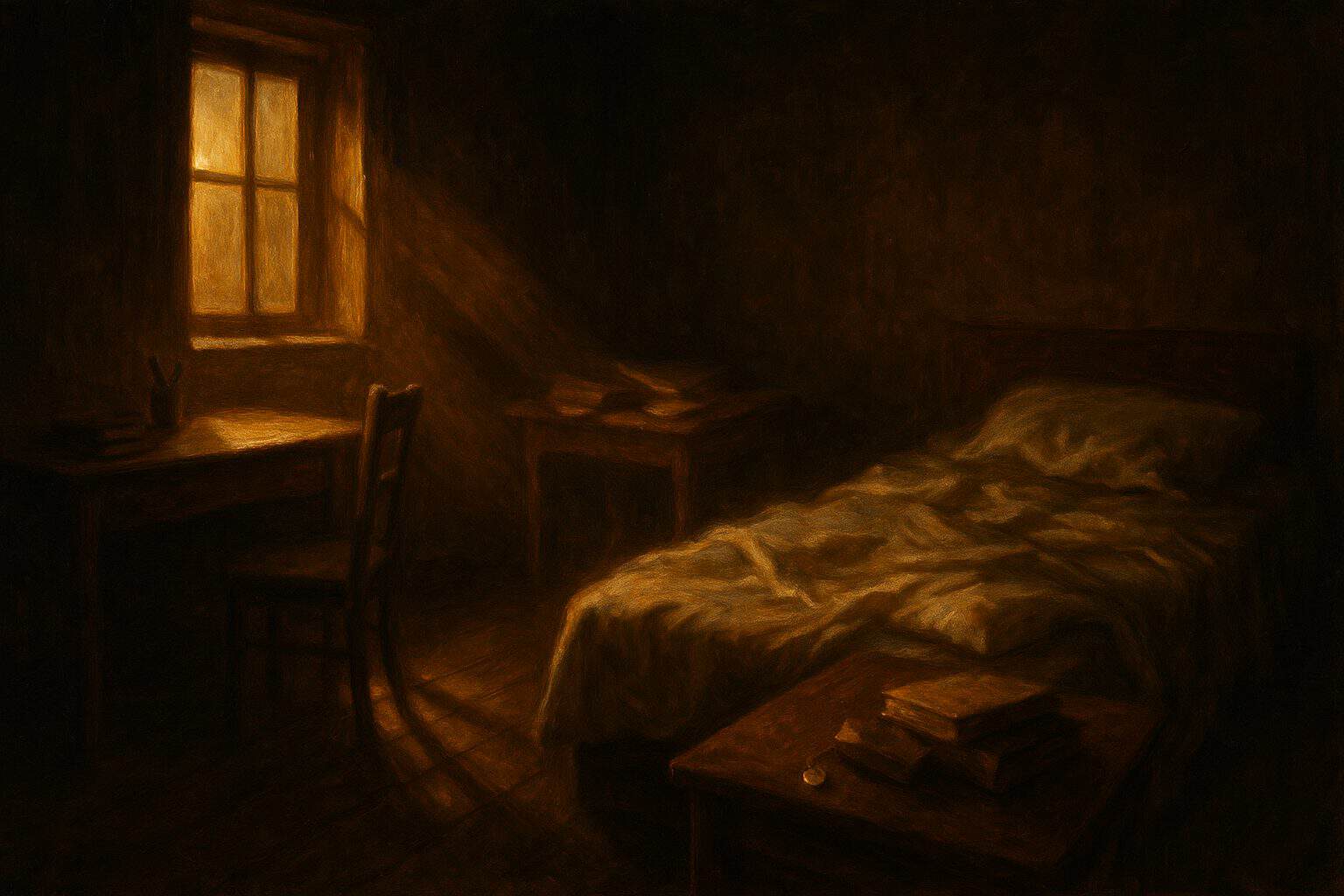
The apartment stands empty now, yet everything speaks. The pens on the desk remain arranged just as they were left, dog-eared pages in scattered books decorate a quiet table, and the unmade bed with its worn pillows holds the impression of a body that will not return. From his point of view, the furniture itself reminds him of absence every time he walks through the door. This is how place reveals itself—not as neutral container but as saturated witness, holding our lives even after we’ve departed.
The Grammar of Approach
Watch two strangers navigate a sidewalk. The space separating them gradually shrinks with each step, transforming public space into social space, social space into personal space. This metamorphosis happens without thought, a bodily intelligence that knows precisely when to angle shoulders, when to make or avoid eye contact, when the invisible boundary requires acknowledgment through a nod or studied ignorance. The body reads space like a text written in distances and proximities, translating the abstract geometry of meters and feet into the lived grammar of approach and withdrawal.
In the shared dorm room, this grammar becomes dense with negotiation. Three young men—Adam, Martin, and another—create a choreography of coexistence. The room that seemed spacious to the housing office becomes a stage for elaborate spatial diplomacy: who claims the desk when, whose music fills the air, how morning routines interweave without collision. “Rooming with Adam and Martin pulled my mind and spirit from its usual dark watering hole, granting moments of respite.” The physical proximity does something beyond mere companionship—it restructures the inner landscape through the outer arrangement.
The Sanctuary and the Street
Rome’s ancient stones impose their own spatial logic. The cathedral doesn’t simply contain silence; it generates it through vaulted ceilings that pull the gaze upward, through massive columns that dwarf human scale, through the play of light through stained glass that transforms ordinary air into something almost substantial. “I returned from Rome’s ancient stones and sacred silences to the chaos of a shared dorm room—a jarring plunge from cathedral stillness into fraternal noise.” The body remembers both spaces, carries them as competing templates for how to be.
The chapel at midnight offers another species of sanctuary. “I entered His sanctuary unseen, as was my pattern, cloaked by darkness in the hour’s stillness when both professors and peers slept.” Here, solitude isn’t emptiness but fullness—a sacred space where one is to close the door and dwell with God in secret and solitude. The late-night hours become a “tent of meeting,” that deepest fraction of soul reserved for encounter with the God who stays. Space transforms into temenos, sacred precinct, not through ritual consecration but through the quality of presence brought to it.
The Horizontal Life
“God ‘walked’ with Adam in Eden; Adam did not walk with God in Heaven.”
This insight illuminates something essential about human spatial existence. We are creatures of the horizontal plane, beings who face each other across dinner tables, who sit side by side in pickup trucks, who lie down to sleep and stand up to greet. Even our mystical aspirations must negotiate this fundamental horizontality—God descends to walk in gardens rather than lifting us perpetually into celestial heights.
The truck becomes unexpected sanctuary: “Silverado. Wade and I re-established our old ritual in my hometown, his truck a rolling sanctuary where we exchanged intelligence from our separate fronts.” The cab of a pickup, windows cracked, country music low on the radio, creates an intimacy different from any room. Movement through space while remaining still relative to each other, the passing landscape providing rhythm and punctuation to conversation—this is how men often find their way to truth, sideways, while ostensibly doing something else.
The Architecture of Absence
When relationship fractures, space itself becomes antagonist. “The rest of the night was a long, cold education in silence. I forced myself onto the couch. She remained in bed.” The same apartment that once held warmth now enforces separation. Every room becomes a statement about distance, every closed door a manifesto. The couch isn’t simply furniture but exile, the bed not merely where she sleeps but territory from which he is barred.
After departure, the space holds more than memory—it holds presence-as-absence. “Everything here reminded me of all that was—the sights, the smells—like nothing had changed during my absence.” The unchanged room becomes almost violent in its insistence on continuity, as if denying that fundamental rupture has occurred. Objects become accusatory: you left, we remained, now explain yourself.
Digital Territories
The BBS—Bulletin Board System—creates space without place, community without proximity. “In contrast, the BBS fostered a diverse community… creating an intellectually and socially stimulating environment ripe for the exchange of new ideas.” Here, minds meet without bodies, creating a different species of intimacy. The party line telephone offers another variation: “If someone was home, all they had to do was pick up the line in order to overhear the conversation in progress.” Privacy becomes porous, the home invaded by invisible ears.
These electronic spaces presage our current digital territories—spaces we inhabit without occupying, where presence means something different than physical proximity. Yet even these abstract spaces follow spatial logic: we “enter” chat rooms, “visit” websites, “go” online. The metaphors reveal our need to think spatially even about the spaceless.
The Solitary Animal
“They tend to favor solitude instead of gatherings of people, derive pleasure from contemplating abstract ideas as opposed to sensory stimuli.” This temperamental orientation toward aloneness isn’t misanthropy but a different way of inhabiting space. The introvert doesn’t simply prefer empty rooms but experiences crowded ones differently—as assault rather than stimulation, as depletion rather than energy.
“Silence had become my language, and I welcomed an environment where fewer sounds pierced my shell.” The shell metaphor reveals how the solitary person must create portable boundaries, carrying their sanctuary with them like a snail. Physical walls become less important than these invisible barriers that can be erected even in public space.
The Return
“Their absence returned me to solitude. But opportunity instead of loneliness filled their vacated space, occasioning visits from Carol, then Elizabeth.” Emptied space doesn’t remain empty—it becomes potential, invitation, different possibility. The room that held three now holds two, changing not just population density but the entire emotional topology. What was crowd becomes couple, what was social becomes intimate.
The old high school friends “lived together under one roof, offering spacious, if gloriously messy, sleeping arrangements for guests.” This hospitality creates another kind of space—temporary belonging, provisional membership in an established order. The guest occupies a liminal position, neither fully inside nor outside, welcomed but not rooted.
The Flesh Cage
Sometimes space becomes prison not through walls but through the very fact of embodiment. “My spirit crashed back into flesh… turning this reality gray and hollow, forcing my continued endurance here, a cage separating me from Him.” The mystic’s dilemma: having touched transcendence, ordinary space becomes unbearable limitation. Every room reminds of what it is not—infinite, eternal, immediate to the divine presence.
Yet even this complaint remains spatial. We imagine transcendence as elevation, release, expansion—all spatial metaphors for what supposedly exceeds space. Perhaps this is why “house is a feeling”—because our deepest experiences of meaning require spatial expression, even when pointing beyond space itself.
The Adversary’s Approach
“Your adversary will sometimes appear as an ominous shadow in the dark… but a distant coldness will always announce their presence.”
Evil, too, has its spatial signature. It approaches not directly but obliquely, manifesting first as atmosphere—a chill, a shadow, a quality of light that shifts. The body knows before the mind, sensing threat through some primitive spatial awareness that predates reason. This is why darkness frightens—not because we cannot see but because hostile presence might occupy the invisible spaces.
Dwelling
What makes a space into a place? Not ownership, not duration, not even affection—but dwelling, that mysterious alchemy by which anonymous space becomes saturated with personal meaning. The soul finds rest “not by winning intellectual arguments or gathering carnal trophies, but by returning to Him in the silence and solitude of the chapel.” This returning marks the difference between occupying and dwelling—one can occupy many spaces but dwell in few.
The places that hold us do more than contain—they shape, they remember, they wait. They become extensions of our bodily existence, wider skins within which we live and move and have our being. Even in leaving, we remain held by them, carrying their imprint like a shell carries the sound of the sea. This is the human situation: always placed, always in place, always making place out of mere space through the simple, profound act of living there.