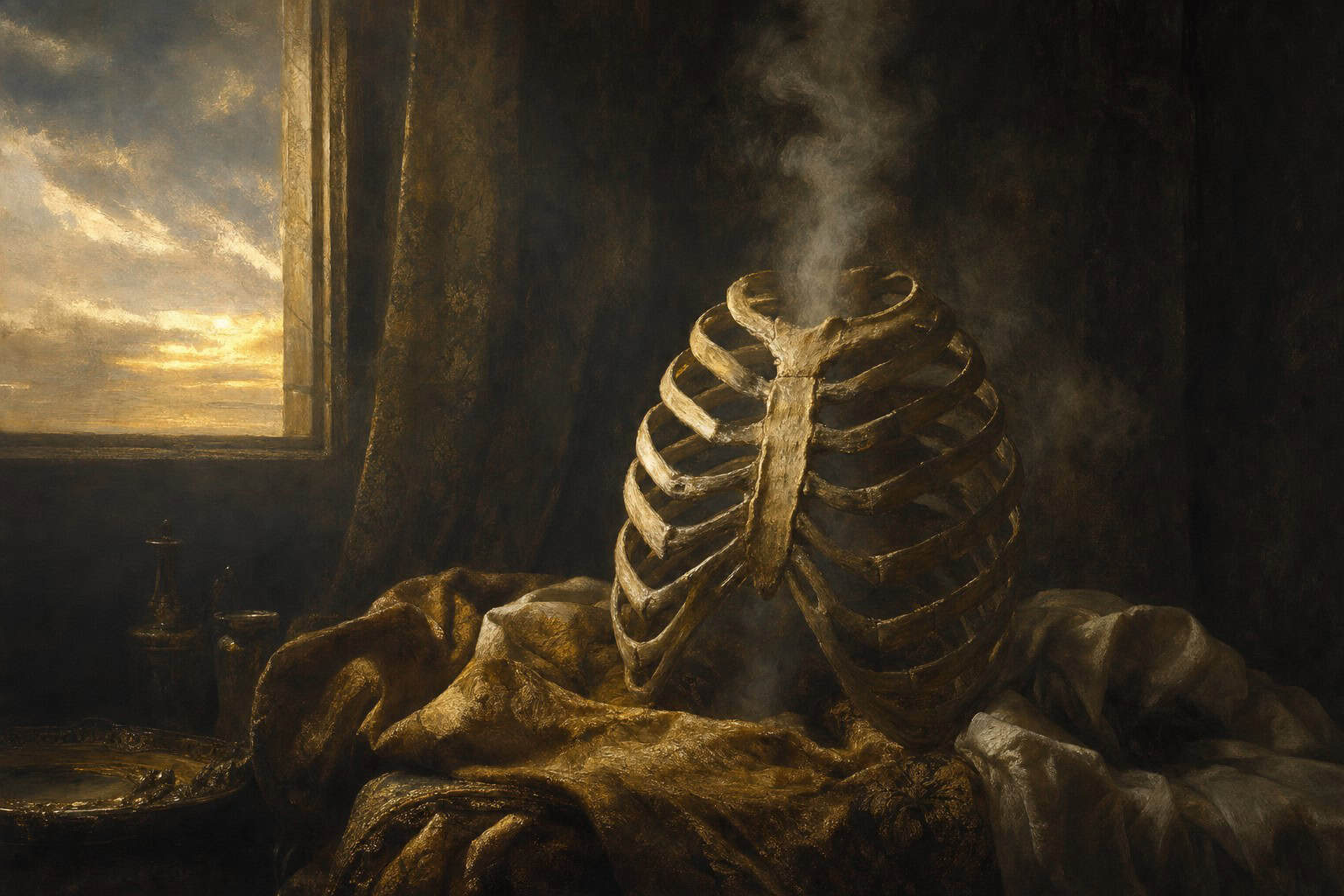
He stops in the middle of his own teaching and turns the lamp on himself, admitting the ache in his chest is no invention but an inheritance — old as the first solitude that longed for a face.
One Breath Moving Through a Tired Chest
A man pauses in the middle of his own teaching and turns the lamp on himself. He admits that his mind is not a clean laboratory but a tired chest, rising and falling with the same inherited breath as everyone he dissects. Birth rooms, gravesides, friendships soured and sustained—these have bent his ribs and thickened his pulse. He refuses the pose of the untouched observer and names himself as another lens, clouded and partial, sorting what comes forward and what stays in the blur. From that owned weakness he steps back even further, to the first lungs that ever filled with air, and to the invisible cargo that rode in with that breath. This chapter lives at that altitude: one man’s confession yoked to a long line of bodies inhaling the same damaged air, each sigh another data point in a story older than language. What looks at first like a simple preface—“know who is speaking to you”—widens into a meditation on how no one can ever stand outside the fog they are trying to map.
Mud Between Fingers, Air in the Lungs
Against that admission, the chapter names its central wound with blunt clarity: man and woman were meant to be fellow climbers, but instead we bend toward each other like worshipers around a small, warm idol. Bodies lock, eyes close, and the climb stops. Flesh becomes a shortcut, a counterfeit answer to a hunger that does not live in the skin. To explain how this keeps happening, the narrator reaches back to the first couple and speaks in the language of inheritance: strengths and weaknesses, virtues and vices, all mixed like blood in a child’s veins. What moved in Adam’s chest moves now in his sons; what flashed in Eve’s heart burns now in her daughters and in their sons as well. The breath first pressed into one body passes to another without ever leaving the line. Mud and spirit stay tangled. By the time the modern man or woman reaches for a lover, their hands already carry that ancient mixture—desire for God, desire for the other, and a dull preference for what can be held over what can be adored.
The First Man’s Hollow Ribcage
Here the chapter slows and listens to a single sound: the empty echo inside Adam before any sin, before any blame. Loneliness appears not as defect but as design, an ache planted in a clean heart. The narrator imagines Adam among the angels, watching their shared joy with their own kind and feeling in his own ribcage a space where something should answer back and does not. He tries conversation with minds made of light, then with beasts and birds fashioned at God’s command, and nothing quite strikes the chord that his hollow expects. The text is careful: these scenes are not romance, not yet, but the education of a man whose chest is being tuned. God, who could have made him full from the start, instead lets the hollowness deepen until even Adam can name it. Out of that deliberate lack, the desire for woman is born—not just as craving for touch, but as a need for someone whose breath will answer his, whose presence will sound right inside his ribs.
Loneliness did not begin with us; it traces all the way back to Eden, where even unbroken solitude first ached for a face to answer it.
Angels Circling a Lonely Heart
Set inside the larger book, this chapter is the deep foundation under every later account of fractured love and multiplying selves. The project here is not to scold romance but to expose its fault line: our hunger for union is older than our corruption, yet now every attempt to satisfy it is filtered through a bruised heart and a warped lens. Even angels enter as a kind of contrast—pure minds who can observe Adam’s loneliness, speak with him, even delight in him, but never feel that same hollow ring in their own center. Their company teaches him what companionship can be, but also what it cannot touch. In Eden, before any betrayal, the whole emotional palette between man and woman is sketched in: joy, harmony, curiosity, the first sting of lack. All of it, the chapter insists, runs forward through the generations alongside sin itself. By the time the narrator dissects modern bad faith and legion-like selves later in the book, this is the buried reference point: a lonely heart circled by brilliant beings who cannot fill it.
A Rib Lifted Toward the Light
What this chapter finally offers is not a solution but a hard frame: the loneliness that drives men and women into each other’s arms is both holy in origin and hazardous in practice. It pulls on something God Himself placed in the first man, yet now it surges through bodies that see, choose, and love through a damaged filter. The narrator’s own surrender—naming his biases, his weariness, his history as both teacher and apprentice—becomes part of that picture. He is not outside the pattern he describes; his chest rises with the same old breath. By tying present desire back to a pre-fall ache, the chapter promises a reading of love that neither sentimentalizes nor despairs of it. There is a reason every embrace feels too heavy for what it can actually carry. Somewhere behind each tangled bed, each late-night conversation, stands that lifted rib, catching the light for the first time, waiting to see what kind of answer it will become.