After Rome’s marble and ancient shadow he lands under a humming fluorescent sky in a crowded triple, calling the men he shares it with brothers, a word he has not yet learned how little he earned.
A Triple Dorm Under Fluorescent Light
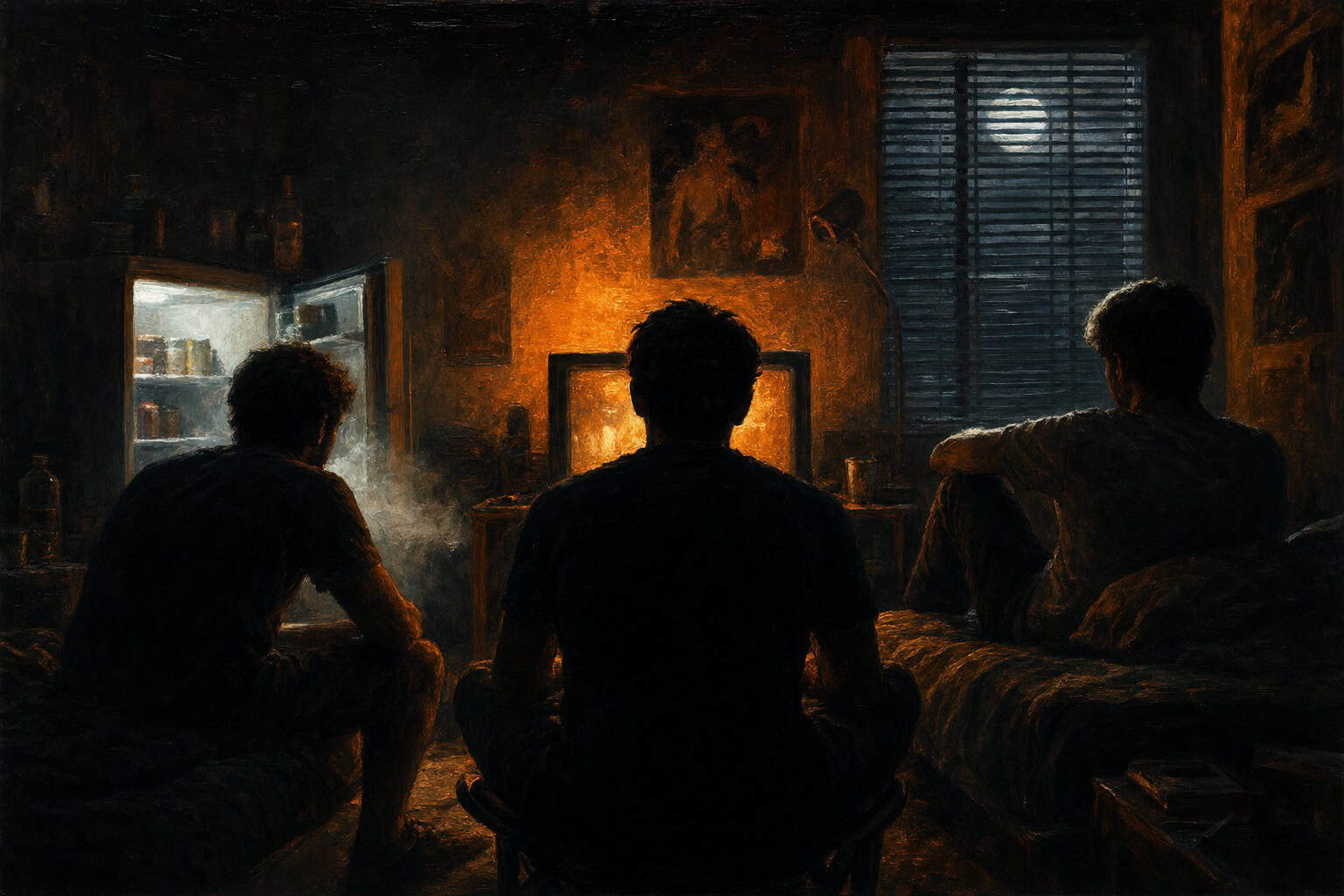
Fluorescent light, humming over a too-full room, becomes the new sky. After Rome’s marble altars and ancient shadows, he lands in a triple dorm cobbled together through a quiet piece of treachery: false roommate groups, last‑minute withdrawals, a calculated grab for the biggest room on campus. It works. The prize comes with its own bathroom and with two men who instantly turn the space into a kind of crude fraternity cell—Adam the theater kid, Martin the politics mind, both fluent in insult and spectacle. This entire chapter lives inside that shared square of carpet and tile: beer cases stacked by the mini‑fridge he hauled from West Texas, a TV glowing with Highlander and video games, speakers blasting music that mocks the very love that once gutted him. The sacred and the profane no longer alternate by semester; they now brush shoulders at the sink, queue for the shower, fall asleep to the same flickering blue light.
The Mini-Fridge as Altar of the Triple Dicks
At the center of their life together sits a mini‑fridge, humming like a small engine under the TV, cold beers and leftover takeout packed beside each other. Around it gather three men who renamed themselves after anatomy, who stitched their identities together like parts of a single obscene joke. The one who orchestrated the housing scam now presides as the shaft between balls and head, comfortable turning his own body into a punchline. That refrigerator becomes their altar of irreverence: they stock it, raid it, lean on it while trading barbs, build their nights around its supplies. Yet the same mind that plotted their rise to the coveted triple also inventories the cost—resentful peers, the hidden pride in being called Triple Dicks, the quiet knowledge that deceit can masquerade as cleverness. This is the organizing reckoning of the chapter: the realization that brotherhood can be born from sin as easily as from virtue, and that he feels more at ease leading a small con than standing alone in a chapel pew.
Laughter in the Glow of the Television
Most evenings, the television washes the room in color while laughter ricochets off the cinderblock walls. Adam sprints down the dorm hallway in nothing but tighty whities and a backpack, pounding on the locked door as Martin demands he guess a password. Inside, our narrator doubles over in hysterics, safe behind the barrier his roommate controls. Sarcasm flies like thrown objects: shaved arrows on bellies, mock‑discipline spankings, absurd nicknames shouted across the hall. The same body that once knelt alone in chapels now stretches on a dorm mattress with a cigar, staring at animated chaos on a game console instead of staring down the moon. Yet under the glow of the TV and the thrum of offensive lyrics, tension gathers. His old self‑torturing playlists give way to songs that slice into sentiment, but they do not erase what lurks beneath. The chapter presses feeling from reprieve into pressure, from shared jokes into the moment when a familiar woman’s locked dorm door rewrites the night into something far heavier than banter.
We call them brothers, the men we merely share a room and a lowered standard with, and only later learn how little the word was ever earned.
Cold Air from the Fridge and Heat from the Bed
The cold breath from the mini‑fridge and the warmth of Kerri’s bed belong to the same moral weather system in this book. This chapter shows him learning to live inside a pack of men without shedding the shadow that followed him from childhood. In the triple, his darkness learns to speak fluent comedy: self‑degrading nicknames, limp spaghetti metaphors, an insistence that he is safe because he is sexually harmless. Yet the Codex still hums below the jokes, ready to log another encounter. Kerri, with her bright mind and meaning‑saturated view of sex, steps straight into that hum when she locks her door, draws the shade, lets her scent cling to the air between them. His body moves according to the old script—compliance, performance—while his spirit grips the edge of itself, unwilling to be claimed. The book’s central question tightens here: can he consent to real love without discarding the dissonant, stained part of him that finds brotherhood easier than purity and conquest simpler than communion?
A Locked Door, a Humming Compressor
In this chapter, the promise is not of sudden conversion but of honest exposure under cheap dorm lighting. We watch a man who once sought holiness among ancient stones now build a different kind of sanctuary around a humming compressor and stacked DVDs, learning that grace can hide in ridiculous nicknames and shared cigars. At the same time, the old contamination shows its teeth: he cannot keep his flesh from answering when a friend decides her body is ready, even as he silently doubts her claim. He wants to shield her from the part of him formed by earlier violations and by the Codex, yet he also wants what she offers, and the chapter refuses to absolve him cheaply. The stakes here are not abstract: a friendship pressed toward something irreversible, a self that risks becoming only the sum of its sexual scripts, a soul that suspects God is watching even in a cluttered dorm. The last line leaves him standing between cold air on his back, heat in front of him, and a choice that will not stay theoretical once he reaches for her wrist.