Living a double life meaning: what it does to a child seen as a riddle, not a person – a memoir reflection on the split self.
The Duckling Slightly Behind the Flock
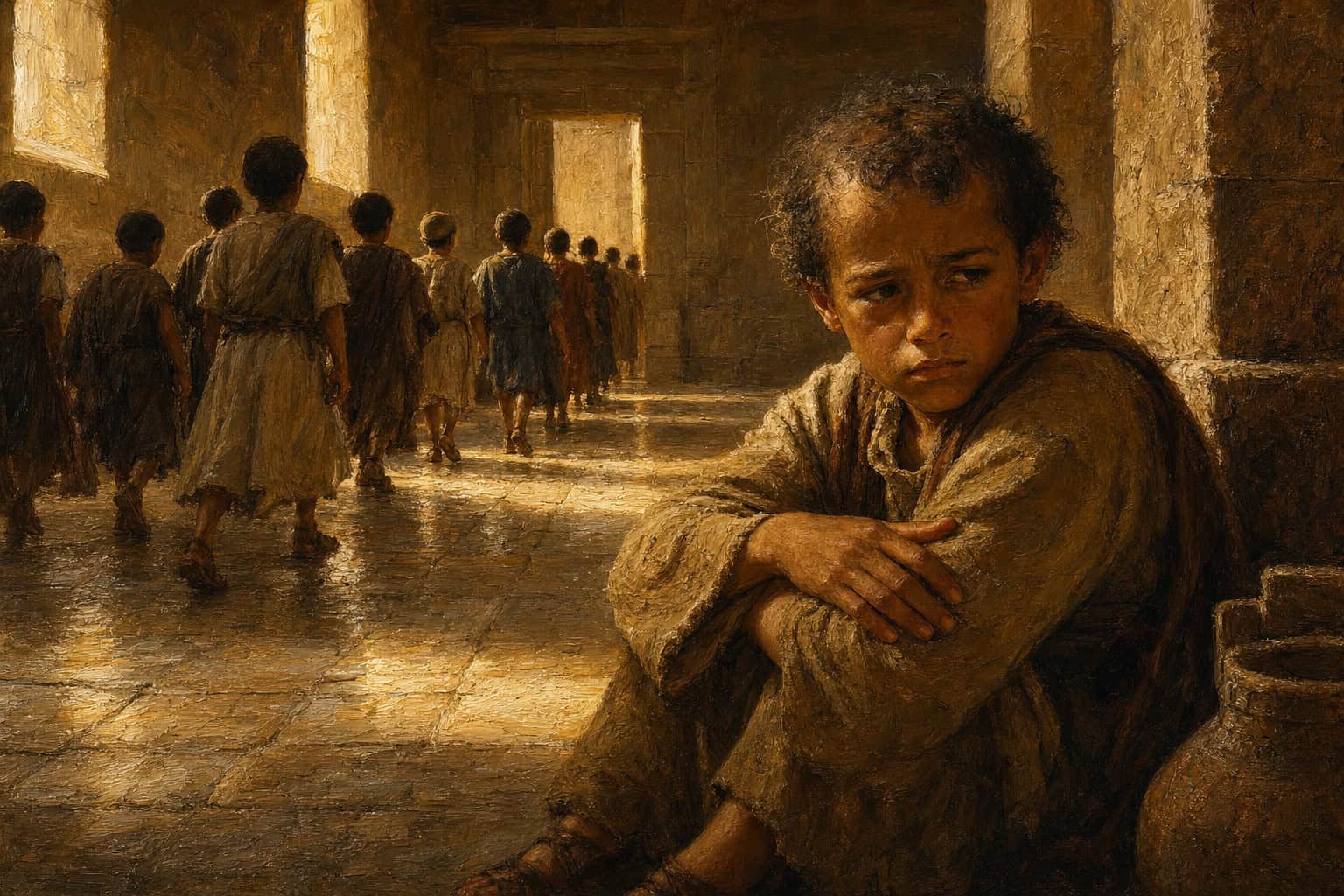
What does it cost a boy to be two people at once, one who walks into the room and one who hides behind him? He asks this before he has the words for it. In Confessions to the Empty Chair, at the opening of the first chapter, a five-year-old is dropped off early in his father’s work van, before the light is even good, and set down on a cold gymnasium floor to wait for the school day to begin. The floor is hard under him. The space is too big for a small body, its high windows letting in a gray, undecided morning. He watches the other children the way a small animal watches an open field, careful, alert, ready to go still. When the teacher comes, she gathers them like a mother duck gathers her line of ducklings, and they follow. He follows too. But inside himself he stands apart, the last one in the line, keeping pace and yet not quite belonging to the pace. That gap is the whole moment. His feet move with the flock; something else in him has already stepped back and off to the side. He has learned, in a home of unpredictable adults, that silence is safer than sound, that a shut mouth draws no anger and no love that turns without warning. The building itself is older than his parents, put up decades before he was born, full of rules that do not shift with a mood. He likes that. He tells us the differences from his old daycare were stark: more children, stricter order, a colder way of teaching, and best of all, less crying. In a home of shifting weather, a fixed rule is a mercy. So he builds a quiet, obliging boy on the outside and keeps the real one folded up small within. This is where a double life starts, not in some dramatic secret but in a child who decides that the self he shows and the self he is must live in separate rooms. He is not lying. He is surviving. Yet even here, at the start, the older man writing it can feel the trap taking shape. The shell that keeps the noise out will keep him in. He does not yet know that the wall he is raising to protect the boy will one day be the wall that seals him. He only knows the floor is cold, the line is moving toward the classroom, and he is the last duckling, keeping the exact pace and watching the backs of the others as they go.
Finishing Before the Others Have Begun
The split deepens in the plainest way imaginable: he is fast. He finishes his work with a speed that unnerves. While the other children still labor over their letters, pencils gripped and tongues between teeth, he sits with a finished page and stares up at the paper decorations hanging from the ceiling. The clock drags its slow feet across the morning. He has already learned something strange and lonely, that time does not move at the same rate for everyone, that his minutes run longer than theirs, that being ahead is its own quiet exile. He is a prisoner of that clock, waiting on the flock to catch up to a place he reached long ago. His teacher, Ms. Chavez, notices. She is not cruel. She sees the boy sitting idle at his desk and, meaning well, asks whether he feels bored in her classroom. Here is the first small treason of the double life, and it is his own. He does not tell the truth. He says no. He does not want to trouble her, does not want to become a problem, does not want the exposure that honesty would bring down on him. So the obliging outer boy answers for the hidden inner one, and the gap between them widens by a hair. This is the ache the searcher is circling. A double life is not only the secret you keep from the world; it is the small daily lie by which you protect the world from you. The child manages the adult’s feelings. He shields her from his own restlessness. He performs a contentment he does not feel because the performance keeps the room calm and the weather steady. The man, looking back across decades, cannot let this pass without turning the lens on himself. Was that discretion, or was it fear? Was he being kind, or was he already a boy who had decided his true state was a burden that had to be hidden? He cannot fully answer, and he does not pretend to. What he can see is that the habit set early, the habit of reading the adult’s mood and giving the adult whatever keeps the adult easy, at the cost of his own truth. The quick mind and the guarded heart grew from the same root, in the same soil. The very speed that made him visible was the one thing he had trained himself to keep quiet about. He was a boy who finished first and said he was fine, staring at the ceiling, counting the long dead minutes, waiting to be led back into the line. The inconsistencies he had lived among at home had taught him a single durable lesson: keep the surface smooth, whatever churns beneath it.
The Look That Turned Him Into a Riddle
Then comes the test. Ms. Chavez gives him a special assignment, harder than the ordinary work, something the district treated as a version of an intelligence test. He does not know the machinery behind it. He does not know that the school system was building a new program for its most rigorous students, or that every teacher, herself included, had been told to watch the rooms for children who might belong there. He only knows he is handed a difficult thing and told to complete it. He does. And then she takes it from him and keeps it, and she looks at him. That look is the turn of the whole scene. She does not look at him the way you look at a child anymore. She looks at him the way you look at a puzzle you cannot yet solve, with interest, with a kind of hunger, with the particular attention of someone who has found an intriguing thing and now wants to understand exactly what it is. The boy feels the change in the very air between them, the temperature of it. He has crossed, in one afternoon, from being a student to being a specimen. And here is the awful doubleness the searcher came looking for, made whole in a single glance. To be seen as a riddle is to be seen with enormous intensity and at the same time to vanish. The child disappears into the question he poses. She is no longer looking at the small tired boy from the work van; she is looking at the mystery of his mind, the speed that cannot be easily explained. Something vast has opened over him in that classroom, wider than the walls and older than the building, and it both dwarfs him and makes a place for him, and he cannot tell whether the place is a gift or a cage. The stillness in him goes deeper. He does not have language for what has shifted, but he knows the distance between himself and the flock has just been measured and named by someone with the power to move him.
To be seen as a puzzle is to be loved for the answer and never for the child holding it.
Chosen and Set Apart in One Motion
The fallout is quiet, which is what makes it terrible. Nothing shatters. No one raises a voice. There is no scene, no crying, no punishment. He simply becomes, from that look forward, a boy who is watched for what he might be worth. The book reads this moment through a hard truth about the grown-ups who guard children: they too often measure a child not by his given dignity, the plain fact that he is a soul, but by his usefulness, his speed, his output, his fitness for a program someone upstairs is planning. The teacher’s kindness is real and her recognition is real, and yet folded inside them is a subtler thing that the man now sees and cannot unsee. He was selected. And selection cuts both ways at once. To be chosen is to be lifted out of the flock, and to be lifted out of the flock is to be left standing alone above it. The other children he might once have belonged among are now somewhere below him on an invisible ladder, and he stands on a higher rung by himself, in air that is thinner and colder. This is the loneliness the gifted child carries into every room for the rest of his life, the sense that he is admired for a thing that is not quite him, valued for the answer he supplies rather than the person who supplies it. He asks himself now, decades on, whether he ever recovered from being turned into a riddle at five. Whether he learned in that classroom to offer the world his cleverness precisely because his cleverness was the one thing the world reliably praised, while the frightened, silent, tender boy stayed folded up in a place no test could reach and no program could recruit. The double life hardened here into something with two clean faces. Outside: the quick mind, the finished page, the special assignment, the promising candidate the district was hoping to find. Inside: the last duckling, keeping pace, watching, unsure whether his absence would even register at the feast. He does not tie this off with comfort. He will not let himself pretend the wound was secretly a gift. The truth is that the recognition and the estrangement arrived in the same instant, wearing the same face, spoken in the same warm glance, and he could not then and cannot fully now tell the two of them apart. The elevation and the exile were one motion.
A God Who Sits With the Hidden Boy
Where, in all this, is grace, and what does any of it finally mean for the person typing living a double life into the dark of a search bar at some late hour? The memoir refuses the easy rescue. It does not pretend that being seen as a riddle was secretly a blessing all along, or that the split closed itself over with time. The split is real and it lasted. But the book holds one thing steady in the cold gymnasium light. The boy who kept his true self locked behind a wall was never actually alone in that hidden room. The very self he thought no one could see, the frightened one, the one who said he was fine, the one who counted the long minutes under the paper decorations, was seen, not as a puzzle to be solved for its usefulness, but as a child to be loved for his plain being. That is the whole difference the searcher needs. A double life splits you into the self that is admired and the self that is real, and it teaches you that only the admired one is safe to show. But there is a gaze that finds the hidden one first, that goes past the finished worksheet and the impressive answer straight to the small boy folded up behind the glass with his fears and his dreams, and stays there. Not to fix him. Not to drag him out of his silence by force. Just to sit with him in it, patient, present, near in every unnoticed tear the boy never let anyone see him cry. This is what the man writing it comes to see in the boy he was, that the deep center of him, the quiet place he retreated to when the world turned into a test, was not empty after all. Someone was already there, waiting, unimpressed by his speed and unbothered by his slowness, wanting only the child and never the riddle. The double life will not resolve on these pages into a tidy lesson; the man still carries both selves and still questions honestly how much of him is only performance. But the book leaves you with this small vast thing, that you are known past your mask, met on the far side of the wall you built, and loved for the one you hid rather than the one you showed to keep the room calm. Follow him back onto that gymnasium floor, into the gray morning light, and meet the boy who finished first and said he was fine.