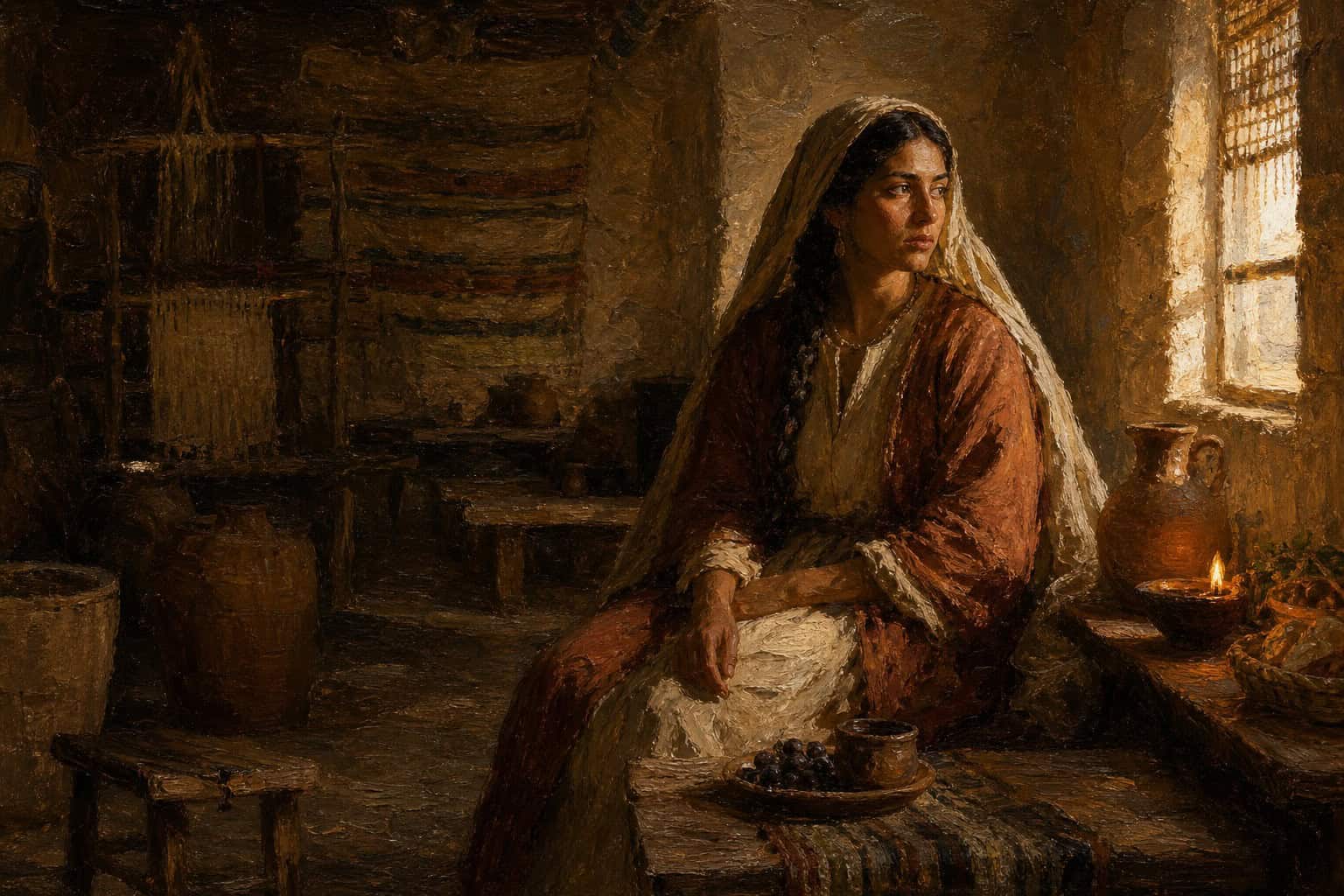
What makes a person invisible? A locked dorm room, a kiss, and a man who mastered the art of vanishing from his own skin.
A Lock Turned, A Shade Drawn
Some men learn to disappear while standing in plain sight. In this passage from Confessions to the Empty Chair, the narrator follows Kerri into her dorm after volleyball practice, a small errand offered as the pretext, and he already knows the shape of what is coming. She closes the door. She turns the lock. She draws the shade against the afternoon and puts on music to fill the quiet. Her scent hangs on the furniture, the sheets, the whole small space, so thick he could name it in the dark. The particulars are ordinary and exact: a room made private, a friend pressing toward more, an errand that was never an errand. But watch what happens to the man inside this room. He recognizes the sequence the way an actor recognizes his cue. Here it comes, he thinks, and the thought carries no heat, only a tired familiarity, the flat recognition of a script he has read many times. His body is present. His body knows its part and will play it well, without hesitation, without a stumble. Yet something in him has already stepped back, already gone to stand outside the scene it is about to perform. This is the first thing to grasp about invisibility. It does not begin when others fail to see us. It begins the moment we refuse to be here, in our own skin, in the only place we are actually standing. He is inside the room, and the truest part of him is not. He has arranged rooms like this more than a dozen times across two years, and each time he has practiced the same quiet withdrawal, the same departure that leaves the body behind like a coat on a chair. The nearness of another body does not shrink the distance in him. It stretches it. The room is small and locked and warm with her, and still he keeps an entire country of open ground between himself and the woman who wants him close. He calls this protection. He tells himself he is guarding his heart, keeping his spirit off-limits, sparing Kerri the darker part of who and what he is. But the man who has stepped outside the scene is not protected by his absence. He is only gone. The whole scene sits early in the chapter’s long descent, before the fuller reckoning arrives, and it hands us the plain, unsettling truth underneath: a person who has learned to go missing from his own life cannot be reached by any love that comes toward him, no matter how near it presses, no matter how it drops the shade and turns the key.
The Skill He Sharpened Until It Cut Him
He has a talent, and he names it to himself without flinching: he can split flesh from feeling. It is not a gift he was born with but one he trained, drawn again and again like a blade over stone until the edge came clean and cold. Kerri never learned it. That is the chasm he sees between them, and it runs deeper than the tidy story he tells about light and dark. He frames it as a difference of morals, hers rigid, his flexible, but the real gap is simpler and worse. She imbues sex with meaning. She cannot make her body move without her heart moving with it. He has taught himself the reverse, to let the body act while the heart stands guard somewhere far off, untouched and untouching, safe behind a wall he raised board by board. He warns her they will stay only friends, that he is not ready for more, and the warning carries a flicker of tenderness before it curdles into something colder. Because the warning is also a boundary marker driven into the ground. It tells her exactly how far she may come and where she must stop. He hides his past with practiced ease, the ones who came before, the whole pattern she cannot see and he will not show. She thinks she is choosing freely. She says she is a big girl and knows what she is doing, and he smirks at the claim and thinks the plain opposite. Here the scene turns cruel in a quiet, interior way that leaves no bruise she can point to. He does not believe her, and he lets it happen anyway. He knows something she does not know, about herself, about him, about what this will cost her, and he keeps that knowing pressed against his chest like a card he will not lay down. What kind of protection withholds the one truth that might actually protect? The older narrator’s shame gathers behind the younger man’s ease, and you feel it filling the room even as the younger man feels nothing. The skill he prized as strength was quietly starving him the whole time. A heart kept off-limits cannot be reached, and a heart that cannot be reached loses, in the same motion, its power to reach. He built the walls to keep pain out. He never noticed they kept everything else out too, the warmth, the meeting of eyes, the chance that a woman might look at him fully and not turn away. He is the most present body in that dorm and the most absent man. The irony he cannot yet name is that his invulnerability is the wound itself. He made himself untouchable, and untouchable turns out to be only another spelling of alone. The blade he honed turned in his own hand, and he did not feel the cut until years had passed.
He Wanted To Fail All Along
One line in his own reflection splits the scene open like a seam giving way: perhaps part of me wanted to fail all along. He had told himself a clean story of protection. He tried to shield his female friends from the carnal part of himself, to keep them unmarked by who and what he was, to spare them contamination. But beneath that story runs a colder current he only half admits, even to himself. When a woman starts with him, he says, it is difficult to refuse, and the difficulty works as a kind of permission he grants himself before the fact. He does not have to choose the sin if he can arrange for it to arrive as something that simply befell him. He can be carried, swept, overtaken, never quite decided. This is the deepest invisibility in the whole passage, deeper than the drawn shade or the guarded heart: he has hidden himself from himself. He calls his ethic a flexible morality, and the phrase is a costume he pulls on to feel taller. Flexibility sounds like wisdom, like a man too knowing for stiff little rules. But the flexibility is fear wearing the clothes of freedom, and the fear is of standing still. He bends his ethics not because he has reasoned past them but because staying in one place, seen and accountable, terrifies him more than the sin does. To imbue sex with meaning, the way Kerri cannot help but do, would mean planting his feet in a single room and being unable to slip out the back of his own body when the moment asked something of him. So he chooses the split instead. He chooses to be a man who is never quite where his own actions are, who watches his hands from a distance and calls it survival. And here the oldest ache in the scene begins to surface through everything else. He believes he is lonely for a woman, or for the version of himself a woman might finally confirm and hand back to him. But the hunger is older and further down than any woman can touch. It is the longing to stand somewhere he can speak a word without strategy, present and undivided, before someone who sees him whole and does not look away. He has never once been in that place. He has spent years making certain no one, not Kerri, not the ones before her, not even God, could stand close enough to require it of him.
The skill we perfect to keep ourselves from harm is the same skill that keeps grace from finding us.
The walls raised against pain become the sealed chamber that shuts mercy out, and only decades later does he begin to hear how quiet it was in there, how long the silence had been building while he mistook it for peace.
The skill we perfect to keep ourselves from harm is the same skill that keeps grace from finding us.
The Country Between Two Bodies
After the lock, the shade, the low music, what remains is distance, the strange widening distance the narrator carries into a room that could not have been smaller. This is the fallout the older self returns to with a level, unflinching gaze. He got what the script promised him. His body performed its part. And nothing closed, nothing joined, nothing crossed the gap. Kerri came toward him wanting nearness, and he met her with a body that agreed while the man who owned it had already walked out. The wreckage is not only what he did to himself. It is what he did to her, and the memoir refuses to let him off that hook or soften the edge. She knew nothing of the ones before. She could not consent to what she could not see, and he made certain she would not see it, hiding the pattern behind a smirk and an easy okay. Her silent trust, her big-girl bravado, her lack of the very skill he had spent years perfecting, all of it made her more open, not less, and he stepped through that openness the way a man walks through a gate someone forgot to latch. The sacred thing violated here is not a rule about bodies. It is the threshold of another person, the holy ground of her hope and her small unspoken hesitation, crossed for the sake of his own momentum. He reads it now and cannot pretend it was mutual in the way that matters. Two people were in the room. Only one of them had already decided how the afternoon would end and chose to say nothing. The loneliness that follows a night like this is a particular kind, not the ache of being unloved, but the emptier ache of a man who arranged, in advance, to be absent from the one place love was held out to him. He carries a hollowness no comfort reaches, because comfort would have to reach the self, and the self was not there to receive it. This is the severe mercy the book keeps circling back to. The isolation is real and raw, and it does not lift with a kind word. It strips him bare. It peels away the scaffold of his sophistication, his flexible morality, his rehearsed calm, and leaves him standing in the dark with the plain truth of what he has done and what he has become. There is no rescue in this stretch of the chapter, no clean turn where he learns his lesson and rises whole. There is only the slow, undeniable revelation that the man who could not be touched had, by the same craft, become the man who could not be found.
Found Only Where He Feared To Stand
What makes a person invisible, then, is not the world’s failure to look. It is a decision, made in advance and renewed a hundred times over, to stand somewhere other than one’s own life. This chapter shows a man who honed that decision until it hardened into instinct, who could enter any room and dissolve inside it, who guarded his heart so well that in the end even he could not locate it. The hardest question the book leaves open is whether such a man can ever be seen again, whether the split can knit, whether flesh and feeling can be sewn back into one presence that stands in a room and does not bolt. It does not answer cheaply. The despair stays raw and un-tidied. There is no moment where he simply learns better and walks out healed. But something quieter moves under the whole scene, and the memoir trusts you to feel it without being told. God does not break into the locked dorm to haul him out. God does not lift the darkness or unmake the sin. God is only near, present in the very afternoon the narrator spent hiding, walking beside the man inside his failure, waiting in the exact place he refused to stand. The longing he mistook for hunger for a woman was, all along, a homesickness for that presence, the ache to be spoken to without strategy, to be seen whole and not turned from. That is the wholeness he could name and never hold, the wide country beyond the small dark room. To read this chapter is to watch a man discover, far too late, that the walls he built for safety were the very thing keeping the sacred locked outside. And it is to feel, beneath his shame, the startling gentleness of a nearness that never once left, even after he had made himself impossible to find. The book does not promise he will be found. It promises only that the One who has always seen him was standing there the whole time, in the dark, unhurried, patient, present in tears he did not yet know how to weep. For anyone who has learned to vanish from their own life to keep from being hurt, this is where the story cuts nearest the bone, and where its strange, difficult hope first draws breath.