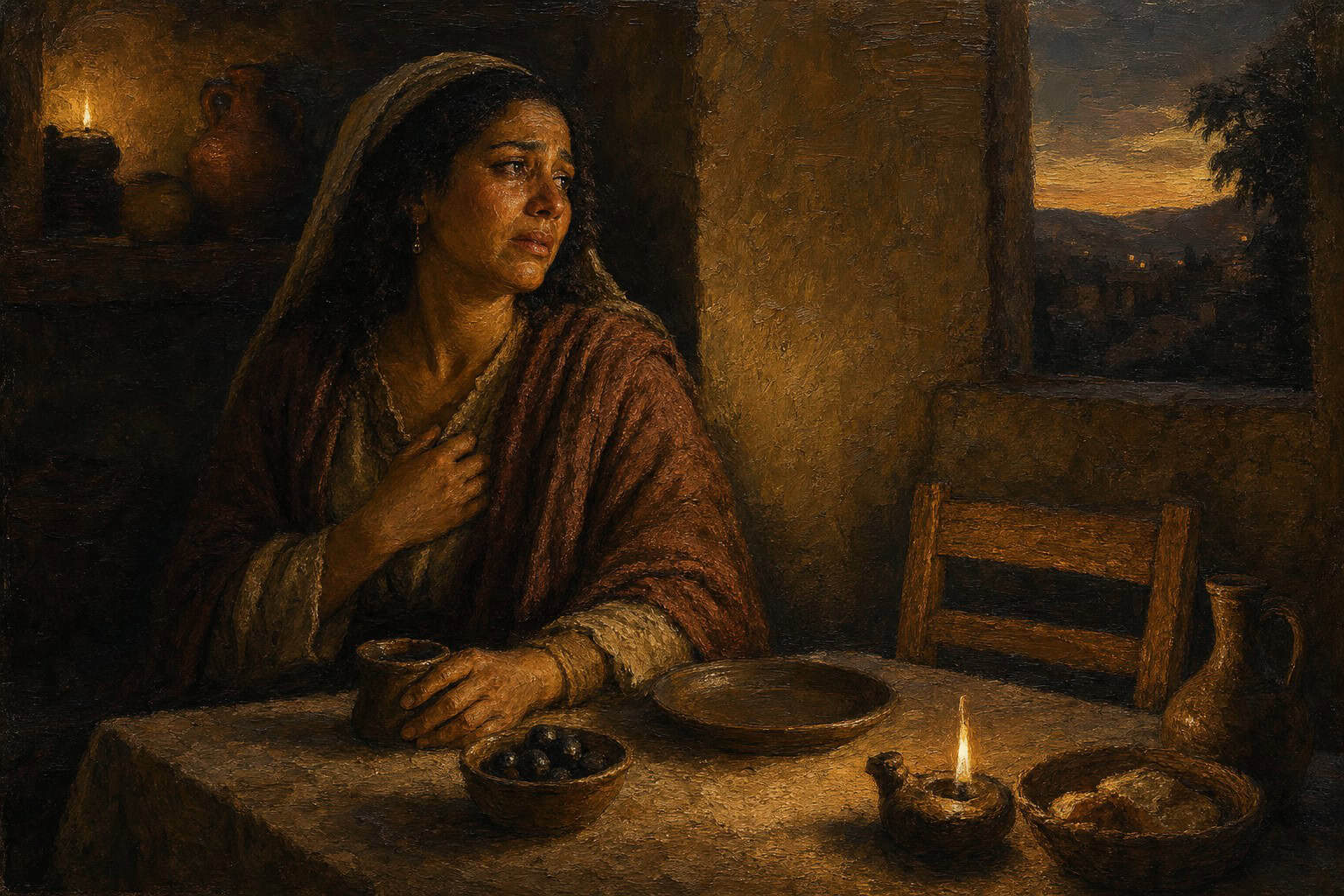
There is an empty chair across from you. What that emptiness asks, and how a wounded soul learns to keep facing it, read through Chapter 8.
The Place Setting for a Guest Who Will Not Come
You set the table. Two plates, two glasses, the fork laid straight because straightness felt like tenderness that night. You lit something small. You straightened the cushion on the chair that was not yours to fill. You rehearsed a face that would look easy and unrehearsed when she finally walked in. Then the chair stayed empty, and it kept staying empty, and the emptiness became a shape you could almost put your hand on. This is the ache underneath your search: there is an empty chair, and it is not neutral, and it does not sit quietly. It watches you eat. In Chapter 8 of Confessions to the Empty Chair, Anthony knows this room from the inside. He stages a small romance for Jane, a meal prepared, an offering arranged, care made visible in warm plates and careful placement. He wants the objects on the table to say what his mouth is too afraid to say out loud. But the woman he tends is not really present. Her body will lie in the bed. Her scent will stay on the sheets after she has turned away. And still the person he longs for keeps her distance, dissolved into a silence he cannot cross even under one roof. You learn this fast, and it is a bruising lesson. The empty chair is rarely about someone buried in the ground. More often it is about someone still breathing who has quietly pulled back the one part of themselves you needed most. You can prepare everything. You can perform love without a single wrong step. You can play the patient host of a marriage that was never yours to host. And the chair answers you with nothing at all. The cruelest emptiness is the one that keeps its shape, the hollow that still remembers the weight of a face you knew. Anthony lowers himself into this before he has words for it, and so do you. The question you typed into the search bar was never really about a piece of furniture. It was about how you have arranged your entire life around a place a certain person was supposed to occupy. You cook for it. You rehearse conversations at it. You catch your own eyes drifting toward it in the middle of a sentence, as if she might have slipped in when you looked away. And she never sits down across from you the way you built the whole evening to make possible. The candle burns lower. The food loses its heat. The chair holds its stubborn, patient, terrible shape, and you go on setting it.
Playing Husband to a Woman Who Never Married You
Watch what he does with the emptiness, because you have done the same thing with your hands. He does not sit still and let the grief come. He gets busy. He becomes useful. He slides into the role of the caretaker, the steady one, the man who fetches and tends and manages the small machinery of a shared life, the pretend husband to a woman who never chose him for the part. This is the trap of the empty chair. It is so unbearable to face straight on that you will do almost anything to keep your hands moving and your eyes lowered. Cooking becomes a way to avoid confessing. The shared cigarette becomes its own small rite, a matched inhale and exhale that mimics closeness while the two of you drift apart with every breath you take together. You light one for her and one for yourself, and for a moment the gesture feels like a kind of communion, two people bent toward the same ember. It is not communion. It is a punctuation mark at the end of a sentence you have already lost. Anthony crowds the space with performance because performance is safer than freedom. To stand there empty-handed and say plainly that he loves her and she does not love him back is a terror worse than any errand. So he does not say it. He arranges instead. He tends. When she withdraws into herself, he does not weep. He studies her. He gathers evidence. He watches for signs and reads her silences like a chart, turning his aching heart into a clipboard held between them. It feels like control. It is only distance dressed up as attention. And here is the hard question he turns on himself, the one you have to let sit unanswered in your own chest. Was any of that care actually for her? Or was the meal, the tending, the constant watching, all a way of pressing her toward a debt she never agreed to owe, love handed back in exchange for service rendered? The prepared meal gets waved away. The staging gets refused. She will not become the object his need has shaped her into, not even under the gentle disguise of a man being good to her. The empty chair, it turns out, sometimes stays empty on purpose, because the person will not consent to be furniture for your longing. That refusal cuts. It is also, though he cannot yet see it, an act of mercy toward them both. The tension gathers right here, in the cold plate and the ignored candle. Everything he does to fill the emptiness only makes the emptiness louder. Every performed intimacy exposes the real absence underneath it. No one has ever hosted their way out of being unloved.
The Homesickness Underneath the Loneliness
Then it turns, and the turn arrives quieter than you brace for. Sitting across from that seat he cannot fill, Anthony begins to understand that he was never only lonely for her. The empty chair had been pointing past her all along. He thought he wanted a woman, or wanted some version of himself she might finally confirm, some proof that he was a man worth staying for. But running beneath that ache was an older homesickness, not for Jane, not for any of the faces he had gathered, but for the One before whom a single word can be spoken without strategy, without arrangement, without a table set to persuade. That is what the chair had been guarding. Every empty seat in your life is a rehearsal for the deepest exile there is, the separation from the place where you could be fully known and still not be left. You have been trying to make finite people sit in an infinite chair. No wonder they keep rising and walking out. No wonder the plates keep going cold in front of you. The chair was never going to hold the person you set it for, because the hunger it uncovers is larger than any living body could satisfy. This is not a comfort that wipes the pain away. It does not fill the chair. God does not stroll into the dining room and pull out the seat and settle in across from him. What happens is stranger and truer than that. He is already there, present in the very emptiness, near in the tears cried over the wrong absence, walking beside the narrator inside the exact loneliness he tried to cure with usefulness. The despair does not lift off him. It is accompanied. An empty chair is not the absence of a person; it is the presence of everything you never finished saying to them. Once you have seen that, you cannot unsee it. The chair stops being a wound to plug and becomes a question you have to face with your hands open. Who did you truly want in that seat? What were you asking them to be, that no human shoulders were built to carry? Anthony sits with this and does not look away, and that is the whole movement of the chapter, not the solving of the emptiness but the finally facing of it, straight on, instead of cooking and tending and diagnosing and performing his way around its cold edges. The chair holds still. He holds still. The candle throws his own shadow onto the wall behind the empty place, and something honest can at last begin.
An empty chair is not the absence of a person; it is the presence of everything you never finished saying to them.
What the Cold Plates Were Really Saying
The fallout is not dramatic. It is domestic, which is worse. The meal he prepared goes untouched or is brushed to the side of the table. The cold, glassy distance she keeps around herself, all sharp mind and withheld warmth, does not soften into tenderness because he asked it to with a fork laid straight. Her body stays in the bed and her real self stays somewhere he cannot reach, leaving only her scent on the pillow as evidence that a soul was here and is already slipping out the far side of the room. This is what the empty chair leaves you with. Traces. Not the person, but the marks the person left behind them. The smell that lingers. The dent still pressed into the cushion. The little rituals your body keeps performing out of pure habit long after the reason for them has gone. Anthony has to sit in a home that is not a home, playing a part that gives nothing back, and the terrible clarity of it is that he chose this seat himself. He walked into those rooms already decided. He knew, before he ever lit the burner, that the whole evening was theater. The self-questioning turns merciless here, and you should let it turn merciless in you as well. What was the care worth if it was aimed at a return? What did he refuse to see about her, because seeing it clearly would have ended the performance and sent him home alone? He wanted to be the good caretaker more than he wanted the truth, because the truth was that she did not want what he was holding out, and the performance let him keep pretending the ending was still unwritten. The chair let him keep hoping against the plain evidence in front of him. That is exactly why we love empty chairs. They stay open. Nothing has been finally refused yet, not out loud. A filled chair can look you in the eye and say no. An empty one only ever murmurs maybe, maybe, come back and try again tomorrow night. So we set the table one more time. We rehearse the conversation we mean to have. We keep the seat warm for someone who has already walked out of the building of our life and is not coming back up the stairs. The chapter does not rescue him from any of this. There is no clean exit, no lesson tied off with a ribbon and set beside the plate. There is only a man learning, slowly and against his own will, that the emptiness he keeps trying to feed is the truest thing in the room, more real than his performance, more honest than his careful tending, and finally, in a way he could never have engineered on his own, the single opening through which grace could reach him at all.
Learning to Eat Alone Without Lying About It
So what do you do with the empty chair across from you tonight? Not what Anthony wanted to do. Not the cooking, the tending, the frantic usefulness that keeps your eyes safely off the seat and busy on the stove. The strange counsel this chapter offers, by living it rather than preaching it, is to stop trying to fill the chair and start letting it teach you something. Sit down. Eat your meal. Let the other place stay empty and refuse to perform for the ghost of whoever was supposed to sit there. Ask the harder questions instead, the ones that cost you. Who did you truly want in that chair? Was it a person, or was it what you needed that person to prove about you? How much of your love was a payment you quietly expected back, with interest? These are the questions Anthony will not soften, and they are the reason Confessions to the Empty Chair reads less like a memoir than like a mirror held at an angle you did not choose and cannot quite escape. The book will not fill your chair for you. It does something more useful and more painful. It helps you see whose absence you are actually mourning, and how many of your empty chairs point past their obvious occupants toward an older, deeper exile you have been carrying since long before you set this particular table. The relief, when it comes, is not that the chair gets filled at last. It is that you are no longer alone in the room with it. There is a Presence in the emptiness itself, quiet, uninvited by any of your strategies, walking beside you in the exact loneliness you worked so hard to disguise as tenderness. He does not take the seat and end your grief with a single clean gesture. He sits down inside the grief with you and stays. That is not the ending you were hoping for when you lit the candle. It may be the one you needed all along. Somewhere in the nighttime streets he once walked, the corners still remember who he was when he tried to fill these chairs with the wrong people, and those memories are not only shame. They are testimony, waiting patiently to tell him the truth about his own hunger. This chapter is where that testimony first begins to be heard over the sound of his own arranging. If you have an empty chair, and you are worn out from cooking for it, this is the book that will finally let you sit down across from the hollow it holds and simply, honestly, stay.