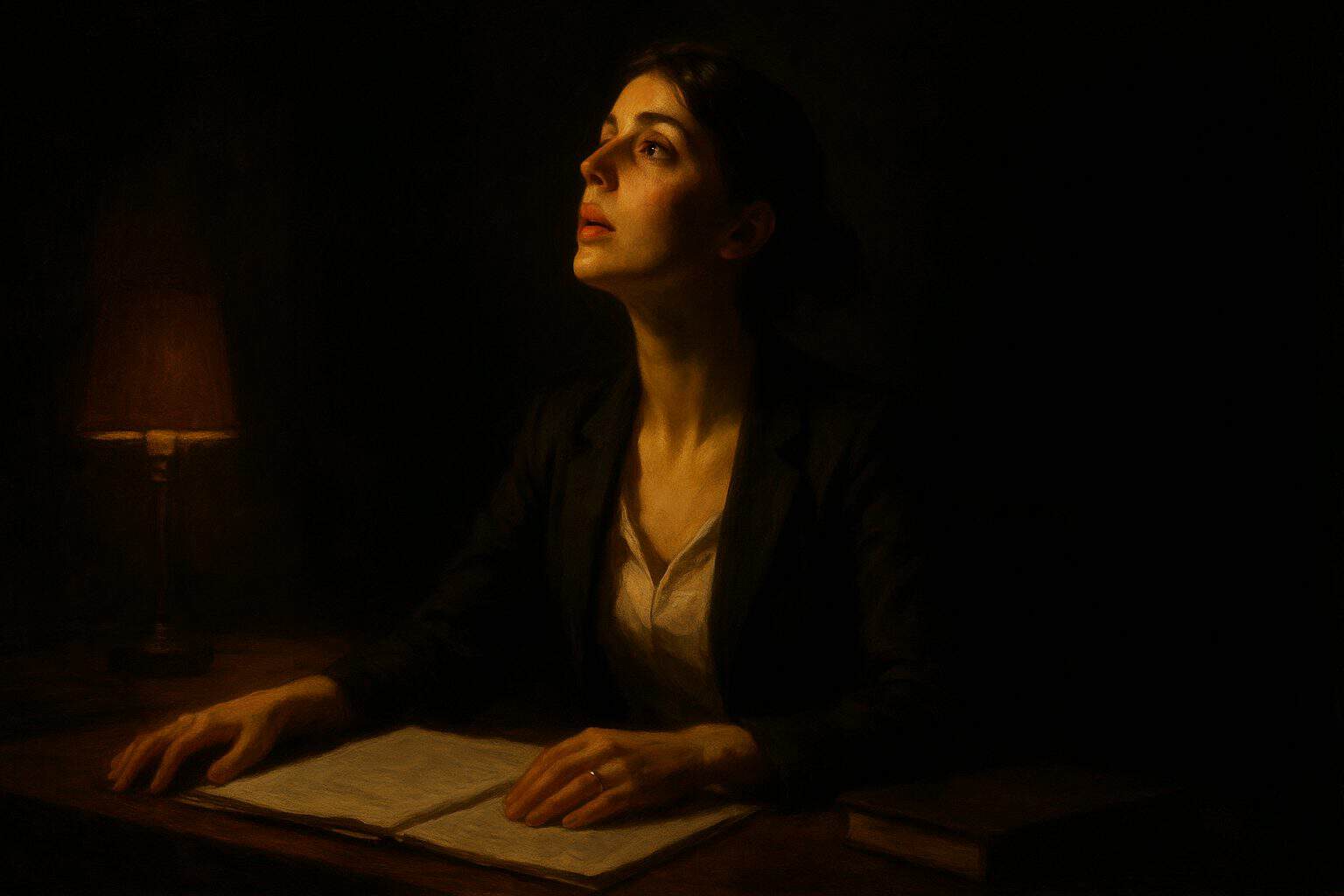
Where desire meets its own impossibility, something ancient stirs awake.
The name arrives first as a quality of attention—not the psychologist whose books line therapists’ shelves, but something more primary that his work merely pointed toward. To say “Rollo May” is to invoke a particular way consciousness discovers itself through the very intensity of its own reaching. It names that moment when desire, pressed against its limits, transforms into something it never intended to become.
The Architecture of Longing
Watch how it happens. A young professional sits at their desk, surrounded by the familiar apparatus of achievement—screens glowing with metrics, calendars dense with meetings, the subtle hierarchies that organize modern work. Everything functions. Everything proceeds according to plan. Yet something pulls, wordless and insistent, toward what cannot be named or placed within this ordered world.
This pull does not arrive as thought. It precedes thought, dwelling in the body as a kind of restlessness that no amount of activity can discharge. The hands that type grow heavy with a fatigue that sleep cannot cure. The eyes that scan documents begin searching for something between the lines, something that was never written there. As Adoré notes, “desire is not meant to be an end in itself… but instead requires an object outside of itself, ‘knowing,’ to pursue in order to actualize its purpose.”
But here emerges the first innocence: the seeker does not yet know what they seek. They only know this reaching, this leaning forward into empty space where something should be but isn’t. The intensity builds precisely because it has no proper object. Every book opened, every conversation initiated, every new experience pursued—each becomes a question the person didn’t know they were asking.
The Contamination of Drives
The body knows things the mind hasn’t learned to think. In the midst of ordinary interaction—a colleague describing their weekend, a friend sharing their troubles—something shifts. The quality of listening changes. What was once social courtesy becomes genuine hunger, not for the content of what’s being said, but for something moving underneath the words.
“Their human consciousness ‘contaminates’ their animal drives and changes the meaning behind intimate physical expression.”
This contamination works both ways. The simplest appetites—hunger, fatigue, desire—begin carrying messages they were never meant to bear. A meal becomes an interrogation of satisfaction itself. Sleep transforms into a nightly encounter with questions that daylight keeps at bay. Physical intimacy opens onto metaphysical territory where, as Adoré observes, “touch becomes a separate dialogue… culminating in sensuality: the point in sex where the spirit of each resonates in the flesh.”
The innocent intensity of Rollo May emerges precisely here, in this confusion of registers where body and spirit refuse their conventional boundaries. The person discovering this in themselves often feels they’re going slightly mad. They’re not. They’re simply experiencing what happens when consciousness awakens to its own depths—when what seemed like simple biological life reveals itself as shot through with significance that biology alone cannot contain.
The Grammar of Resistance
Most people, confronted with this uprising of intensity, reach for familiar maps. They might diagnose themselves: depression, anxiety, midlife crisis. They might seek solutions: therapy, meditation, a change of scene. But Rollo May names something more radical—the moment when consciousness recognizes that its very structure is the question.
“The natural attitude for most people caught up in the familiar,” Adoré writes, “is to dismiss contrary or different systems, to engage in an ego competition.” But the one caught in this particular intensity can no longer maintain such dismissals. Every system becomes potentially revelatory. Every perspective might hold the key. This is not relativism but its opposite—the desperate certainty that truth exists, coupled with radical uncertainty about where it might be found.
Watch them in a bookstore, running fingers along spines, pulling volumes at random. Philosophy, psychology, poetry, theology—categories cease to matter. They’re not shopping for ideas but listening for resonance, for that subtle vibration that says yes, here, this direction. They’ve become what Merleau-Ponty might recognize as pure interrogation, a question mark made flesh.
The Threshold of Permission
Then comes the turn, subtle but decisive. The intensity that had been experienced as affliction begins revealing itself as invitation. But invitation to what? Not to any particular practice or belief, but to a different mode of being altogether. As Adoré discovered, “Despite his power and majesty, the King of the Universe did not act where He was not invited; He did not betray or act against the free will of His creation.”
This is Rollo May’s second innocence—the recognition that the very intensity that seemed to imprison actually awaits permission to transform. The person must choose their own becoming. No external authority can make this choice for them. No system, however comprehensive, can substitute for the personal act of saying yes to what seeks to emerge.
But permission for what, exactly? Here language fails in the most instructive way. The person standing at this threshold knows only that something in them wants to live more fully, more authentically, more intensely than their current arrangements allow. They don’t know what this means. They can’t know—not yet. Knowledge will come only through the living.
The Descent That Means
The one who says yes to their own intensity often finds, paradoxically, that the first movement is downward. Dreams that had sustained them lose their appeal. Relationships that had seemed solid reveal their fragility. The competencies that had defined them begin to feel like costumes worn too long.
“Do not resent the descent,” Adoré counsels, “it is where the ascent finds its meaning and purpose.”
This descent is not depression, though it may wear depression’s mask. It’s the necessary dissolution that precedes new formation. The person discovering Rollo May in themselves learns that intensity, followed honestly, leads first through a kind of dying—not physical death, but the death of who they thought they were, who they had agreed to be.
“All human beings perceive through their limits, with their limits, and because of their limits.”
Yet these very limits, once experienced as prison walls, begin revealing themselves as the necessary structure through which transformation becomes possible. The executive who can no longer pretend to care about quarterly reports doesn’t simply quit—they discover through their inability to continue pretending what genuine care might actually mean. The parent who can no longer perform the expected enthusiasms doesn’t abandon their children—they find, in their very failure to perform, a more honest presence.
The Language Before Language
In the depths of this process, something unexpected emerges. The intensity that had seemed so personal, so isolated in its particularity, begins recognizing itself elsewhere. Not in obvious places—not in self-help books or spiritual teachings that name what they’re selling—but in unexpected encounters with art, nature, strangers.
A piece of music played on the radio suddenly splits them open. A tree glimpsed from a window speaks volumes. A passage in an old book lights up as if written in flame. These are not metaphors. They’re experiences of recognition where what had seemed external reveals itself as intimate, where what had seemed other shows itself as self.
“For the passions speak their own language,” Adoré observes, “and create the fodder that reason must later digest.” But this language of passion precedes the divisions between inner and outer, self and world. It’s the language of resonance itself, where meaning doesn’t transfer from one place to another but emerges in the between-space of encounter.
The Community of Intensity
The one living through Rollo May eventually discovers they’re not alone. Not because they find others going through the same thing—though they might—but because the intensity itself connects them to a tradition they didn’t know existed. Every genuine artist knows this intensity. Every authentic mystic has walked this path. Every person who has refused to let their life become mere routine has faced these same impossibilities.
This is not consolation but recognition. The books that suddenly make sense—Kierkegaard’s fear and trembling, Rilke’s angels, Jung’s individuation—these are not instructions but testimonies. Others have been here. Others have survived the passage. More importantly, others have discovered that the passage itself is the destination, that the intensity doesn’t resolve into calm but deepens into capacity.
“Biological reality and material causality are accepted as facticity,” Adoré writes, “and set the horizon within which meaning, openness, consciousness, and perception appear.” The one who has integrated their Rollo May doesn’t transcend their limits but inhabits them differently. They still go to work, still pay bills, still navigate the ordinary frustrations of embodied life. But now these activities occur within a larger field of meaning that transforms them without changing their outer form.
The Gift of Unrest
What does Rollo May name, finally? Not a problem to be solved but a gift to be received—the gift of divine unrest, of sacred dissatisfaction, of the intensity that won’t let us sleep through our own lives. It names the part of consciousness that refuses reduction to biological drives or social roles, that insists on more without being able to specify what more might mean.
This intensity appears innocent because it doesn’t know what it wants—it only knows that what’s currently available isn’t enough. It appears as suffering because it disrupts every equilibrium, questions every satisfaction, renders every achievement provisional. Yet this very disruption is its gift. Through it, consciousness discovers its own depths, its own possibilities, its own authentic direction.
The person who has lived through their Rollo May—who has followed their intensity through dissolution into reformation—doesn’t become peaceful in any conventional sense. They become capable of sustaining greater tensions, of holding more complex questions, of living more fully in the space between what is and what might be. They’ve learned that intensity itself is a form of guidance, that the very feeling of impossibility points toward untapped possibility.
“My mind constituted the only territory I truly controlled,” Adoré reflects, “and I refused to let it be infected by secondhand haze.” This is the ultimate teaching of Rollo May: that our intensity is our own, that no one else can live it for us, that we must choose whether to follow it into unknown territory or let it atrophy into mere neurosis.
The Return
The journey through Rollo May doesn’t end in some other place. It returns us to exactly where we started—but now everything has changed. The desk remains a desk, but the one sitting at it has discovered dimensions of experience that no job description could contain. The relationships continue, but now they unfold within a field of possibility that neither person fully controls.
This is perhaps the strangest innocence of all—the discovery that transformation doesn’t require leaving ordinary life behind. Instead, it reveals the extraordinary that was always already present, waiting to be recognized, waiting to be lived. The intensity doesn’t disappear but becomes integrated, a permanent resident in consciousness that keeps us honest, keeps us searching, keeps us alive to what each moment might reveal.
The one who has integrated their Rollo May moves through the world with a particular quality of attention—alert to resonance, sensitive to the uprising of meaning, ready for the next invitation to become more fully who they are. They’ve learned that intensity itself is a form of prayer, that longing is how the infinite calls to us through our own hearts, that the very impossibility of our desires points toward possibilities we couldn’t have imagined when the journey began.