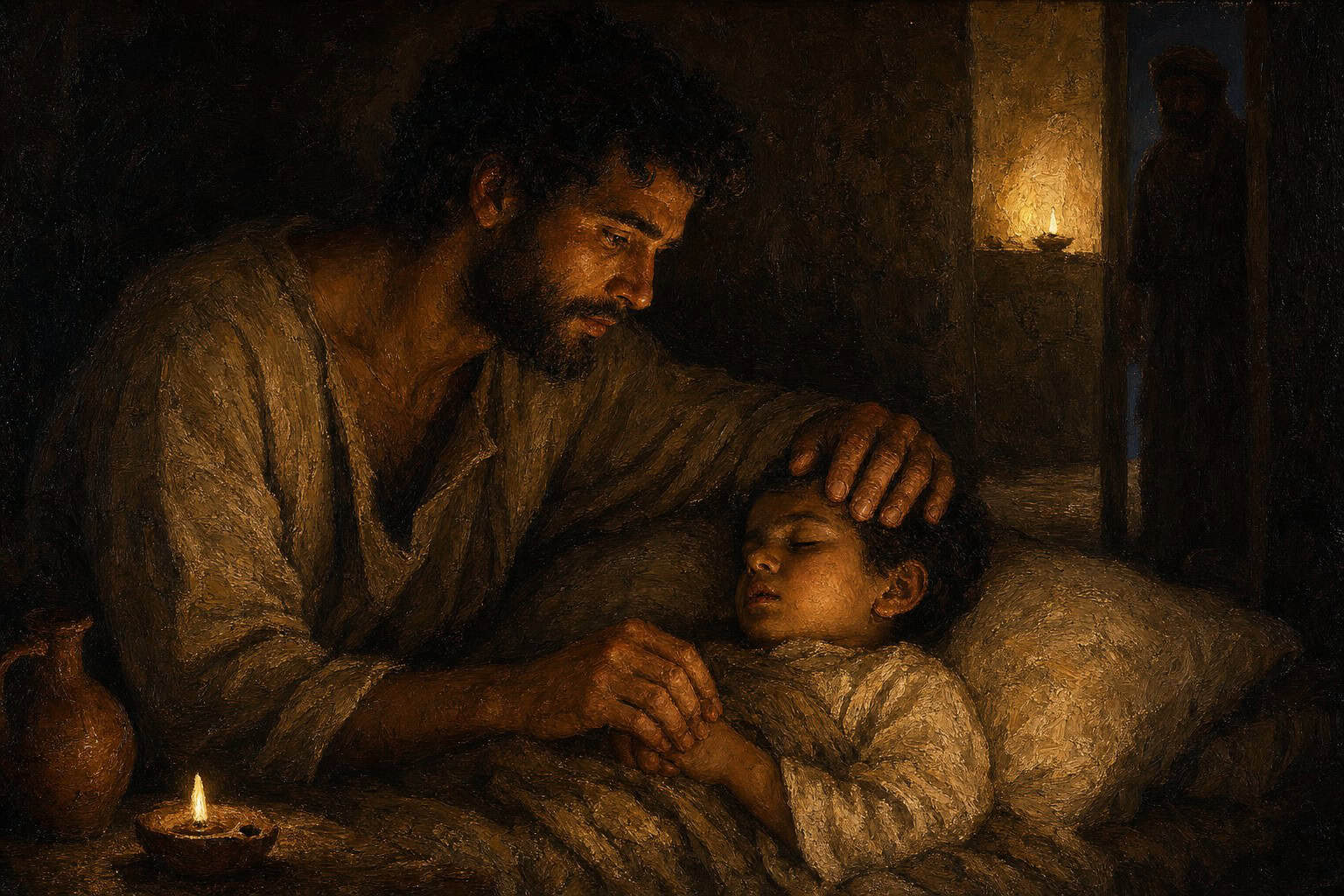
You want to know how to handle childhood trauma. The honest answer is not erasure but endurance—and the strange nearness of God inside the dark.
The Click of the Thermostat
You were too small to name it, and that is the first cruelty. The whole thing survives now as a splinter of sound and skin: the click of the thermostat, then cool air moving over a wetness that was new and shameful against you. This is where I begin, writing back to you across almost fifty years, because this is where you began. Not at your baptism, though that happened and was real. Not at your first word or your first prayer, but here, in a room you cannot fully see, at the hands of someone trusted to keep you. I want you to understand something the child in you could never say out loud: what was done was a kind of ritual, and rituals leave a mark that does not wash off. It contaminated something. It set a chord ringing in you that has never gone quiet in all the years since. You will spend decades trying to trace that ring to a source, and you will fail, because the wound came before your memory could hold it. All you keep are fragments—the temperature of the air, the sudden damp, the smallness of your own body under the covers. People will ask you, later, what exactly happened, and you will have almost nothing to give them but sensation. That is the strange fact of the earliest harm: the flesh remembers what the mind cannot. Your skin became a witness your words could never be. You became, without consent, a place where something invisible pressed in and stayed. There is a vertigo in this that I feel even now, writing it—the sense of standing at the very edge of your own life and seeing that the floor was never solid, that the ground gave way before you could walk on it. And here is the part I need you to hear, tender as I can make it: it was not your fault, and it was not chosen, and it is not a story you can simply set down. It is the lens now. You will read every year of your life through it. Even your faith, which comes later and comes real, will be seen through this darkness rather than around it. The past does not stay behind you like a closed room; it walks with you into every morning, pressing on the present as if it were still happening. I am not writing to promise you it lifts. I am writing to sit beside you in the cold you cannot name and tell you the truth—that this small, contaminated moment is where a whole life of wrestling will begin, and that you were not abandoned in it, though it will take you decades to believe those words.
Two Musics Refusing to Resolve
Something in you started to split that night, and you have never fully understood it. From then on, two strains ran under your days at once. One was slow and deep and beautiful, though its beauty came mostly from sorrow—the sound of a world that God still loved even in its grief. The other was loud, vain, endlessly repeated, a few notes brayed over and over like trumpets that could not find a tune. Both were you. That is the thing you kept trying to escape and never could. You wanted to be one clean melody. You wanted the dark strain gone so the other could sing without interference. I remember how you prayed for that, how you begged God to simply reach in and pull the wrong note out of you. He did not. He never has. And the dissonance held on despite everything you threw at it: the Catholic upbringing that should have sealed you shut, the books you read to grow your mind and widen your world, the love that came slowly through people who chose you. None of it silenced the second music. What I know now, that you could not, is that the two were never meant to be separated. They were meant to be woven together. The triumphant, hateful notes of the loud strain kept getting taken up—somehow, past all your understanding—into the pattern of the sorrowful one, folded into something larger and stranger than you could hear from inside it. You experienced this only as war. You felt it as vigilance that never rested, as a body braced for a cold that had already come and might come again at any hour. You lived tensed, like a man who has heard a noise in the house and cannot lie back down. Peace hung on other people like a coat cut to fit them exactly. On you it never sat right; it bunched at the shoulders and pulled at the seams and slid off the moment you relaxed. You began to suspect peace was not something you were built for, and the suspicion aged you before your time. I want to tell you that the weariness is not weakness. The weariness is the honest weight of carrying two musics that will not agree, of standing in the friction between what you lived and what the world calls normal and rested and fine. You are always waiting—that is the shape of your days, a long waiting for a rest that keeps not arriving, like a traveler stuck one more night in a poor and noisy inn. Do not despise yourself for being tired. You were made to hold a dissonance most people never have to hear, and holding it is its own kind of faithfulness, even on the nights when it sounds like nothing but noise.
The Grotesque Mockery in the Dark
I have to tell you about the moment you have spent your life trying to forget, though I will not linger where it wounds. The thing that visited you did not come with grandeur. It did not announce itself as some vast and dignified evil that a child might at least fear with dignity. It came, at its worst, as mockery—something childish and grotesque, a rudeness aimed at a boy, a defacing of the image of God stamped in you. That is the part that has always felt unbearable, isn’t it? Not that evil was strong, but that it was so small and so proud, so willing to stoop to a raspberry blown in the dark at a boy who could not defend himself and could not run. You lay there in a silence that walled you off from everyone. Down the hall, your parents lived in an ordinary world—warm lamplight, dull safe murmurs, blankets and clocks—with no idea of the terror occupying the same house, the same handful of feet of air. That gap has haunted you more than the visitation itself. To be a few walls away from love and utterly alone inside your own body: this is a solitude nothing later ever fully cured. And still I need you to see what took me half a lifetime to see. The absurdity of that mockery is also its poverty. Evil defaced you, yes, but it could not create you, could not unmake the image it was mocking. The very fact that it had to stoop to a taunt reveals how little it actually held in its hands. It could contaminate. It could not annihilate. You survived it, small as you were, breath by breath in the dark, and you are reading these words because the God whose image you carry did not let it have the last note. Here is the truth I would carve into the wall of that room if I could reach back through the years: *The oldest wounds do not live in memory; they live in the body, and the body keeps waiting for the cold to come again.* You are not crazy for flinching at things you cannot explain. You are a boy whose flesh became a receiver for something it should never have had to register, and the signal never fully stopped. It comes as a chill without a draft, a ringing without a sound, a stillness that pins your limbs. Knowing this will not free you. But it will stop you from thinking the fault is yours. Handling childhood trauma does not begin with fixing it. It begins with naming, plainly and without shame, exactly what was done to you and refusing to carry the blame that belongs to someone else.
The oldest wounds do not live in memory; they live in the body, and the body keeps waiting for the cold to come again.
Lacing the Gloves Each Morning
So what do you do with a darkness that will not lift? This is the question you will carry into every chapel and every empty hour of your life. You wanted deliverance. You imagined a morning you would wake and find yourself finally clean, the chord dissolved, the war over, the room warm at last. I have to be honest with you, because you deserve honesty more than comfort: that morning does not come. God, who has the power to remove it, does not remove it. I know how that lands. It lands like abandonment. It felt to you like being ignored by the one Being who could end the fight with a single word and simply chose not to say it. But hear me now with everything I have learned since. His refusal was not His absence. He willed you to wrestle—not because He is cruel, but because the wrestling is how you become who you actually are, muscle laid down in the fight and nowhere else. The strength in your mind and spirit was forged in the struggle, not spared it. Every morning you will lace the gloves again. Every morning you will wait for Him to make things new, and every morning the darkness will still be standing in the corner where it stood the night before. This looks like defeat and is not. It is a slower, harder mercy than rescue would have been, a mercy that takes years to recognize as mercy at all. And here is what I did not understand as a young man and can barely say now without breaking: He was in the ring with you the whole time. Not watching from a safe distance up in some quiet heaven. Down in the sweat and the tears and even in your sin, keeping pace with you through the very thing you begged Him to remove. The night itself was doing a work you could not see—stripping you of easy comforts, emptying you out, hollowing a place where a light you had no words for could someday stand. The consolation was rare—a moment here, a breaking-through there, unmistakable and then gone—but the accompaniment was constant. You mistook the silence for absence when it was actually presence keeping step in the dark. There were beautiful realities that pierced the gloom: the embrace you felt when you least deserved it, the memory of times He made Himself plainly known, the two children you helped bring into being, the patient love of a wife who chose you knowing what you were. These did not erase the dark. Nothing erased the dark. They taught your eyes to see through it. That is the whole difference. Do not wait to be handed a life without shadow. Learn to see in the shadow. The light is real; it simply comes as a lamp carried down into the cave, not as the roof of the cave torn off to let in the noon.
Bread Made From the Groaning
There is one last thing I want to give you, and it is the strangest of all. All those years you spent groaning privately in empty chapels, ashamed of the darkness, convinced it made you a wretch unfit for the God you loved—all of that was becoming something without your knowing it. The wound you thought disqualified you was becoming bread. You will one day take what you whispered where no one could hear and say it out loud, in public, on a page anyone can open. It will terrify you. It will feel like exposure, like standing in that cold room again with the covers pulled back and the whole world watching. But it will feed people. Others carry the same inexplicable darkness from their earliest years, the same sensory fragments they cannot trace to any source, the same private conviction that they alone are broken in this particular way. When you finally speak, they will recognize themselves in your words and know they are not alone in the fight. Your confession becomes their communion. This is the meaning of the wound you never chose: it was given a purpose you could not have designed and would never have asked for, wrung out of the very thing you hated. I am not tying this off neatly, because it does not tie off. You will still be tired. You will still lace the gloves before the sun is up. The two musics will still refuse to resolve into one clean line, and some nights the loud, vain strain will nearly drown the beautiful one out of your hearing altogether. But it never quite does. Its most triumphant notes keep getting caught and woven into the sorrowful pattern, and the pattern is always larger than the noise. That is your life. That is the shape of a soul marked in childhood and kept, against every reasonable odds, by a God who walks in the dark rather than switching on the light. And notice the direction it all runs: the past that branded you keeps feeding forward, the wound becoming food, the groan becoming speech, the fear becoming a hand held out to a stranger you will never meet. If you are reading this because you typed your own grief into a machine at some late hour, asking how to handle what was done to you when you were small—I have nothing tidy to sell you. I can only tell you what I would tell the boy I was: name it truly, refuse the blame that is not yours, stop waiting for the cold to lift, and start learning to see the lamp already burning beside you in the room. Confessions to the Empty Chair begins in that room, in that cold, with that first click of the thermostat. It goes on because he did. So can you.