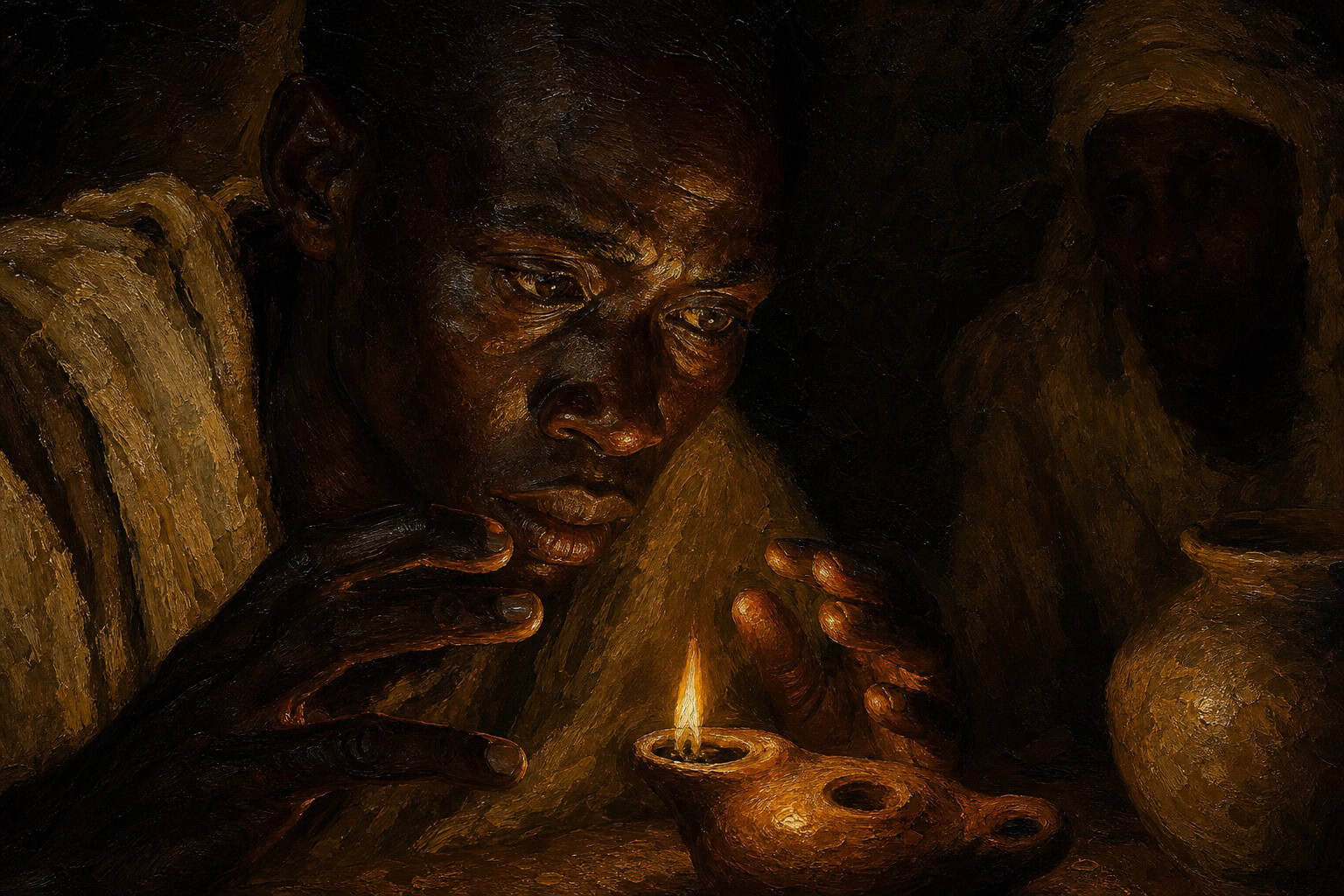
Searching for lonely people to talk to online? A confession about the hunger for real conversation, and the cost of hunting connection like prey.
Blue Light on a Face at Three in the Morning
You typed the words late, when the house had gone cold and quiet and your thumb kept moving on its own. Somewhere out there was a lonely person to talk to, and you wanted to be the one who found them first. I know the hour you did this, because I lived it in a form you would recognize. Back then you carried a whole private system, a set of rules you called your own law, and you read a person the way a farmer reads clouds before the rain comes. You watched the mouth for its small permissions, the little nod at the corner of the lips that told you to keep speaking. You watched the eyes for their retreat. You had already learned that a woman lost inside the light of her own phone, sitting near you in body but gone somewhere else entirely, was giving you the plainest answer a person can give. That glow was a closed door, and you named it correctly, and you were proud of how quickly you could read it. What you could not name yet was your own glow. You sat in the very same blue light, present to no one, casting into a sea of strangers, and you called it a search for connection when it was closer to a hunger you had never once been able to feed. You told yourself you were looking for someone lonely. You were the lonely one. The whole apparatus you had built, the reading of a lean, a curt reply, a hand that mapped where your own hand was allowed to rest, all of it was scaffolding around a boy who had been hurt through his skin and never again wanted to guess wrong. So you made a discipline of watching. You became, in your own words, an observer, a man who never moved first. There was a real dignity in that restraint, and I will not stand here and mock you for it, because I understand exactly what it cost you to build it. But a dignity made entirely of watching slowly becomes its own kind of confinement. You watched so that you would never be refused. You read the whole room so that you would never bleed in front of anyone. And here you are again, older some nights, younger others, scanning the dark for a stranger whose sadness might fit the shape of yours, half believing the screen will finally hand back what a screen once took. I want to sit down beside you in that light before you press send. I want you to feel, plainly, how the wanting and the fear are one thing wearing two different coats.
Reading Reply Times Like a Body That Isn’t There
You called yourself a careful reader of souls, and the phrase still makes me flinch and love you in the same breath. You demanded that the other person offer the first signal, always. You would not initiate touch, would not initiate the risk, because somewhere along the way you had decided that anything you began could not truly count as consent. There was a hard truth buried in that. Your own history had branded touch as a high-stakes language, the same channel through which both violation and something like grace had once poured into you. So you built a careful faith around waiting. You received a hand laid on your hand as permission to stay near, never as license to advance an inch further. When you were unsure, you asked out loud. In a world of men who leaned their bodies forward straight through a woman’s silent no, you had at least trained yourself to stop, to feel the small resistance and honor it. But look at what the waiting became online, where there are no hands, no laughter, no light punch on the arm to read. Here the entire vocabulary of the body is stripped away. You could not watch a shoulder turn, so you watched a reply time instead. A message left unanswered became your closed door, and you refreshed and refreshed, and every stretch of silence pressed on your sternum like a slow thumb. You had sworn, in your law, never to invest more in another than they offered you. Never, you said, and you meant it like a vow. Yet the screen made a small liar of you, because you poured everything into the waiting itself, into the gray bubble that flickered up to say someone was typing and then vanished. You wanted a soul rare enough to hold heavenly things and keep them quiet, to treasure something and not immediately spend it. You were right that such souls are rare. But you went hunting for them in the one place where surfaces breed the fastest, where every person performs and almost no one is actually present, and then you grieved the shallowness as though it had ambushed you. Let me ask you gently, the way no one asked me. Were you seeking a person, or were you seeking proof that you were choosable at all? Were you offering real conversation, or running a quiet diagnostic to learn who was safe enough to let close without being torn open again? Cold hands cannot warm anyone, no matter how skilled. And a soul you approach only to measure will feel the cold coming off you, even through a screen, even in the kindest words. You were not wrong to be careful. You were wrong to believe carefulness was the same thing as love.
The Sorting That Left You Alone in the Room
Here is the turn you could not possibly see from the inside of it. The great sorting you were so quietly proud of, the one that divided people into those with an inner sanctuary and those who were only dull, common surfaces, was doing the exact opposite of what you believed. You thought it guarded the sacred. It was starving you. Every conversation became an examination the other person had to pass before you would let yourself be reached. Every lonely stranger you found in the dark was, before you had even typed hello, a candidate to be weighed against your private law and quietly failed. And the more you filtered, the fewer people remained standing, until you sat inside a space built entirely by your own hands, certain that the whole world was shallow and that you alone still longed for the deep. Child, listen to me. That certainty was the loneliness. It was never a true report about the world. It was the shape of your own hiding, drawn in the air and mistaken for a map. You could not bear to risk being known, so you made a rule that almost no one qualified to know you, and then you gave the resulting emptiness the noble name of spiritual solitude and wore it like a cloak. God was there with you the entire time, and you would not turn your face from the screen long enough to see Him. He was not off somewhere waiting for you to finally locate the perfect rare soul. He was already there, sitting in the ache under your ribs at three in the morning, in the tears you clamped down because letting them fall was one more risk you could not price. The lonely person you kept scanning the dark for was nearer than any stranger on the other end of any message. It was the boy you had been taught to despise, the one whose touch had been stolen from him, folded up small inside you and asking, without words, only to be held for once instead of tested.
You were not lonely for people; you were starving for a soul quiet enough to hold the truth without selling it.
Grief That Stays in the Fingers Long After
After I finally saw this, I could not return to the hunt the way I had before. But seeing did not repair it, and I refuse to pretend to you that it did. You will keep opening the screen. You will keep scrolling for a stranger whose sadness matches your own, and on certain nights the wanting will simply win, and you will send the message anyway, half hoping for a soul and half hoping only to be answered by anyone at all. The habit does not lift like morning fog burning off. It stays in the fingers, in the reflex to refresh, in the small dropping sensation in the gut when the gray bubble disappears and no words come to fill the space. Grief lodges in the body long after the mind has understood the lesson. The same hands that once leaned a whole life forward through another person’s discomfort now tighten and pull back at plain silence, and both motions are the same old flinch, trying to keep you from being left behind again. What changed was not the wanting itself. What changed was that you finally stopped calling the wanting a virtue. You began to notice that when you approached a stranger as a subject to be measured, you were doing to them a quieter version of what had been done to you long ago. You were shrinking a whole person down to their usefulness, to the signal they might hand you. You had sworn never to advance without permission, and with your hands you had kept that vow faithfully. But with your searching, hungry heart you advanced on strangers constantly, taking their attention, mining their loneliness for evidence of your own worth, and never once stopping to ask whether they had a quiet inner place you were about to walk across in muddy boots. The falling away of this life is not dramatic. There is no thunder in it. It is one man sitting in front of a darkened screen, letting the tears he refused for years finally break and run, and discovering that God did not recoil from the sin or the sadness but lowered Himself down and sat on the floor beside him in it. Not to haul him up out of the dark. To be with him inside it. To stay with the boy in the very corner he had built to keep every last person out. That nearness did not dissolve the loneliness the way you had always begged it would. It did something stranger and harder to name. It made the loneliness bearable, because for the first time it was no longer alone. The ache stayed. The company beside the ache was new.
Send the Word You Do Not Need Returned
So go ahead and look for lonely people to talk to online, if you truly must. I will not tell you it is a sin to want another human voice in the dark. The hunger for real conversation, for a person whose inner room is quiet enough to hear the truth without immediately selling it off, is a holy hunger, and it comes straight from God, and I would never shame you for feeling it. But before you send that message, I want you to try one thing you never once managed in all your years of careful reading. Approach the person without the filter. Do not run the diagnostic on them. Do not decide beforehand whether they are a rare soul or a common surface, worthy of you or merely dull. Let them be, simply, a person, as tired and hidden and half-hopeful as you are, another one of God’s lonely children awake at the same impossible hour. Offer the conversation not as a test they must pass to earn you, but as a gift you can bear to have go unreturned. That is the reversal you spent so many years failing to see. The strength was never in the waiting that shielded you, and it was never in the momentum that shoved past a no. The strength is in making yourself safe enough that another soul might choose, of its own accord, to speak first to you, and then not grabbing at whatever opens. Receive it. Do not press forward onto it. Let it stay small and real and unfinished. You cannot cure your own loneliness by locating the one perfect person built to fix it. No stranger on earth carries that power, and every one you load down with it will feel the weight settle and quietly step away. But you can stop hunting long enough to actually be present in one exchange. You can lift your face from the glowing screen and notice that the God you kept scanning the far horizon for has been sitting on the floor in the dark beside you the whole time, in every message that never came back, in every tear you at last allowed to fall. If you want to see how one wounded man tried to build an entire theology of touch and consent and rare souls, and where it quietly saved him and where it very nearly buried him alive, that whole reckoning is written down and handed over. The confession is Confessions to the Empty Chair. Do not read it for a technique. Read it to learn that you were never the only lonely one awake in the dark.