How familiar spaces become foreign when touched by absence, and foreign spaces become intimate when touched by presence.
The furniture knows. This is what Anthony Adoré discovers in the aftermath of departure—how the arrangement of objects in a room can testify to an absence more eloquently than any words. “From his point of view, the furniture itself reminded him of her absence every time he walked through the door.” The couch angled toward a television, the kitchen table set for two, the bathroom mirror reflecting only one face where two once appeared in morning ritual. These objects do not merely occupy space; they hold it, maintaining the shape of a life that has withdrawn, like the impression left in a pillow long after the sleeper has risen.
The Grammar of Dwelling
There is a grammar to how we inhabit spaces, a syntax that emerges not from conscious arrangement but from the simple fact of living. Adoré returns to find “everything here reminded me of all that was—the sights, the smells—like nothing had changed during my absence.” The unchanged quality itself becomes uncanny. The room has held its breath, suspended between occupations, neither quite empty nor quite full.
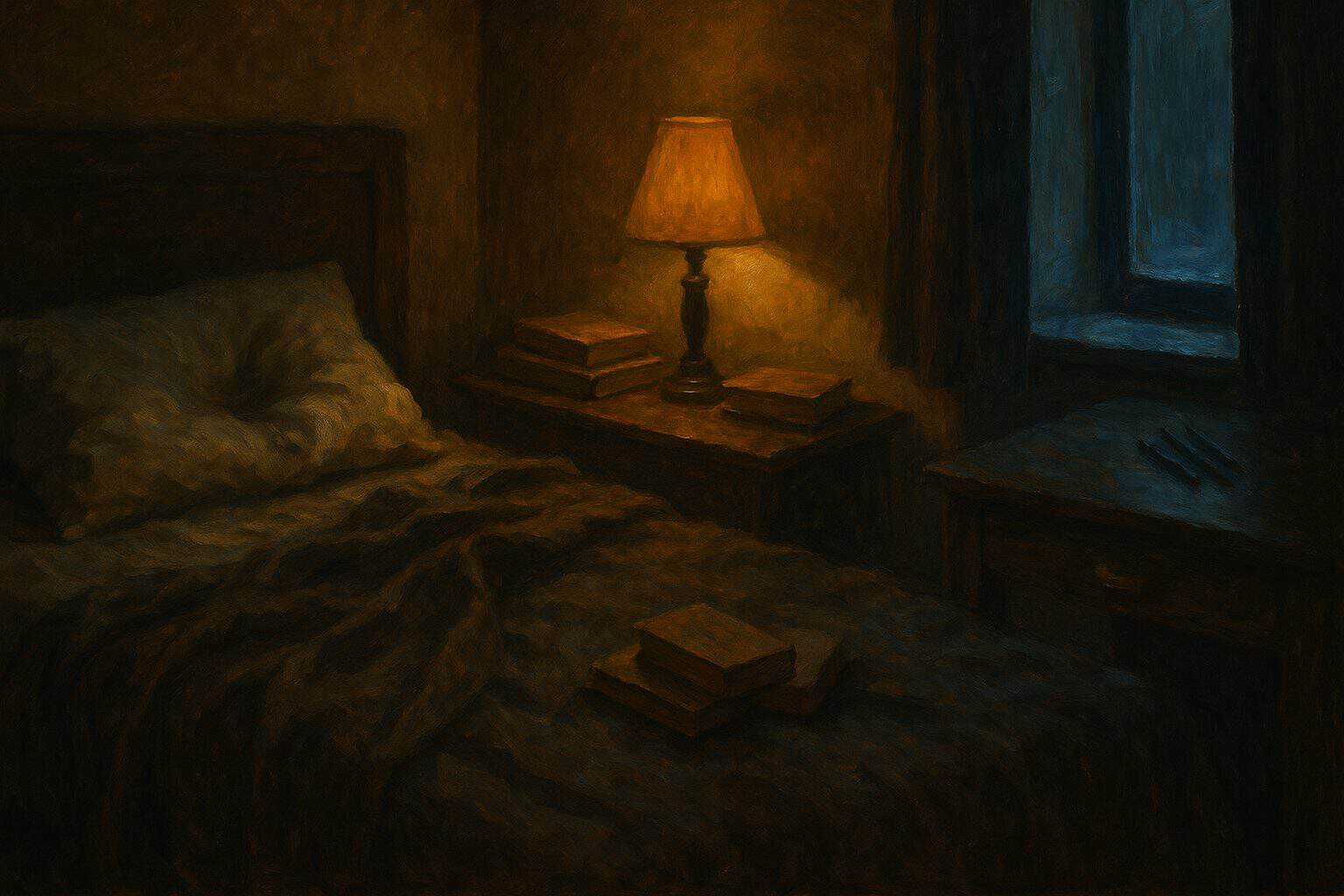
What strikes most forcefully is the stillness of personal effects: “Pens on their desk remain arranged just as they were left, dog-eared pages in scattered books decorate a quiet table, and their unmade bed and worn pillows.” These details compose what Merleau-Ponty might recognize as the flesh of dwelling—not mere objects but the crystallized gestures of a life, each item bearing the invisible weight of the hand that last touched it. The pen remembers the grip; the dog-eared page holds the moment of pause; the unmade bed preserves the shape of a body’s rest.
“It is, to them, a safety blanket—a sanctuary—and a lens through which the world comes into focus.”
This is how space becomes place—through the slow sedimentation of presence that transforms neutral coordinates into a world. The room becomes not just shelter but Stimmung, that untranslatable German word for the mood or attunement that saturates a space. We do not simply occupy rooms; we season them with our being until they take on the particular flavor of our existence.
The Choreography of Distance
Adoré traces a phenomenology of spatial transformation that reads like a dance: “the transformation of third-person public space into social space, social space into personal space, and personal space into shared.” Watch how this unfolds in lived experience—two strangers in a coffee shop, the vast anonymous space between them gradually collapsing as conversation begins. The table shrinks. The surrounding noise recedes. What was public becomes a small circle of intimacy carved out of the larger indifference.
But the process reverses too, sometimes violently. “The rest of the night was a long, cold education in silence. I forced myself onto the couch. She remained in bed.” The shared bed, that most intimate of spaces, suddenly admits distance. The few feet between bed and couch might as well be miles. The apartment that once felt too small for two people now feels cavernous with estrangement. Space dilates with emotional distance; the same walls that once embraced now merely contain.
This choreography reveals what Bernd Jager calls the horizontal dimension of human existence—our fundamental orientation toward and away from others. We do not first exist and then relate; rather, our very being emerges through these movements of approach and withdrawal, facing and backing, that constitute the dance of human proximity.
Sacred Solitudes
“I entered His sanctuary unseen, as was my pattern, cloaked by darkness in the hour’s stillness when both professors and peers slept.” Here Adoré discovers another register of spatial experience—the room that becomes portal. The chapel at night transforms from public worship space into what he calls his “tent of meeting,” invoking the ancient Hebrew structure where Moses encountered the divine presence.
The phenomenology of sacred space reveals itself through a particular quality of emptiness. Not the hollow absence left by departure, but a pregnant void that invites presence. “The night still received me as an old friend, offering the familiar comforts of her understanding stars, her silent moon, and her empty chapel.” The emptiness here is not lack but capacity—space held open for encounter.
Augustine knew this interior architecture, how the soul itself becomes a kind of room: “a sacred space where you are to close the door behind you and dwell with God in secret and solitude.” The physical chapel merely externalizes an inner sanctuary, that fraction of the soul Adoré reserves “for the late-night hours, for my ‘tent of meeting’ with the God who stays.”
The Portable Absences
Some spaces travel with us. “Even in Rome, miles from home, the empty chair traveled with me, a silent confidant beneath Italian stars.” The empty chair—that recurring figure in Confessions to the Empty Chair—becomes a portable absence, a space that maintains its shape regardless of geography. It is not tied to any particular room but manifests wherever Adoré finds himself alone with memory.
“She sat opposite me—not in a room, but as a ghost I could not exorcise, living behind my eyes.” The phenomenology of haunting reveals how absence can become more present than presence itself. The ghost does not need walls or floors; it inhabits the space behind the eyes, that strange nowhere that is everywhere, following us from Rome’s ancient stones to modern dormitories.
This portable absence illuminates what Sartre understood about consciousness as negativity—how we carry within us spaces that are not, presences that are absences, rooms that exist only in the strange geography of memory and longing.
Fraternal Geometries
“These old high school friends lived together under one roof, offering spacious, if gloriously messy, sleeping arrangements for guests.” The mess itself speaks—not as disorder but as the visible trace of unguarded living. Male friendship creates its own spatial logic, what Adoré experiences when “rooming with Adam and Martin pulled my mind and spirit from its usual dark watering hole, granting moments of respite.”
The shared dorm room after Rome presents a particular phenomenology: “I returned from Rome’s ancient stones and sacred silences to the chaos of a shared dorm room—a jarring plunge from cathedral stillness into fraternal noise.” Yet this noise is not mere disturbance. It is the sound of unselfconscious presence, of lives lived without the exhausting vigilance of solitude.
Notice how the truck becomes another species of male sanctuary: “Silverado. Wade and I re-established our old ritual in my hometown, his truck a rolling sanctuary where we exchanged intelligence from our separate fronts.” The cab of a pickup truck, windows cracked, country roads unfolding—this becomes a confessional on wheels, a space where masculine reticence yields to the hypnotic rhythm of highway miles.
The Room of Witness
“There, beneath my faithful tree, I stood witnessed by the moon and stars. The moon and stars have overheard conversations and witnessed events.” The outdoors becomes room when it holds memory. The tree, the moon, the stars—these become walls and ceiling of a vast chamber where the most intimate revelations occur.
This is not the romantic projection of feeling onto nature, but something more primordial—what Heidegger might recognize as dwelling in its most essential form. We do not first have interior experiences that we then project onto exterior spaces. Rather, certain spaces call forth interiority, draw out what could not emerge in conventional rooms.
The window becomes threshold between these worlds: “she invited me into her room through her window for more passionate kissing, the local Christian radio station acting as background noise.” The window—neither fully inside nor outside—marks the liminal space where boundaries blur, where the safety of enclosure meets the danger of exposure.
Vacated Spaces
“Their absence returned me to solitude. But opportunity instead of loneliness filled their vacated space, occasioning visits from Carol, then Elizabeth.” Absence creates room for new presence. The phenomenology of the vacated space reveals how emptiness can be either hollow or expectant, either abandoned or cleared for arrival.
“The silence of that empty apartment was another forge. In the wreckage of the realization—that I was a placeholder—I abandoned the hope of love.” The apartment after revelation becomes workshop of transformation. Its silence is not peaceful but productive, a forge where the heat of disillusionment reshapes the soul.
“They tend to favor solitude instead of gatherings of people, derive pleasure from contemplating abstract ideas as opposed to sensory stimuli.”
This is the introvert’s spatial preference—not antisocial but differently social, seeking rooms where presence can unfold slowly rather than erupt suddenly. The empty apartment becomes laboratory for a different kind of experiment in living.
The Nearness That Remains Far
Throughout these meditations on space and place, a paradox emerges that Frank Buckley, reading Merleau-Ponty, would recognize: the closest spaces often remain the most opaque. We know least well the rooms we inhabit most fully. Only in departure or estrangement do they suddenly become visible, strange, questionable.
The furniture that reminded him of her absence—it had always been there, but only absence made it speak. The unchanged quality of his childhood home—it required absence to perceive what presence had rendered invisible. The empty chair that traveled to Rome—it materialized only through the distance from what it represented.
This is the phenomenology of the rooms that turn strange: they reveal that we never simply occupy space but always dwell, and dwelling means to be so intimately implicated in our surroundings that we cannot see them until they fail us, leave us, or cast us out. Then, in that moment of estrangement, the invisible architecture of our lives suddenly appears, foreign and familiar at once, like encountering our own face unexpectedly in a mirror.
The rooms know us better than we know ourselves. They hold the shape of our living even when we have forgotten the gestures that gave them form. In their sudden strangeness, they return us to ourselves—not as we imagine we are, but as we have actually lived, loved, and lost within their patient walls.