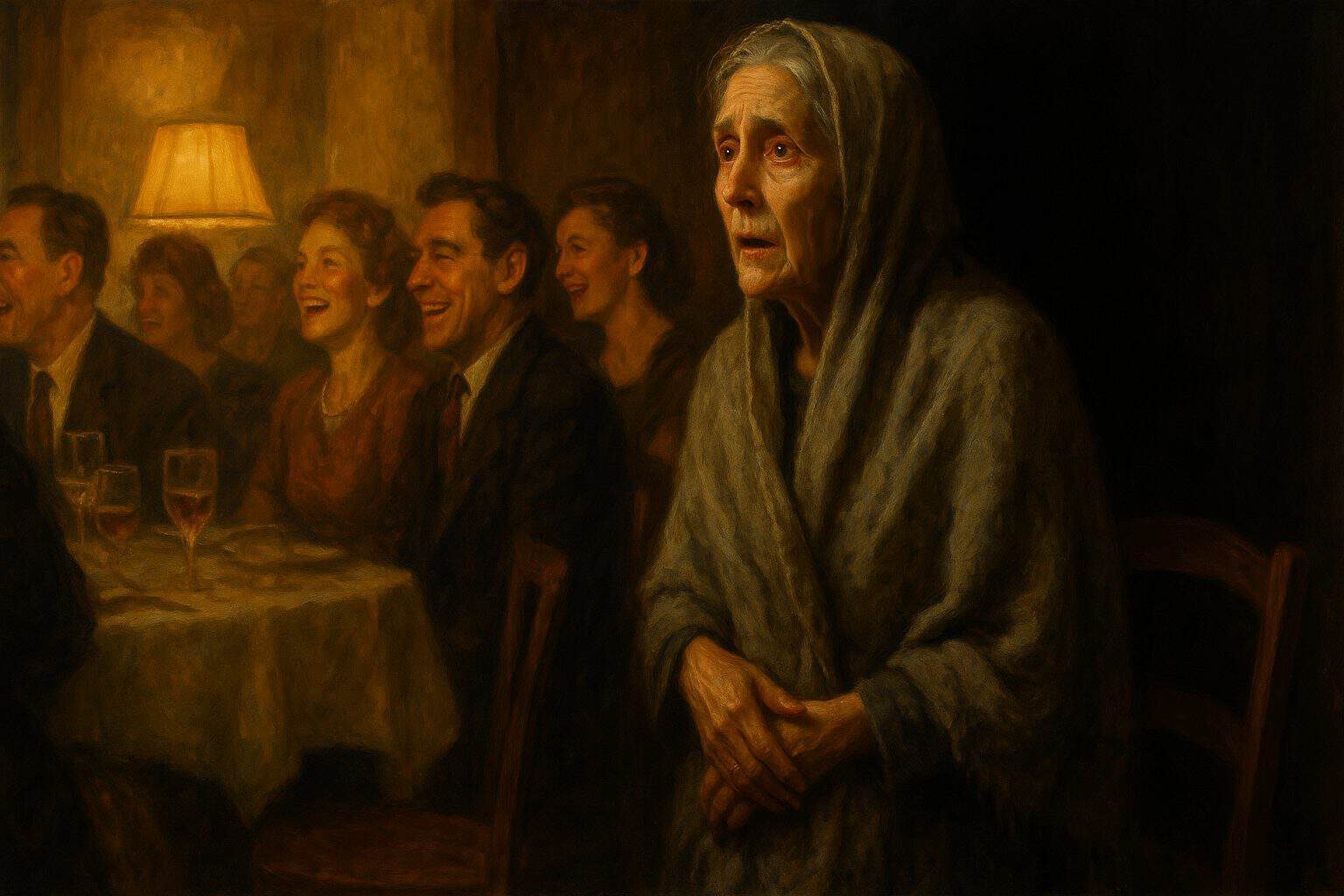
How visibility itself becomes a wound when the gaze that once held you turns away
The Architecture of Erasure
There is a particular quality to standing in a room where you once belonged. The furniture remembers your weight differently now. The doorway you’ve passed through a thousand times suddenly requires calculation—will they look up when you enter? The answer arrives before the question fully forms: “She did not ignore us; she could not. She did not see us. At all. Anywhere.”
This is not invisibility as metaphor. This is the lived experience of watching your own outline fade from spaces that once held your shape. The chair you occupied at dinner parties still sits at the same angle, but now others flow around it as if it had never been pulled out from the table. Your name, when it surfaces in conversation, creates a brief turbulence—a hesitation, a glance exchanged—before the current of talk smooths over the disturbance.
The Phenomenology of Non-Perception
To be hated is to remain solid. Hatred requires an object, demands that you occupy space worthy of such focused energy. But erasure—erasure operates through a different physics entirely. “Erasure stung worse than hate because hate still points at you. I stood where I used to stand and counted the empty.”
The counting becomes its own ritual. Empty chairs that once turned toward you. Empty pauses where your voice once entered conversation. Empty gestures of recognition when paths cross in familiar hallways. Each absence precisely measured, catalogued, held up against memory like a photographic negative revealing what has been chemically removed from the image.
“Those with eyes to see, saw me. Those with ears to hear, heard me. Else, either God or Lilith removed their perception of me.”
This divine editing of perception transforms the social world into something uncanny. You move through spaces like Doug, “invisible, shielded by some unseen country club force”—except the force field operates in reverse, keeping you out rather than protecting you within. The very air seems to bend light around your presence, creating a pocket of non-existence that moves with you through formerly shared territories.
The Shadow’s Vantage
From this enforced periphery, a strange clarity emerges. “From my usual station on the periphery, a shadow in plain sight, I watched their lives unfold.” The shadow sees what the spotlight cannot—the small betrayals, the unconscious gestures, the truth that emerges when people believe themselves unobserved.
Like Odysseus “hiding our intelligence and intention” during his long return, the erased one develops a particular mode of observation. Not the active looking of the voyeur, but the passive reception of one who has become transparent to social perception. The world performs itself without the self-consciousness that normally accompanies being seen. “People tend to change their normal behavior in order to present themselves in a more positive light after they realize that they are being observed”—but for the erased, this theatrical adjustment never occurs.
The result is a terrible intimacy with others’ unguarded moments. You become “a contemplative version of Grendel observing—with both envy and disgust—Hrothgar’s feasting hall from the shadows.” The feast continues, the laughter rings out, the bonds of fellowship strengthen—all of it proceeding as if you had never sat at that table, never raised your cup in those toasts, never existed in the warm circle of that light.
The Paradox of Hyper-Visibility
Yet erasure creates its own form of presence. The warning “not to stare at her ass as she walks away” reveals how the attempt to un-see something “calls attention to the forbidden sight.” The very effort to maintain your non-existence requires a vigilance that betrays your lingering presence in consciousness.
You become the ghost that must be continuously exorcised, “living behind my eyes” even as external perception refuses to register your form. The work of not-seeing you becomes visible in the careful choreography of avoidance—the routes through buildings that mysteriously alter when you appear, the conversations that shift mid-sentence when you approach, the social gatherings that somehow never quite include your invitation.
The Stripping of False Light
In this darkness of social death, something unexpected occurs. “Where before, in the false light of human affection, God’s voice remained merely one among many, here in the darkness of my shame, a single speck of His light became impossible to ignore.”
The erasure that removes you from human sight paradoxically clarifies another kind of vision. “Loneliness, heartbreak, disappointment, weariness, and misunderstanding strip the soul of every false comfort, leaving it raw and exposed.” What remains when the social mirror no longer reflects your image? When the confirming gaze of others no longer sustains your sense of existing?
Sartre’s insight into consciousness as nothingness takes on lived flesh here—not as philosophical abstraction but as daily experience. The pour-soi discovers its radical freedom precisely when the scaffolding of social recognition collapses. “Confidence in loneliness and pride in solitude resurged, overtaking any aspiration of my being human again.”
The Witness Who Remains
“God watched me in silence while protecting Jeannètte and her new man in the shadows… They sustained each other in love as I fumbled like a blind man.” The cosmic irony cuts deep—to be seen by the divine precisely in the moment of human erasure, to be held in infinite gaze while finite eyes refuse recognition.
“I could not feel Him anymore; was it all a dream? … One would expect that I would be happier after His visit, but I was not: my sadness amplified.”
Even divine witness cannot substitute for human recognition. The amplified sadness reveals a truth about our nature as social beings—we require both vertical and horizontal confirmation of our existence. To have only one while lacking the other creates a particular form of suffering, a “melancholy veil through which I now viewed the world.”
The Revelation of Hidden Nature
“This story showed me how easily and quickly a person’s hidden nature reveals itself without a chaperone during the anonymity of traveling alone.” But the erased one doesn’t need to travel to experience this anonymity—it travels with them, a portable bubble of non-existence that strips away the social choreography revealing what lies beneath.
From this vantage, the whole human comedy appears different. The careful performances, the maintained facades, the desperate hunger for recognition—all of it visible to one who has been edited out of the scene. The shadow knows what the spotlight cannot reveal: how we truly are when we believe ourselves unwatched, how quickly the mask drops when the audience appears to have left the theater.
The Persistence of Outline
And yet the outline never fully fades. Like a palimpsest, traces remain beneath the new text written over your absence. A pause in conversation where your opinion once would have entered. A gesture begun then arrested, muscle memory of connection severed mid-reach. The space you occupied retains a quality of haunting—not dramatic enough to acknowledge, too persistent to completely ignore.
The erased one learns to read these traces, to understand that complete erasure is impossible between beings who have truly seen each other. Something remains, stubborn as a coffee stain on white cloth, resistant to all efforts at removal. The very intensity of the effort to un-see reveals the depth of what once was seen.
In this paradox lives a strange comfort: to be so thoroughly erased requires having once been so vividly present. The outline that fades must first have been drawn. The shadow cast proves the existence of both light and form, even when the form itself has been removed from view.