His fingers move along another arm with the precision of ink on paper, the mouth knowing its lines, while somewhere outside the scene the soul watches, untouched and unable to enter.
Hands Moving While the Soul Holds Its Breath
Fingers trace the familiar path along another person’s arm, a practiced touch that lands on skin the way ink lands on paper—precise, controlled, without surprise. The mouth knows its lines, the small half-smile, the soft laugh at the right beat, the reassuring murmur that keeps everything safely pleasant. Inside, though, something pulls back like a tide, leaving the shoreline of the body bare and exposed but strangely empty. He has trained himself to step sideways out of his own flesh just as closeness draws near, as if slipping behind a curtain no one else can see. What looks like presence is choreography: the tilt of his head, the way he leans in, the measured pressure of his hand. He is both actor and audience, watching his body fulfill expectations while the part of him that can be hurt floats at a distance, holding itself very still, like someone keeping their breath held underwater until the danger passes.
The Empty Armor Polished to a Shine
He counts his endurance in scenes like this: how convincingly he can stay, how little he actually feels. Each successful detachment registers as a quiet victory, a mark of strength carved into the inner ledger. Yet when the moment ends and the bodies part, what lingers is not triumph but a faint metallic taste, as if he has been chewing on coins. The armor he wears is invisible but heavy, a second skin made of rehearsed indifference and tidy explanations. Every time he slips away from his own sensations, he adds another plate to this shell, more protection against the old childhood fear that being fully present means being at the mercy of someone else’s chaos. The reckoning in this passage cuts through that story: the same armor that once shielded a small boy from being overwhelmed has grown into an exoskeleton that traps the man inside, holding his pulse at a safe, steady distance from every outstretched hand, even the divine.
Heat Without Flame in the Blacksmith’s Shed
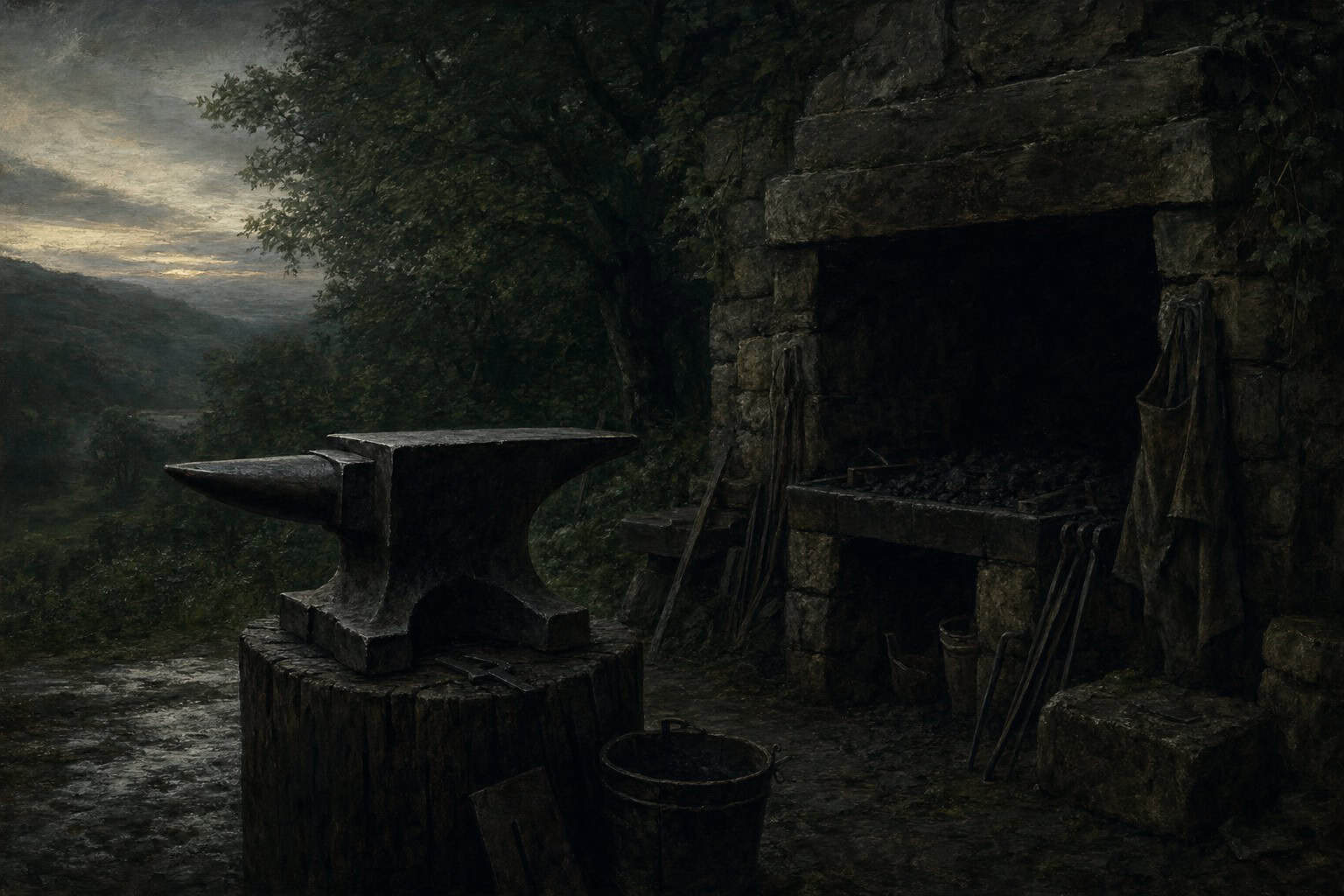
The scene carries the air of a forge waiting to be lit. There is friction here—skin on skin, breath on breath—but no real fire, only the echo of what heat could be. He senses the gap more sharply than the other person ever will, a hollow space between gesture and interior assent that hums like metal not yet struck. This is where the deeper pressure gathers: he knows his detachment is not neutral anymore; it is chosen, refined, almost loved. The spiritual language in the passage names a different kind of workshop, one where ascent and descent, consolation and trial, are meant to temper a soul into something capable of bearing both love and pain without fleeing its own body. Instead, he has learned to blunt every blow by leaving the anvil altogether. The tension sharpens: if suffering is meant to be a fire that shapes, what happens to a life that keeps dodging the flame, staying close enough to feel the heat but never close enough to glow?
When the body performs its script while the spirit watches from somewhere outside, untouched and untouchable, even love cannot find the door.
The Cost of Floating Above Your Own Skin
Anyone who has survived by going numb can recognize the pattern written into this passage. There is the quiet pride in being unflappable, the way one learns to read a room quickly, say the right thing, offer touch or humor like tools pulled from a belt. There is also the secret ache afterward, when the body is finally alone and the stillness feels less like peace and more like a room with no oxygen. The text names what many never dare say aloud: the trick that kept you safe as a child—splitting feeling from flesh—keeps you from receiving anything now, even what is good. If grace works through contact, through presence, through a God who chooses flesh as His own language, then the habit of leaving yourself just when things become real is not only a relational problem. It quiets prayer, hollows out confession, turns devotion into a script your body performs while your soul waits outside, untouched by the words your lips shape.
The Unfinished Note Hanging in the Throat
By the end of this passage, something like a held note vibrates in the chest—a sound that wants to become song but never quite starts. There is longing in him, clear as a muscle twitch, for contact that does more than skim the surface, for a love that could enter even the places he has declared off-limits. There is also terror: the fear that if he drops his defenses, the darkness wired into him from childhood will spill out and ruin whatever it touches. The text refuses to flatter this fear, but it does not dissolve it either. Instead, it circles a harder possibility: that the very fracture he guards so fiercely, the split between his body’s script and his soul’s retreat, might need to be brought forward as offering, not hidden as shame. The question is left humming, unanswered, like a word on the tongue before speech—whether a God who forges saints out of mixed metal can take even this alloy of numbness and desire and strike it into something that can finally ring.