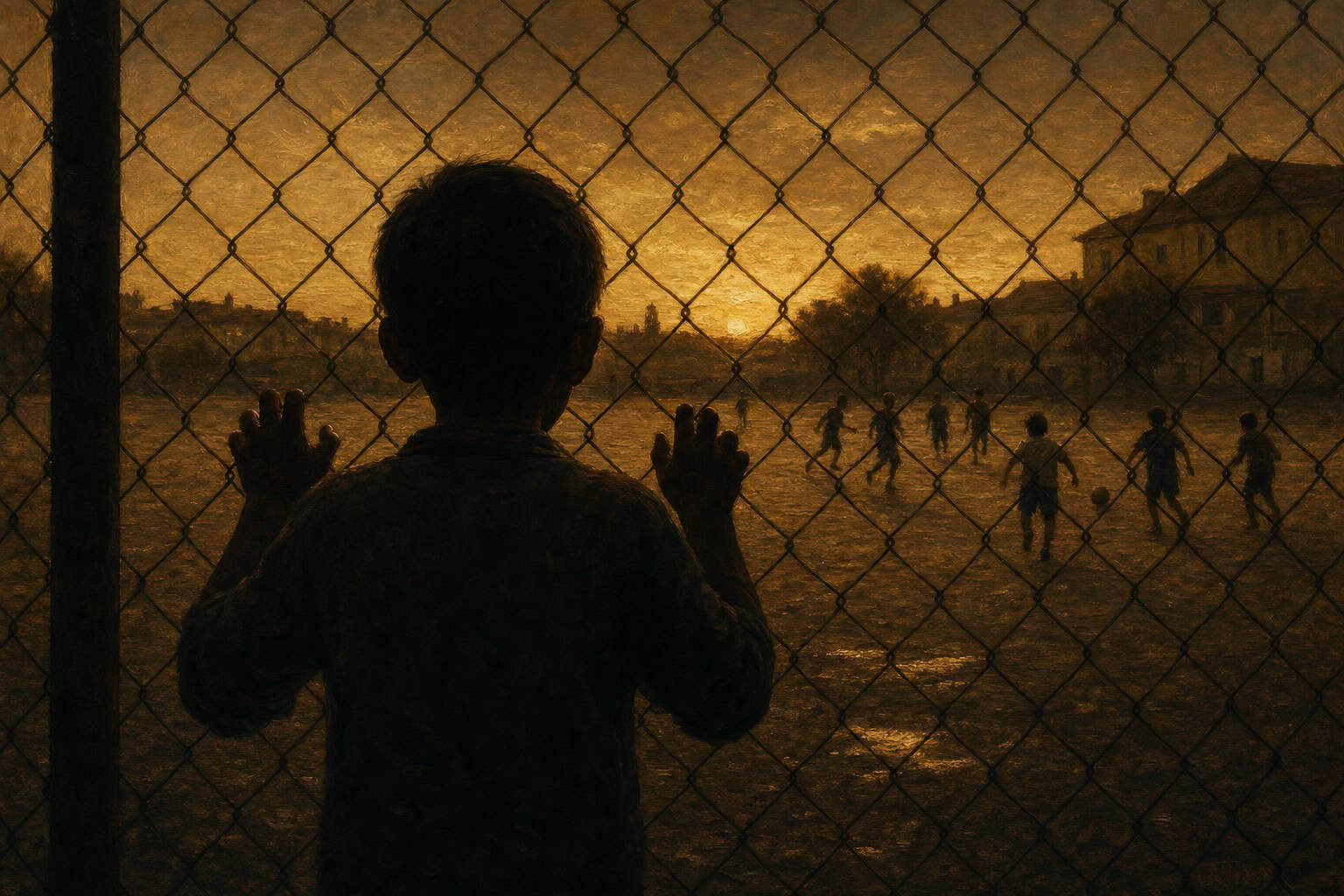
Recess explodes like a small city under a pale sky, kickballs thudding, a whistle shrieking, and a boy learns that the oldest wars are fought on the most ordinary ground — even here, even on gravel and painted lines.
Chalk Dust and Battle Lines
Under a pale sky and the hum of distant traffic, recess explodes like a small city. Kickballs thud against asphalt, gravel spits under running shoes, and somewhere a whistle shrieks. In the middle of it all, one boy lingers near the painted boundary lines, close enough to watch, far enough to stay untouched. The packs form almost instantly around certain children, as if signaled by an unseen flag. Their laughter cuts through the air, bright on the surface but edged with something sharp that stings when it lands on a weaker classmate. Others drift to the margins, backs against the chain-link, eyes lowered, bodies turned inward to save what little peace they have. The boy feels the split long before any catechism names it: one current that feeds on fear, another that endures it. No one announced the teams, yet everyone seems to know where they belong.
The Boy at the Fence Line
Pressed against cold metal, his fingers curl around the rusted diamonds of the fence while dust sticks to the sweat on his palms. He is not chosen for the game, not called into any huddle; his absence is the rule, not the exception. A tray set down alone at lunch, a seat unfilled beside him on the bus—each small refusal piles onto his chest like wet clothes. What begins as simple hurt thickens into a heavier question: if human faces turn away this easily, what does that say about the Face he cannot see? Yet even as loneliness tightens around his ribs, there is a faint sense that being outside the circle spares him from something inside it. Their jokes, their sudden turns of cruelty, their casual lies about weaker kids—he watches and feels both envy and a strange relief. Isolation wounds him, but it also keeps a part of him untouched that he cannot yet name.
When Laughter Turns Carnivorous
The sharpest moments come not with fists but with jokes. A stumble in gym class, a mispronounced word, the wrong kind of shoes—tiny details become triggers. Someone fires the first line, and the circle closes in, laughter swelling like a siren. At first it has the rhythm of play, but there is a second beat beneath it, a hungry satisfaction when the target’s face begins to crumble. The boy watches how the jokers glance at each other for approval, how their grins widen only when the other child’s shoulders fold. Their own fear of falling out of favor drives them to press the attack, to keep the laughter rolling no matter who pays the cost. Overhead the fluorescent lights in the classroom will later buzz as if nothing has happened, but he will still feel that strange, cold certainty: something more than childhood meanness is feeding on this scene.
The oldest wars are fought on the most ordinary ground; even a playground has its hidden front lines.
The Taste of Metal in Your Own Mouth
You may not have stood on that exact patch of cracked asphalt, but your body remembers its own version. The sour taste in your mouth when a coworker became the punchline and everyone stared at their phone, pretending not to see. The way your stomach tightened when a manager brushed too close, or a family member turned affection into control and called it love. You learned to laugh along, or to disappear into the edges, or to harden your face so no one could read it. Those choices felt small at the time, just survival in a bad moment. Yet some part of you knew there was more at stake than pride or comfort—that each silent nod, each forced chuckle, was a tiny rehearsal of what kind of person you would become. The tension between wanting to belong and refusing to join in that game has never really left your muscles.
The Bell That Never Quite Stops Ringing
Years later, long after the last report card has yellowed in a box, the old bell still sounds in certain moments. A harsh laugh in a meeting, a joke that thins the air at a dinner table, a supervisor leaning too close under office lights—the body recognizes the pattern before the mind catches up. The grown man carries himself like someone who has mapped exits in every room, who knows how quickly play can turn to spectacle. Yet what once was only fear has become a strange kind of fluency. He can feel when a room tilts toward cruelty, when someone’s dignity is about to be traded for a cheap bond. The early isolation, the barbed jokes, the small betrayals have taught him a grammar of spiritual weather others never notice. Whether this grammar will become prayer, protest, or something more dangerous is not yet decided; the bell keeps ringing somewhere just beyond his hearing.