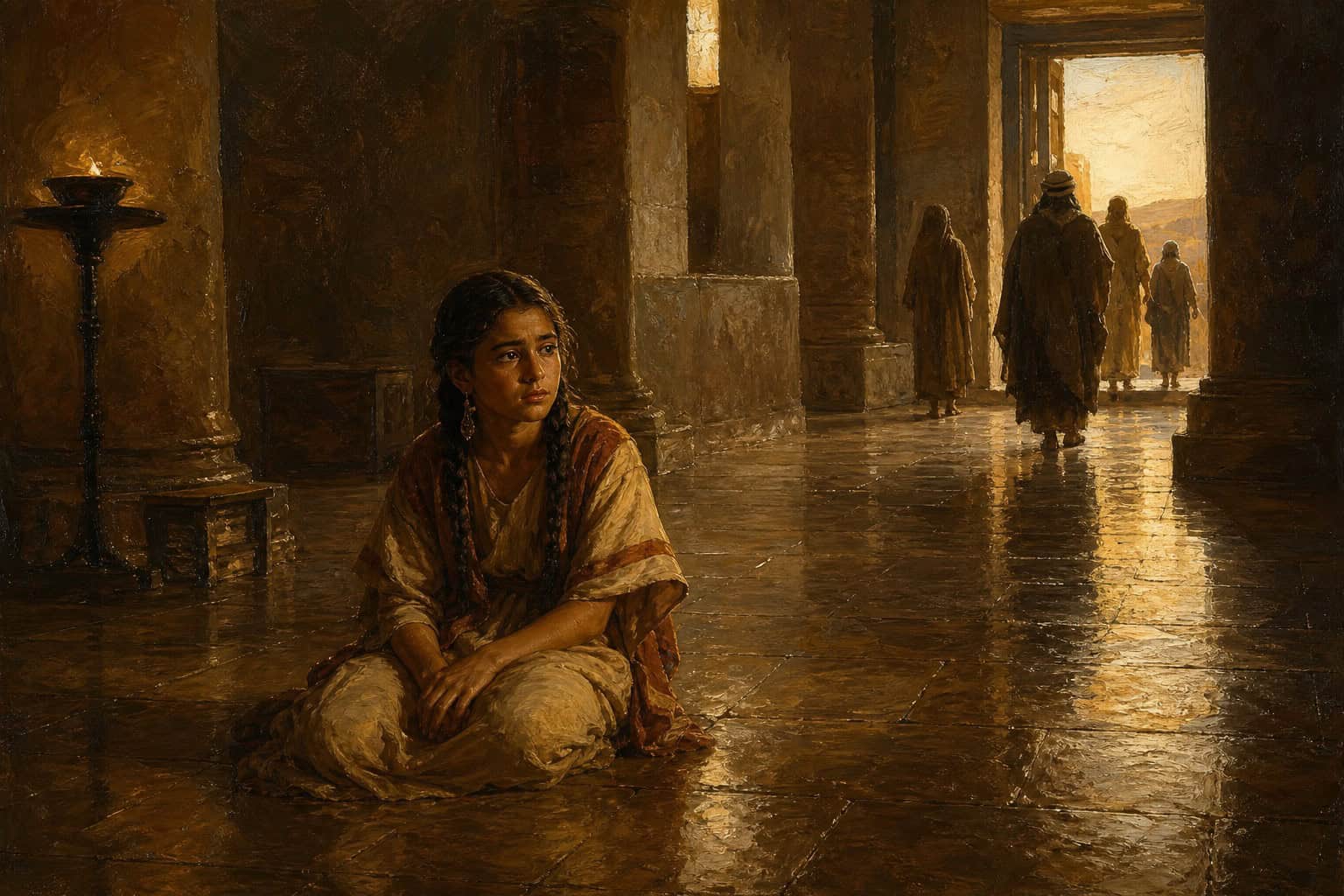
You can’t leave your room. Here’s how being handpicked young can seal you inside yourself—and where God waits in that shut place.
The Boy on the Gymnasium Floor, Kept One Step Behind
What if the thing that lifted you up is the same thing that walled you in? I ask it now, sitting in a room I cannot seem to walk out of, and the answer runs back forty years to a cold gymnasium floor. I was five that August, a few months after my birthday, sent into a public school built decades before I was born, its rules stiffer than anything I had known at the daycare. Each morning my father woke me before dawn and dropped me off in his work van on his way to his shift, so I arrived earlier than most and sat longer than most, waiting with the other children until a teacher gathered us and led us away like a mother duck collecting her ducklings. I always saw myself as the last one, keeping pace but never quite folded into the flock. The differences from the daycare were stark and I catalogued them: more students, stricter instruction, a rigid order to the day. Best of all, less crying. Silence had already become my first language, the shield I carried out of a house of unpredictable adults, where love and anger came without warning and I learned that quiet cost me the least. In this new building I welcomed the thinner noise, the fewer sounds that pierced my shell. I did my work fast and well, so well that I finished while others still labored, and then I sat staring at the paper shapes hanging from the ceiling, a small prisoner of the clock. Even then I understood something strange about time. It crawled for me and ran for the rest of them, as though I had been handed a different watch. I did not know that the withdrawal I called safety was also the first wall of a cell. The shell that kept the noise out was slowly hardening around the boy inside it. I see it now with a plain, unhappy clarity that I could not have owned at six. That silent child, so competent, so easy to overlook, was building the architecture of his own aloneness one waxed morning at a time. He thought he was hiding and finding a kind of peace in it. He did not know he was disappearing, and that no one would come looking for a child who had made himself so quiet. The room I cannot leave today has that gymnasium floor for its foundation, laid before I had any word for what I was doing, poured in the mood of a small boy who had already decided the safest thing was to take up as little space as possible. That decision felt like wisdom then. It reads now like the first line of a sentence I have spent my whole life serving.
A Teacher Who Looked at Me Like a Puzzle to Solve
Ms. Chavez noticed. My quiet competence, the speed of a mind she could not easily explain, did not slip past her the way I slipped past most people. One day she leaned toward me and asked whether I felt bored in her classroom. I said no. I said it because I did not want to upset her, and even at six I was already managing an adult’s feelings instead of telling the plain truth, reading her face for what answer would keep the peace. That small lie matters to me now more than it should. I have spent a lifetime saying the acceptable no, hiding what was really moving in me, performing a contentment I did not feel, and it started at a low desk under those hanging shapes when I was six years old. She gave me a special assignment, harder than the others, something the district treated as a version of a test of intelligence. I finished it, of course; finishing was the only thing I trusted myself to do well. She kept the paper. And then she looked at me in a way I have never been able to shake loose. She did not look at me as a student anymore. She looked at me as a riddle. That gaze changed the temperature of the room, and of everything after it. To be studied is not the same as to be loved, though a child cannot yet tell the two apart. A puzzle is something you solve and set down on a shelf. A child is someone you gather up and hold. I felt, without having words to hold the feeling, that I had become an interesting problem rather than a boy who needed anyone, and that the interest was a kind of currency I would never have to earn again the ordinary way. The district was launching a rigorous new program, and every teacher in the building was quietly hunting for children who could survive its demands. My silence, my speed, my unnerving ease had marked me as a candidate before I understood any of it was happening. I understand now that she meant well, that she was reaching toward something real that lived in me. But reaching toward a child’s mind is not the same as reaching toward his heart, and the two got fused so early that I could not separate them for decades. Was I grateful for being seen, or was I already lonely in a new and more permanent way? Both, I think, and the honesty of that answer still stings. The confusion between gift and burden began here, in the warm and well-meaning look of a teacher who saw a mystery and forgot, for a moment, that there was a small trembling person underneath it who wanted, more than any test could offer, simply to be one of the ducklings led out the door with the rest.
Handpicked by Heaven and Hell in the Same Breath
Here is the turn I could not have seen at six, and can barely hold at fifty. A teacher had handpicked me, yes—and so, I have come to believe, had heaven and hell in the same breath, and neither of them told her what they were doing through her hand. That single selection set my whole life in motion, a stone dropped into still water that is still sending its rings out to the edges. To be chosen for the advanced program was an elevation, and my parents were proud, and I was told I was fortunate. It was also an exile. The two arrived fused together at the root, and I have never once managed to pry them apart. Selection separates before it lifts. The moment they pull you out of the flock you are no longer of the flock, and no achievement earned afterward ever hands back what the pulling quietly took from you. I gained sharper work, harder subjects, teachers who expected more and got it. I lost the ordinary belonging of the children waiting on the gymnasium floor, the plain animal comfort of being one among many. What looked like a door opening was also a wall sliding shut behind me, though I clapped for it and everyone around me clapped too, and the clapping made the loss impossible to name. The gift that set me apart became indistinguishable from the sentence that kept me apart. And here is the raw thing, the thing I refuse to sand down into a lesson: God did not spare me this. He did not swoop down and lift the boy out of the loneliness of being marked. What I have found instead, looking back through the years, is that He was there inside it, quiet and unremarked, walking beside a child whom no one quite reached. He did not remove the dark. He was simply present within it, the way a hand rests on a shoulder in a room with no lamp.
To be seen as a riddle instead of a child is to be selected for a solitude no reward can pay off.
That is the accounting I owe, and I mean to give it straight. Not that being chosen ruined me, and not that it saved me, but that it did both at once, and that I have spent decades pretending it did only one, the flattering one. I said yes to every elevation and never once let myself mourn the flock I was leaving behind. I took the pride my parents offered and swallowed the grief whole, because grief was not on the list of acceptable answers. The bill for that long silence came due late, and it came due, of all places, in a room I could no longer walk out of.
To be seen as a riddle instead of a child is to be selected for a solitude no reward can pay off.
The Dossier of Competence and the Self It Could Not Feed
Now I sit with what I made of it, and the fallout is quieter than you would expect—no crash, just a slow cooling. My life works on paper. The record is intact and impressive: capable, accomplished, the assignments finished early, the tests passed, the programs completed on schedule. But the words do not stick to me. They float somewhere above my head like a résumé held out in the wind, describing a man I recognize from a distance but do not actually live inside. The dossier is full and the self it was supposed to nourish is starving in the corner. This is the strange cruelty of being handpicked young. You become very good at producing the evidence of a life while the inner rooms go cold and unlit, and no one thinks to check them because the evidence is so convincing. I count the graduations now, especially the premature ones, the times I was moved forward too soon into the next thing. Each time I felt not the joy of freedom but a low fear of what I was abandoning. I mourned the leaving more than I celebrated the arriving, and I never said so aloud, because the expected answer was gratitude and I had made gratitude my costume. That first lie to Ms. Chavez—no, I am not bored—grew, quietly, into an entire way of living. I performed contentment for years while something under the performance had already stopped working. And the hardest part of this accounting is that I cannot lay it all at the feet of the adults who handpicked me. They saw a bright child and reached for him with the tools they had, which were tests and programs, not tenderness. The withdrawal was mine. The silence was mine. The habit of reading a room and managing everyone’s feelings while burying my own was a choice I made and remade every single morning until it hardened past the point of choosing. I locked the door from the inside, and then I stood at it and complained that no one ever came. What did I refuse to see for so long? That being interesting is not the same as being known, and that I secretly preferred being interesting, because it asked so much less of my wounded and hiding heart. I could dazzle a person without ever being touched by one. I could finish the hard test and hand it back and keep the small, frightened self tucked safely behind the score, where nothing could reach it and nothing could ask anything of it. That is the sin buried under the story of my early gift, and I am finished pretending it was only misfortune done to me by careless hands. Some of it was done to me, yes. But much of it, the heaviest part, I chose.
God Walking the Floor of the Cell I Built
So the quiet boy grew into a man who cannot leave his room, and the older self writing this finally understands why. This place is not a prison the world built around me while I slept. It is the shell I began weaving at five on a cold gymnasium floor, thickened by every selection I accepted, sealed tight by every performed yes I offered instead of the truth. Whoever I might have been down there in the flock is gone, and I have learned, slowly and against my whole grain, that I cannot find my essence back there in what might have been. That road is closed and I have to stop staring down it. The self I am looking for is not behind me in some unlived belonging I can grieve my way back into. It is ahead of me, in what I am still called to become, in the plain and terrifying words to be. This turning is what steadies me, and it also undoes both my nostalgia and my self-pity. I keep wanting to grieve the flock, the ordinary child I never got to stay, and there is a real and honest loss there worth grieving without flinching. But I cannot make my home inside the grief. Four walls do not have to stay a tomb. They can become, instead, the place where a starved self is finally fed, if I will only stop confusing the dossier with the soul, the score with the person. And here, at the settling of all this, is the one thing I can say without dressing it up. God did not rescue me out of this place. He did not unmake the loneliness of being handpicked, nor did He erase the years I spent hiding behind my competence like a boy behind a fence. What He does, what I have felt in the smallest and worst hours, is walk the floor of the very cell I built with my own hands. He is present in the tears, near in the failure, close even in the self-deception I am still untangling one thread at a time. Not a fix. An accompaniment. The despair is real and He does not cheapen it with a tidy comfort or a quick moral; He simply refuses to leave. If you cannot get out of your own room tonight, if being chosen or gifted or admired somehow left you sealed inside yourself with an intact record and a hollow center, I will not promise you the walls will suddenly fall away. I will tell you the harder and truer thing I found instead. Someone is already in here with you, and has been the whole time, sitting patiently in the chair you thought was empty. That is where Confessions to the Empty Chair begins, in the honest accounting of a boy handpicked into solitude, and in the slow, unhurried discovery of Who was keeping him company in the dark all along.