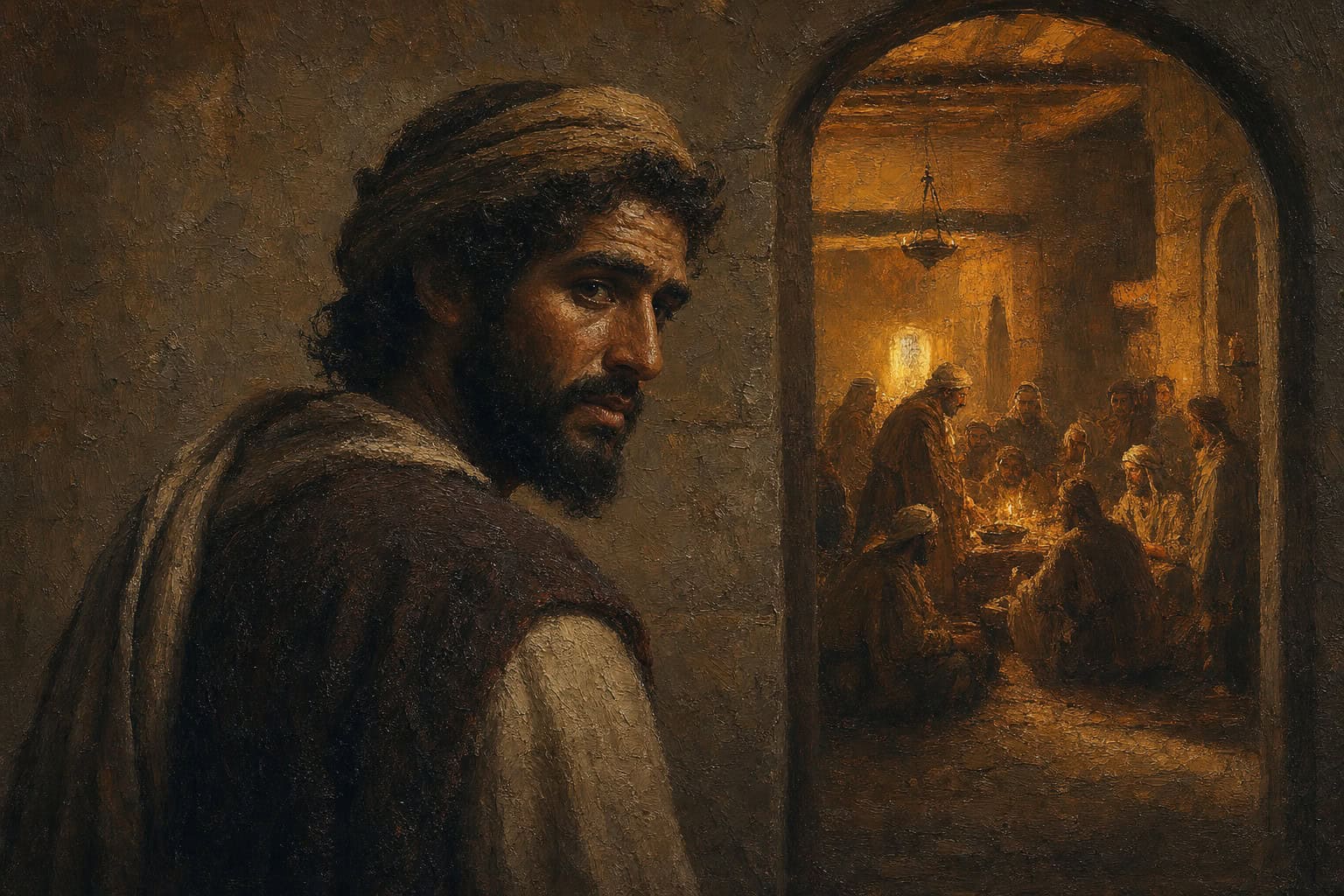
What does it feel like to belong? A hard, honest look at standing outside while beautiful people pair off with ease – and what the ache was really asking.
The Boy Who Counted Other People’s Ease
What does it feel like to belong? Ask the child who never did, and he will not describe warmth. He will describe distance. In the pages of Confessions to the Empty Chair, the narrator remembers standing at the edge of things in junior high, watching the popular boys and girls move toward one another with an ease that felt almost cruel in how little it cost them. They were beautiful. That was enough. Their bodies did the work that other people had to earn with kindness, with patience, with the slow labor of showing a soul worth loving. He watched them pair off like it was breathing. No depth was asked of them. No mercy. No long conversation where you risk being misunderstood and have to try again anyway. He counted their ease the way a starving man counts loaves through a bakery window. And counting is its own kind of ache. It means you are outside, always outside, doing the sums of a belonging you cannot buy. The mood settled over him early and never fully lifted – a felt tone that colored the whole world before he could name it. Everything looked rigged. The rich kids in grade school played by rules he was never shown. The girls there treated him and his friends as less than people, dehumanizing them with a casual carelessness, and something in him hardened where softness should have grown. He did not choose that mood the way you choose a shirt in the morning. He woke inside it. It came before thought, before reasoning, before he could argue with it. And from inside it, every room of laughter looked like a private club that had already voted him out. He could hear the talk and the flirting from the shadows, and every sound of it landed as proof he had been left off the list. That is where the wound begins – not in a single cruelty, but in the slow discovery that you are the one always looking in. His caregivers had taught him nothing gentler; the babysitter, the daycare, the adults who let their tempers spill onto him had already shown him a world that punished before it explained. So the glass never warmed. The window never opened. And a boy who watches long enough stops asking to come in and starts telling himself the feast was never worth entering in the first place. That lie is small and comfortable at first. It takes decades to reveal what it has quietly cost him, and by then he can no longer see where it ends and he begins.
Envy Wearing the Mask of Disgust
He calls himself, in that chapter, a contemplative Grendel – the creature crouched in the dark outside the great hall, listening to the feasting he can never join. It is a sharp confession, and the sharpness is deliberate. Grendel does not merely stand apart. Grendel hates. He wants what the hall has and despises the hall for having it, and both feelings live in the same chest at the same time, snarling against each other. The narrator names his own resentment plainly: he hated the beautiful, shallow people whose physical existence alone drew suitors and suitresses to them, who traded partners among their extended circle like a game of musical chairs, testing who fit best before moving on. Their dates were hollow pleasantries before the body took over. The words are ugly on purpose. He is not sparing himself. But the older man reading this scene now sees something the boy could not. The disgust was envy in a better coat. He wanted the feast. He wanted to be chosen for his face and skip the exhausting work of proving his soul across long, misunderstood conversations. He despised the shallowness partly because it was closed to him, and a thing you cannot have is easier to call worthless than to admit you crave. That is the hidden shape of the excluded man’s hatred – it wants what it despises and despises what it wants, and the two feelings hold hands in the dark. Here the reading turns severe. A displeasure this constant, this contemptuous toward whole crowds of people, rarely points only outward. When a man has no living vision of a better life to set against the one he sneers at, his contempt curdles back onto himself. He is not really judging the beautiful. He is judging the boy in the mirror who was not chosen. And a heart that can only feel anger, or vengeance, or the passive, sulking versions of both, has quietly lost the ability to love, to cherish, to understand another person as more than a threat or a rival. That was the real poverty. Not that no girl wanted him. That his own caring had narrowed to a single bitter note, played over and over until he mistook it for music. He thought he was seeing the world’s rot with unusual clarity. He believed his exclusion had sharpened his eyes. But a man who scans a room only to catch its shallowness will always find shallowness, because that is all he has trained himself to see. The clarity was contempt in disguise. He was not looking at them. He was mostly looking at his own reflection and hating what it could not get.
The Bread That Came Back a Stone
On Sundays he heard the command clearly: do not be conformed to this world, but be transformed by the renewal of the mind, love and have compassion, discern the will of God. He believed it. He tried to obey it. He tried to stand apart from the crowd while still living inside it, to be in the feast-hall and not of it. And here is where the chapter cuts deepest, because the obedience did not feel like grace. It stung. He describes it as asking for bread and being handed a stone, asking for fish and receiving a snake. He did the holy thing and it hurt. He held back from the game, kept his heart open, sought comfort and acceptance and peace from the world and its girls while trying to love God at the same time – and what came back was conflict, pain, and being misunderstood. Sword, he calls it. Not comfort. Sword. This is the raw place the book refuses to smooth over. Obedience is supposed to console, and it did not. He is honest enough to admit the sting, honest enough not to pretend faith felt warm when it felt like abandonment, honest enough to say that standing where God told him to stand left him bleeding. But the older narrator, reading now, will not let the boy off with the boy’s own verdict either. He knows the questions he must put to himself. Did he obey to love, or to prove he was better than the beautiful people who did not bother with charity? Was his standing-apart holiness, or was it the pride of a man who could not get into the room telling himself he chose to stay out? Could he even tell the difference then? He admits it plainly: he could not discern God’s will from behind a wall – and it was his own wall, built stone by stone from every rejection. Perhaps the silence he read as God handing him stones was not absence at all. Perhaps it was a severe kind of presence, teaching him through hunger what abundance never could, walking with him in the very bitterness he was ashamed of.
To hate the feast you cannot enter is only another way of confessing how badly you wanted a seat.
The Wall That Became a Cell
To hate the feast you cannot enter is only another way of confessing how badly you wanted a seat. That confession, unspoken, is the thing the whole scene circles. So what happens to a boy who watches the feast long enough and calls the watching wisdom? He builds. Every insult from the girls, every rich kid’s private rule, every pair moving off together while he stood alone – each one added a stone to the wall he raised against being hurt again. And the wall worked. That is the terrible part. It kept the world out. It also kept him in. The defense and the cage were the same structure, built with the same hands, and he could not have one without the other. The chapter shows a mind that turned inward not for peace but for self-defense, that learned to observe human warmth the way a scholar observes a species he has already decided to distrust. Contemplative, yes – but a contemplation soured into surveillance. He watched people to catch them being shallow, and of course he caught them, because a man looking for hollowness finds it everywhere, even where love is quietly trying to grow. The reading here holds a hard truth about loneliness that the older narrator now accepts. Loneliness of this kind is not only inflicted from outside. It is partly chosen, and stranger still, partly enjoyed – a bitter comfort, a scab picked at because the picking gives a grim, sour pleasure. There is a masochism in it, a way of finding a sad joy in confirming that no one wants you, that you were right all along to expect nothing. And the cruelest fact is that only the lonely man can end his own loneliness, and the walls he built to be safe are exactly the thing that keeps him from ever doing it. So the boy’s rage did not stay the boy’s rage. It aged with him. The protective fury of a child hardened into the chronic affliction of a man, until the hatred became so woven into his personality that he could no longer feel the seam between himself and it. He thought he was a person who had been wronged. He had become, in part, a person made of the wrong. The humiliation of not being chosen had shifted into a settled conviction that he must simply endure this, that his future was smaller because of it, that justice was owed him and would never come. And under all of it, quietly, the question he would not ask: what was he doing with the wound? Not only suffering it. Living in it. Furnishing it. Calling it home.
The Seat He Was Too Afraid to Take
Read from the far side of years, the whole scene turns on a mercy the boy could not receive. He thought belonging was a room he was locked out of. The older narrator suspects it was a room he was afraid to enter, because entering meant being seen, and being seen meant being found wanting – the very thing he was sure he could not survive. So he stayed in the shadow outside the hall and called it discernment. He named the beautiful people shallow so their world would not matter, and if it did not matter, then not being wanted by it could not wound him. It is an old trick, and it never once worked. The ache stayed. The counting continued. What Confessions to the Empty Chair does with this, without tidying it into a lesson, is let the reader sit inside the honest cost of it. To belong, you have to risk the shame of being known. You have to walk into the hall and let people look at your soul and possibly turn away, and there is no version of belonging that skips that terror. The beautiful, shallow people were not free of the risk; they had only postponed it, swapping partners in their cynical game before anyone could look too closely, and the narrator misread their postponement as escape. He envied a freedom that was not freedom at all – it was another kind of hunger, wearing a prettier face. The bored eyes of the adored, the sense of playing a part in something false, the unreality of being wanted only for a surface – he could not see any of that from the shadows. He saw only their ease. The book does not hand him, or us, an easy healing. God does not sweep into the hall and fill the empty seat and make the loneliness vanish. What the pages offer instead is quieter and harder: the sense that God was standing in the cold beside the boy who watched, present in the very resentment the boy was ashamed of, not fixing it, not removing it, simply there. Nearness in the dark, not rescue from it. If you have ever stood outside a warmth you were certain would never open to you, and felt your longing twist into contempt so that it would hurt a little less, this chapter will find you where you actually live. It will not flatter you. It will not tell you the feast was worthless. It will ask, gently and without mercy, whether the wall you swore was built against you was one you had quietly built yourself. And it will leave you needing to know what the boy finally did with that question, and whether he ever set down the single stone that could have let him move.