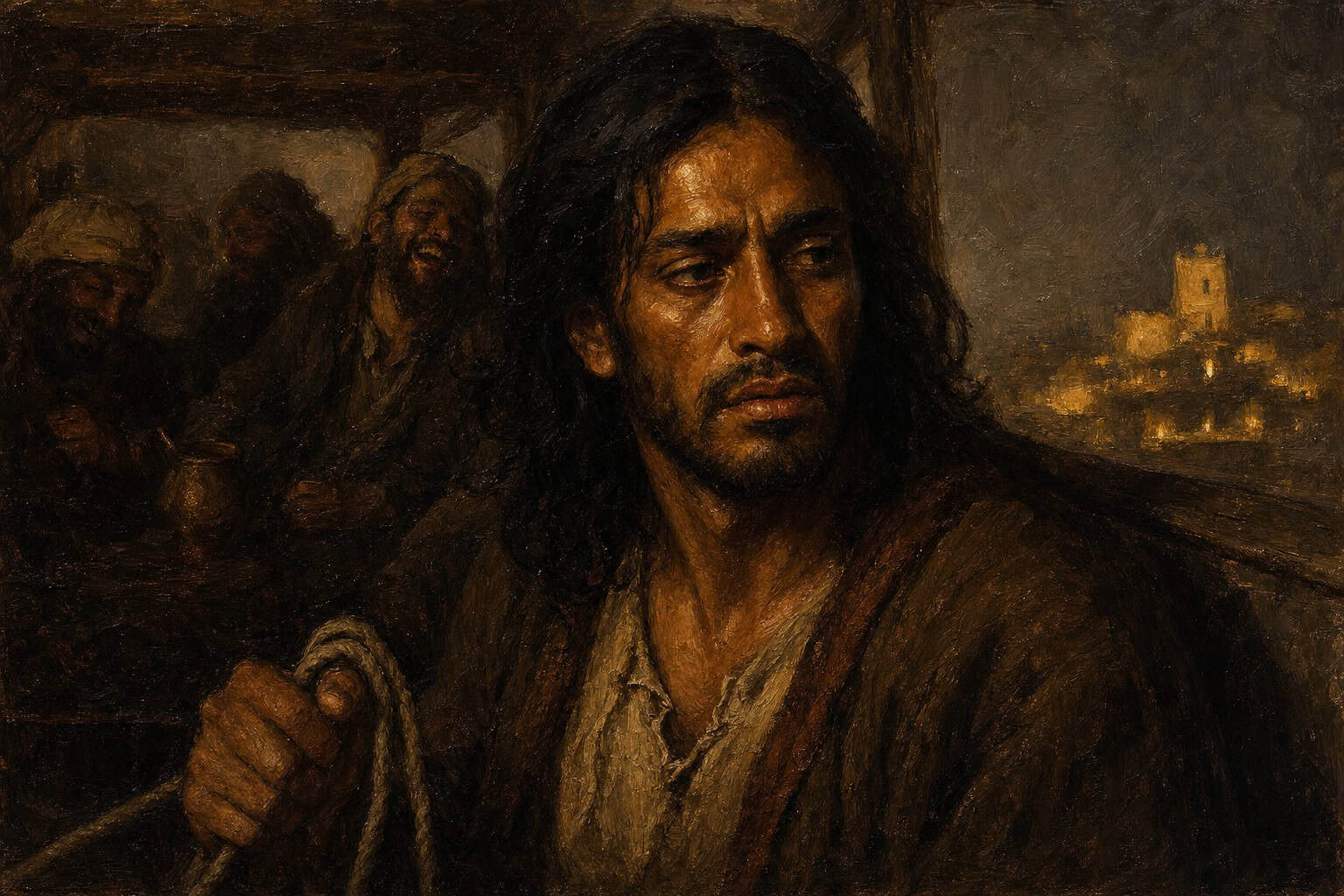
What the empty chair lyrics really name: how a sober man becomes another’s tool, and what desire and clarity cost in a house of intoxication.
The One Glass That Stayed Full
Have you ever been the only clear head in a room that had already gone soft and loose? That is where this chapter of Confessions to the Empty Chair sets the narrator down. The house is warm with drink that night, warmer than usual, the air thick with breath and spilled sweetness. Glasses tip and do not right themselves. Laughter runs a beat too long, then folds over into something wetter. Words slur into each other like paint that will not dry. And in the middle of all that softness, one man’s glass stays full, or nearly so. His mind holds its edges while everyone around him lets go of theirs. This is the small, hard fact the whole scene turns on: sobriety, in a room like this, does not read as virtue. It reads as availability. The narrator feels it happening to him before he can put a name to it. His clear eyes, his steady hands, the memory that keeps working while the others empty out, all of it turns into something the room can spend. He stops being a guest. He becomes equipment. Another man, hunting a woman across the haze, glances at the sober one and understands at once what he is worth. Not as a friend. As a means to an end. The car keys are half in the narrator’s palm before anyone even asks. That is the setup, and it is more common than we like to say out loud. Every crowded room has its designated clear head, and that clear head almost never volunteers for the part. It is handed to him. The music underneath all of this matters too, because the chapter is built like a playlist, one track bleeding into the next, each song a stop on a longer road. The sound filling the house is not innocent. It carries obsession, appetite, the low steady thud of bodies that want and know they want. It sets the terms of the night before a single choice gets made. The narrator sits inside that pulse, sober, watching, and the watching itself starts to pull him in. He is not drunk, so he will not be able to plead the fog later. He saw. He saw all of it. That is the first thing the scene lays across his shoulders, and it is the thing he carries into everything that follows. The reader learns fast that clarity here is no shelter. It is exposure. To stay sober in that house is to be handed a job you never applied for, and to find out your usefulness was decided by someone else’s hunger. The quiet, sharp question opens like a small cut: what does a clear man owe, and to whom, when the room has already chosen for him?
Old Friendship Spent Like Coins
The hunting man does not move alone. He moves on borrowed credit. This is what the scene lays bare as the drink deepens and the pursuit narrows to a point: the seducer’s power is not really his own. It is loaned to him by the people standing near him. Old friendships turn into currency. The trust the narrator built over years, the ease others feel around the steady man, the warmth in the room that has his name on it, all of it gets spent to buy the hunter a credibility his own face could never earn. He needs the herd. He needs the sober friend at his elbow to make the whole thing look safe, ordinary, allowed. A man alone in that pursuit would put a chill down the woman’s spine. A man flanked by trusted friends looks like a good night. This is the ugly machine humming under what we politely call charm. The narrator, clear-eyed in the noise, begins to feel it working through him, using him. His presence is doing labor he never agreed to do. His good name is being melted down like soft coin and passed across a table. And the woman at the center of the hunt is not simply prey here either, which is part of what unsettles him. The chapter refuses to make her only a victim. There is something in her the men circle, something even the hunters seem to catch and flinch from, a disorder in her that repels as much as it draws them in. Appetite recognizes appetite but cannot ever rest in it; it isolates even the men who share it. So the room fills with people using one another, each one both hand and instrument, and the narrator’s sobriety sets him in the worst seat in the house: he can see the entire transaction. He watches the friendship get cashed out. He watches the woman get circled. He watches himself become a prop, and he does not stop any of it. Why not? That is the question the older narrator turns over in his hands and cannot set down. He tells himself he was only helping. Only driving. Only there. But the body knows a thing before the mind will admit it, and part of him wanted to be there, wanted the nearness of the heat even at one remove, wanted to be the useful one at the very center of the appetite. The tension builds because nothing has broken yet. Everyone is still smiling. The songs still pulse against the walls. But the credit keeps drawing down, and someone always pays the bill. The narrator senses it coming, and he suspects, even in the moment, that some part of the cost will fall on him.
The Chauffeur Sees His Own Hunger
The turn does not arrive as an event. It arrives as a recognition, and it lands in the body before it reaches the mind. Somewhere in the drive, in the small errand, in the service the sober man performs without complaint, he catches sight of himself in the mirror of the whole arrangement and understands that being sober did not make him innocent. He had cast himself as the helper, the safe one, the clear head lending clarity to the confused. But clarity that serves a hunt is not clean clarity. The man at the wheel holds more power than the drunk men he ferries, and power is always choosing. He had been choosing the whole time. His hands on the wheel were not neutral hands. His steadiness was not charity. It was taking part, dressed up as being useful, and the costume is exactly what makes it so hard to name. This is the sharpest thing the scene drags into the light: harm wears the face of help. The man who sets himself up as the responsible one, the reliable one, the one who would never, is so often the one standing closest to the vulnerable, precisely because that role hands him access nobody thinks to question. The narrator sees it in himself. Not a monster. Something quieter, more ordinary, harder to confess. A man who wanted to stay clean and stand near the fire at the same time, who told himself he was only driving while his whole heart leaned toward the heat. And under the sobriety, under the service, his own hunger sat unspent, awake, watching. He had not drunk, but he was not empty. Clarity in a room of drunk men is never neutral; it becomes a service, and the one it serves is rarely you. The recognition does not free him. It only strips away the story he had been telling himself. He cannot claim he was used against his will, because some part of him raised its hand. He cannot claim he was blind, because he was the only one who could see. This is the sober man’s particular curse: he keeps the whole night in his memory while the others will wake with none of it, and memory is a kind of reckoning the drunk get to skip. He drove. He watched. He wanted. And God, in this chapter, does not descend to stop his hands or scrub the moment clean. That is the strange mercy running through the book. There is no lightning, no voice, no rescue pulling him out of the car. There is only a nearness, quiet, unarmed, seated beside the man inside his own compromise, present in the very thing he is ashamed of, refusing to leave even while refusing to save him from it.
Clarity in a room of drunk men is never neutral; it becomes a service, and the one it serves is rarely you.
What the Clear Head Carried Home
When the night ends, the drunk forget and the sober remembers, and that unfair split is the fallout the narrator has to live inside afterward. He carries the whole evening home in full color while the others carry nothing worse than a headache and a gap. This is where time presses on him hardest. The past will not let go of him. It sits inside him, undissolved, because he was clear enough to record every frame of it. Each glance he chose not to interrupt, each mile he drove toward another man’s appetite, each moment he told himself he was only the helper, all of it stays sharp-edged. Drunkenness would have smeared it into a kind of mercy. Sobriety keeps it as evidence, filed and dated. And so the clear head becomes the one who must answer for the night, not to the others, who remember nothing, but to himself and to God, who was in the car the whole time. The chapter does not let him drown in it, though. It turns the lens instead toward what he still refuses to see about desire itself. He begins to wonder about the woman at the center, the one he had flattened into prey, and to sense slowly that she was a whole person lived from the inside, with her own hunger and her own disorder and her own long history that walked into that house before any of the men laid eyes on her. He had used her presence to feel something. The hunter had used her body as a conquest to boast of. But she was not a machine, not a trophy, not only a warning to file away. She was a person he never once tried to know. That failure sits heavier on him than the driving does. And he wonders about himself as a man, about the way men gather around a wanted woman like animals crowding a watering hole, each one pretending his thirst runs nobler than the next man’s. The strategic reading lights up one layer of it, the way appetite arranges a room, the way trust gets traded across it like a marked deck. But it cannot reach the tenderness the narrator also felt, the ache that was not conquest at all but a longing for union he could not name and had done nothing to deserve. He holds both readings in his open hands. He does not fold one into the other. The slow, sober reckoning is this: that his clarity made him more accountable, not less; that his usefulness had been a disguise all along; and that the God he had turned away from was nearer to him in the shame of that drive than in any clean prayer he might have offered instead of it.
A Breviary Built From Broken Songs
Where does a night like this finally come to rest? Not in a lesson. Confessions to the Empty Chair is built to refuse the tidy moral, and this chapter keeps faith with that refusal. It settles instead into the long, strange playlist running beneath the whole thing, the sequence of songs that carry a soul from raw wanting toward some hidden thirst it never knew it held. The industrial pound, the obsessive tracks, the cold hum of the darker songs, and then, without warning, a sacred carol cutting through the wreckage, or the names of two saints sung out over the ruin of the hour. This is the shape the chapter finally takes: a broken set of prayers, the hours of a fallen night said in the wrong key, and yet still, somehow, said. The narrator learns that even his lowest appetite carried a seed inside it. Under the appetite ran a real thirst for union, and under the false thirst ran the true one, the one only God could ever answer, buried so far down he could barely feel it beating against his ribs. This is the book’s most demanding claim and, at the same time, its most consoling: that the depths of wanting are not only the enemy of grace but sometimes the smuggler’s road by which grace slips in. God did not lift him out of the drunken house. God climbed into it with him and stayed through the whole compromised night, present in the thud of the music, present in the shame of the drive, present in the woman he failed to see as a soul, present even in the hunger he tried to disown. The dark did not lift. It was never meant to. What the narrator found was not rescue but company, a nearness in the exact place he had been most certain he was alone with his own appetite. The chapter closes with the sober man no longer able to pretend that clarity is innocence, or that helping is neutral ground, or that watching is anything other than choosing. He carries the whole night home in his clear, unforgiving memory, and he lays it, at last, before the empty chair the book takes its name from, the place where he says aloud what he can no longer keep hidden. If you have ever been the clear head handed a part you never chose, if you have ever felt your own goodness spent as another man’s coin, if you have ever wanted to stay clean and stand close to the fire in the same breath, this chapter will read you back to yourself. It hands you no absolution you did not earn. It offers something far rarer than that: the plain honesty of a man who saw everything, drove anyway, and found God riding quiet in the seat beside him.