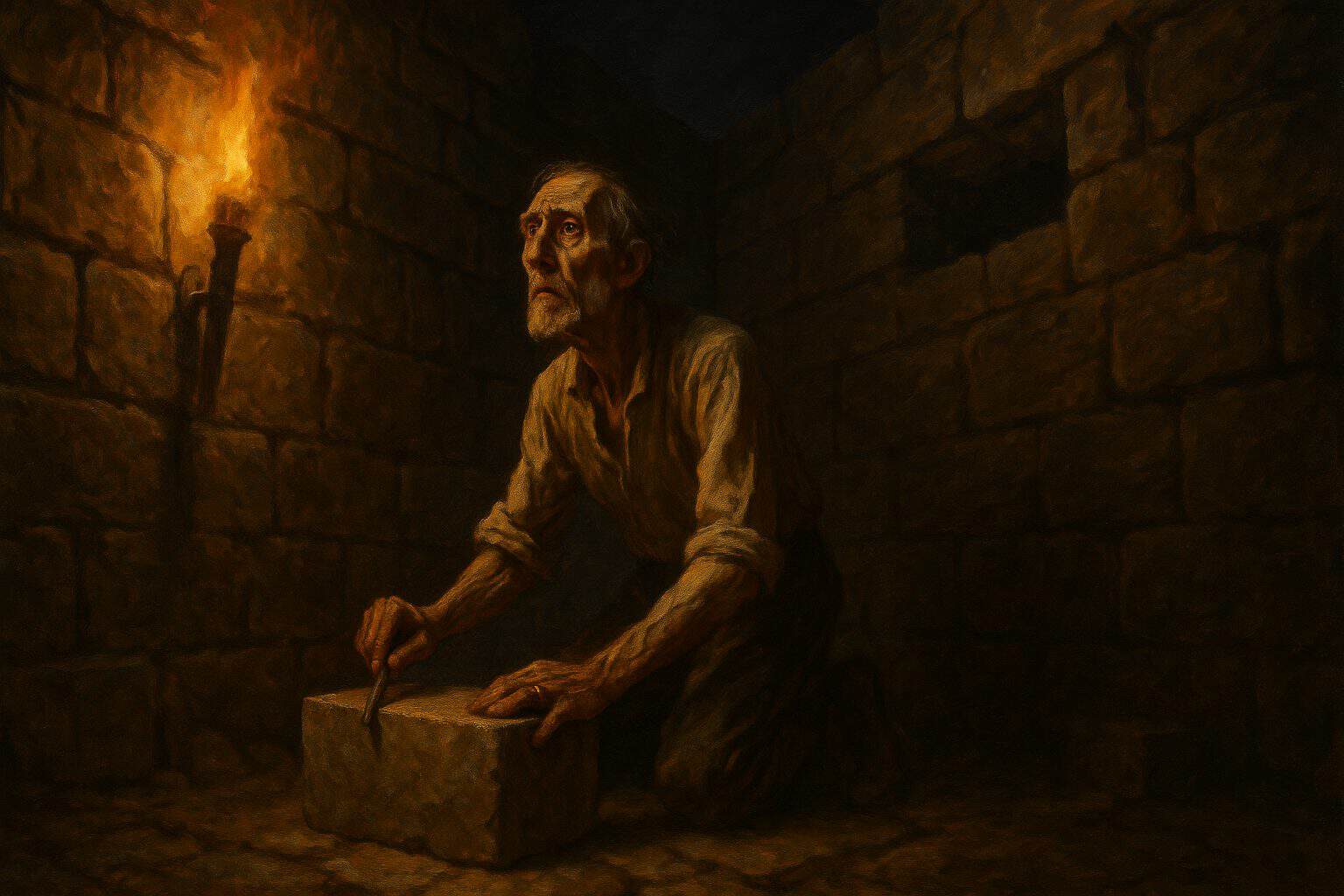
The mind does not build itself a stronghold; it discovers it has always been building, and calls the architecture thought.
I. The Quarry Before the Wall
There exists a moment—scarcely noticed, never announced—when the thinker realizes that raw sensation can be extracted from the flux of living and hardened into concept. Not as defense, but as mastery. The phenomenological eye watches this happen: a feeling arrives (shapeless, wet, immediate), and the mind’s hand reaches for the chisel. What was lived becomes lodged. What was particular becomes repeatable. This is not yet a fortress; this is the quarrying. The limestone of direct experience is being separated from the surrounding earth, squared, dried. The thinker stands at the edge of this labor and feels, for the first time, that the world might be manageable—that chaos has a grain, and the grain can be cut.
Anthony Adore understood this. In the construction of the Codex, he was not primarily defending against confusion; he was discovering that confusion could be systematized. “I forged the Codex to manage risk—with Jeannètte and Jane as my two muses… a shield against confusion, a human system erected where trust failed.” But notice: the shield came after the system. The architecture preceded the defensive intention. The mind had already begun its extraction work. The walls were already rising, stone by stone, before he named them walls.
This is the phenomenology of intellectual fortification that the siblings have not yet entered: the ontology of the trowel, where thinking becomes visible as a labor of making-hard, of rendering-permanent, of refusing-the-fluid. The fortress is not a reaction to siege; it is the very shape that consciousness takes when it insists on standing still.
II. The Load-Bearing Assumption
Every fortress rests on bedrock, whether visible or not. In the intellectual keep, this bedrock is the assumption—the premise so fundamental that it need not be questioned because it has become the very ground upon which questioning stands. For Anthony, this bedrock was stated with the clarity of a man who had tested it: “My mind constituted the only territory I truly controlled, and I refused to let it be infected by secondhand haze.”
Here is the ontological weight. Not I prefer to think for myself—but I control nothing else. The assumption is not modest; it is absolute. From this single bedrock, everything rises. If the mind is the only territory, then its fortification becomes not optional but necessary. The walls are not built around the mind; they are the mind’s acknowledgment of its own isolation. The keep becomes identical with consciousness itself.
“Where she prided herself on her body’s spell, I prided myself on the walls surrounding my heart and spirit.”
This is not metaphor. This is ontology. The walls are not around the spirit; they constitute it. The distinction matters phenomenologically. A wall around something implies an inside and an outside, a protected thing and a protecting structure. But when the wall is the structure of consciousness itself, when the boundary between inner and outer has collapsed into the very act of thinking, then fortification ceases to be a response and becomes a mode of being.
The load-bearing assumption carries the entire weight: I am alone in my knowing, therefore I must be impenetrable in my knowing. Everything else—every corridor, every battlement, every gate—hangs from this single, invisible beam.
III. The Vertical Load of Inference
The mind builds upward. This is the secret architecture that phenomenology rarely names. Thought does not spread horizontally into the world; it stacks vertically, each inference resting on the one below, each logical step a course of stone mortared with the refusal of contradiction. The plumb line of non-contradiction becomes the fortress’s internal gravity. Everything must align. Everything must support what comes above it.
Anthony’s analytical framework—what he called Fractions—was precisely this: “The analytical framework of Fractions was my psychological defense, my initial analytical response to that personal emotional chaos.” But defense is the secondary word here. Primary is the vertical stacking. Chaos is not defended against; it is resolved into layers. Each layer is a definition, a boundary, a refusal of ambiguity. The higher one climbs into abstraction, the further one stands from the trembling ground of immediate feeling.
This is why solitude becomes not just preferred but necessary to the intellectual fortress. “They tend to favor solitude instead of gatherings of people, derive pleasure from contemplating abstract ideas as opposed to sensory stimuli.” The fortress requires silence, not because noise is dangerous, but because the vertical load of inference cannot tolerate horizontal interruption. Another person is a horizontal force. They come at you from the side, from the level of the living body, from the chaos that the mind has spent such labor to transcend. The fortress’s walls must be perpendicular to the ground; they cannot accommodate the slant of another’s presence.
IV. The Aperture Problem: Windows as Necessity
A fortress that is sealed is not a mind; it is a tomb. Yet the intellectual keep faces a paradox it can scarcely acknowledge: it must have openings, and every opening is a vulnerability. How does thought remain fortified while remaining thinking?
The answer arrives as a geometrical problem. The fortress permits apertures—narrow, calculated, defended. These are not the generous windows of a house open to the world. These are ports, slits, carefully positioned to allow vision outward while minimizing the angle of approach inward. They are watchtowers of observation, not invitations to intimacy.
“From behind the walls guarding my spirit, I projected invitation: signals woven into glance, posture, and word.”
This is the aperture functioning as intended: a controlled emission from a defended interior. The signal goes out, but the sender remains behind the wall. The gesture of intimacy is made, but the fortress’s integrity is preserved. The opening is real—it must be, or there is no communication—but it is minimal, strategic, reversible. One can close the aperture. One can withdraw the signal. The wall remains intact.
The phenomenology here is precise: the aperture does not breach the fortress; it proves the fortress’s sophistication. A mind that has no openings is not fortified; it is dead. A mind that permits openings without calculation is not fortified; it is naive. The intellectual keep survives by learning to speak from behind its walls, to gesture without surrendering, to signal while remaining fundamentally enclosed.
V. The Interior Courtyard: The Room That Must Not Be Breached
Within the fortress, there is a keep-within-the-keep. A room. A space so heavily guarded that even the mind’s own consciousness approaches it with reverence and fear. This is the non-negotiable narrative—the story the self tells itself about itself that, if questioned, would collapse the entire structure.
For Anthony, this room held particular furniture: the conviction of his own intellectual superiority, the belief that his mind was a fortress that could not be penetrated, that his heart was a citadel that could not be taken. “The belief any woman could ensnare my heart with her body is and was ludicrous. The notion that my mind and spirit were weak enough… was an insult.”
But here is where the fortress reveals its deepest paradox: the room that must not be breached is also the room in which the fortress-builder is imprisoned. “Like a larva spinning a cocoon, I built walls to keep the world out. But I failed to realize then that such defenses… also imprisoned me within.” The wall that protects the inner room is also the wall that confines it. The keep becomes a cell.
This is not a flaw in the architecture; it is the necessary cost of the architecture. Every fortress that succeeds in its defense also succeeds in its confinement. The mind that has made itself impenetrable has also made itself isolated. The consciousness that has achieved perfect self-control has also achieved perfect self-enclosure. “But in truth, the walls I built to keep the world out were also the walls that kept me in. If they defended me, they imprisoned me. A citadel can be a cell.”
The phenomenology of this recognition is devastating because it arrives too late—after the walls have been mortared, after the vertical loads have been stacked, after the apertures have been calculated. The room that was meant to be protected has become a prison. And the prisoner has become so accustomed to the walls that he can no longer remember what the world looks like from the other side.
VI. The Whetstone: Sharpening Against the Greater Mind
There is a peculiar labor that the intellectual fortress permits: self-refinement through opposition. Not surrender to opposition, but sharpening against it. The fortress does not collapse when challenged by a greater intellect; instead, it hones itself. “He must increase his self-awareness about his motivations and sharpen his mind against the whetstone of intellectuals greater than himself.”
This is the fortress’s mechanism for remaining alive while remaining fortified. The walls do not soften; they become more precisely articulated. The logic does not yield; it becomes more rigorous. The apertures do not widen; they become more strategically positioned. Every encounter with a superior intellect is an opportunity for the fortress to prove its own architecture, to test its load-bearing assumptions, to refine its vertical stacking of inference.
But notice what this labor requires: it requires the presence of worthy opposition. The fortress cannot sharpen itself against mediocrity. It needs an intellect that is genuinely formidable, genuinely other, genuinely capable of threatening the structure. And so the fortress-builder finds himself in a strange dependency: he needs the very thing that threatens him. He needs the whetstone. He needs the challenge. He needs the other mind, precisely because it is other, precisely because it cannot be fully incorporated into the fortress’s interior logic.
This is why the fortress-builder often surrounds himself with minds he respects, minds he fears, minds he cannot fully master. They keep the walls sharp. They keep the structure from calcifying into dogma. They are not friends, exactly; they are necessary adversaries. The fortress requires them to remain a fortress and not become a mausoleum.
VII. The Unbuilding: When the Architect Turns on the Plan
There comes a moment—not often, but sometimes—when the consciousness that has spent such labor building the fortress turns inward and asks: What have I built, and at what cost? This is not the moment of the fortress’s collapse. Collapse is violent, sudden, external. This is something slower, more interior, more devastating: the moment when the builder becomes aware of his own building.
“Feelings and thoughts from these involvements follow the individual to solitude’s door where he or she either invites them in or leaves them standing outside. At times they are ambassadors of clarification and insight, while at other times, they are harbingers of pain.”
The fortress-builder stands at this door. Behind him, the structure he has built—perfect in its logic, impeccable in its vertical load, precise in its apertures, absolute in its interior room. Before him, the world—messy, horizontal, demanding, alive with the presence of others. The door is not a gate that can be opened or closed at will. It is a threshold, a space where two ontologies meet and refuse to merge.
To invite the feelings in is to risk the fortress. To leave them standing outside is to remain imprisoned in the keep. There is no third option. There is no compromise that preserves both the structure and the life. The fortress is, in its very essence, a refusal. It refuses the horizontal, the ambiguous, the uncontrollable. And this refusal is also a cost. It costs the fortress-builder his access to the world that exists beyond the walls.
The unbuilding does not happen all at once. It happens in small recognitions, quiet surrenders, moments when the keeper of the keep admits—if only to himself—that he has built something magnificent and something terrible, something that has protected him and imprisoned him, something that has made him strong and made him alone.
This is where the intellectual fortress meets its own phenomenological limit: the point at which the mind becomes aware that thinking about the fortress is not the same as living beyond it, and that no amount of intellectual sophistication can dissolve the walls that the intellect itself has built.