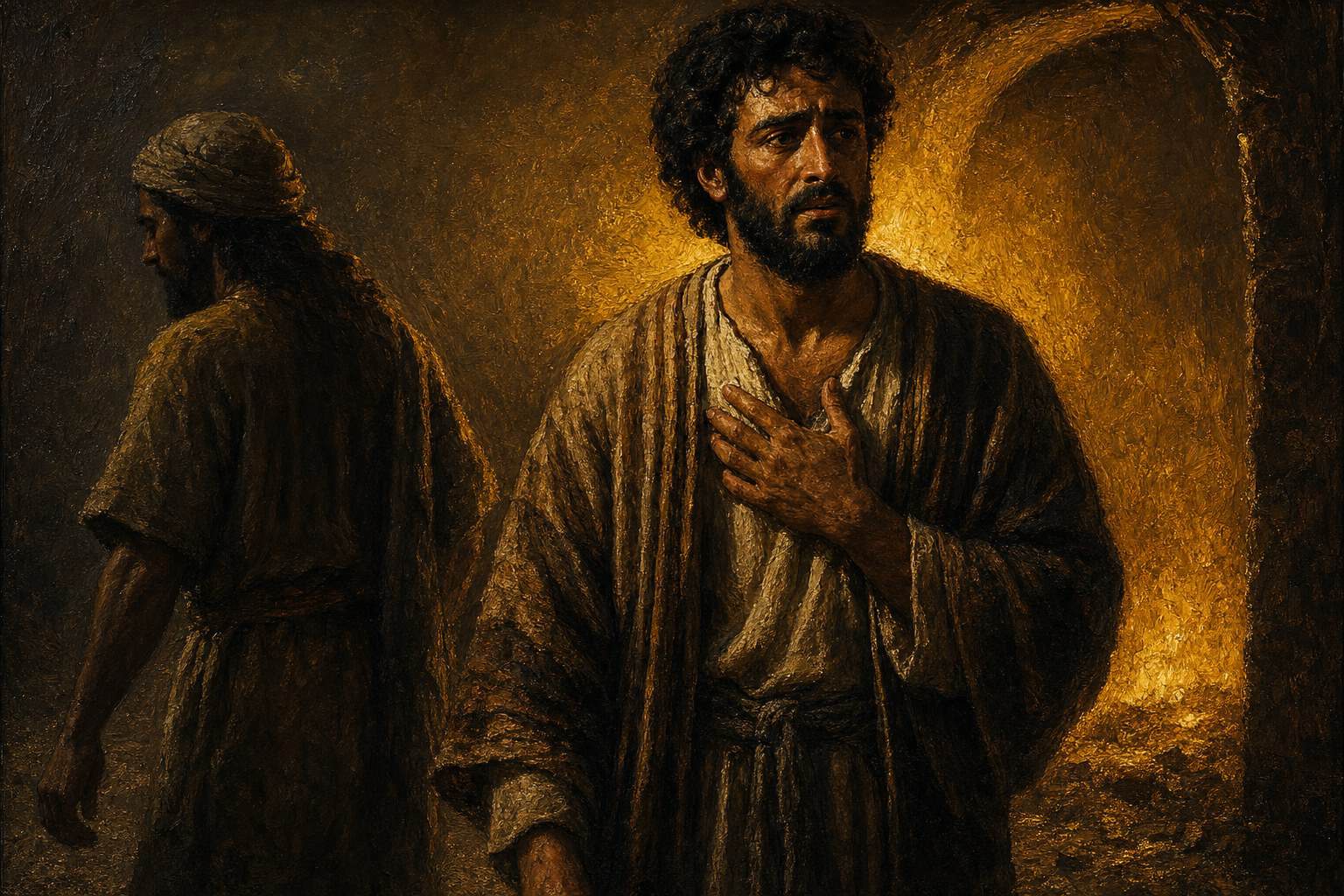
Feeling God’s presence physically when you feel only pain? A reflection on the moment despair became a place where He was already standing.
The Girl Who Built Her House on His Bones
Begin with a young man cast out. There was a girl named Jeannètte, and she was his first true love, and she chose someone else. In Confessions to the Empty Chair this is not a footnote or a passing ache; it is the ground zero of everything that follows. The older narrator, looking back across thirty years, refuses to pretend the bond was shallow. He insists it was real, because a shallow wound heals in a season and a real one opens a passage down into places a man cannot reach on his own. He uses a hard image for what happened. She built a new life on top of his body, the way a village raises houses over old graves, and his bones became the floor of her future. Feel the specific humiliation in that. Not only rejected, but rejected and then walked over, used as foundation while she moved on untouched, alive, elsewhere. He was not enough to be kept, and worse, he was still useful as ground, as something to stand on and then forget. That is the sensation the searcher who typed feeling god’s presence physically may not expect to meet here first. Because the physical thing this young man felt was not warmth, not comfort, not any glow of the divine settling over him like a blanket. He felt heat. He felt himself burning. He felt scorched, hollowed, thinned down to a raw nerve. His chest hurt. His hands did not know what to do with themselves. Sleep came in pieces or not at all, and morning arrived like a second sentence. The question of where God is when you feel Him in the body opens, in this chapter, onto the possibility that the fire itself was the feeling, that the sensation on the flesh was scorching rather than solace. The narrator does not smooth this over. He lets the reader sit inside the raw fact that during this whole stretch God said nothing. Silent, he calls Him, and he chooses that word with care. Not gone, but silent. That distinction is the whole tension of the scene. A man in agony, abandoned by the girl and, it seemed, by heaven at the same hour, standing in a heat he never asked for. He wanted to be seen and kept. Instead he was seen just enough to be used, and then set down like a tool. The chapter begins in the ash of that, and it declines every quick rescue. It asks a question the older man is still turning in his hands: what if the burning was never punishment, and never absence, but a nearness he could not yet recognize as touch?
A Black Flame He Could Not Read Right
The heat had a color, and the color was wrong. Inside the fire, the young man saw only blackness. He named it with the private mythology he had built to survive: a black flame of sorrow, of depression, of the strange downward pull toward hurting himself further, toward pressing on the bruise because the bruise was at least his. Everything in him read the fire as evidence of ruin. He was being consumed, he thought, and consumed by something dark, and the darkness only confirmed what the loss had already told him, that he was worthless enough to be walked over and left behind. Here the older narrator does something quietly devastating. He explains that the flame’s color was never a property of the fire at all. The blackness was a reflection. It was his own state thrown back at him, his blemished lens smoking the glass, so that a bright thing looked like a pit and warmth read as annihilation. This is where the assigned angle bites hardest. A man dissolving under another’s absence, unseen and set aside, cannot trust his own eyes. When you feel erased, you read every signal as further erasure. The fire that should have announced a presence instead seemed to spell out his end, letter by letter. And this is exactly why the search to feel God on the flesh so often misleads. The narrator was hunting for Him through the raw nerve of sensation, through the reports of the body, and the body was screaming that it was being destroyed. Yet the thing more inward to him than his own most inward part was already there, closer than the pain itself, and he could not perceive it because he was straining for a rescue shaped like his own idea of comfort. He wanted a hand reaching down to lift him clear, the way he remembered being healed once at thirteen. That is not what came. What came was heat, and silence, and a girl’s fresh life raised on his ribs. He interrogates himself here without mercy. Did he cling? Yes, he confesses, he burned to the exact degree that he clung to other things, to her, to the discarded picture of himself she had carried off. The fire was measuring his grip. Every place he held on hardest was precisely where he scorched worst. There is no cheap comfort offered in this. The older man never says the pain was small or the loss deserved or the girl a villain simple enough to hate and be done with. He says the reading was wrong, that the eye was smoked, and that a smoked eye cannot tell holy fire from hell. The tension gathers toward an unbearable reversal. The very thing he was certain was killing him may have been the nearest thing keeping him alive, the one heat that would not let him freeze into nothing.
The Fourth Man Was Always Walking Beside Him
Then the turn. The narrator reaches for an old story of three men thrown bound into a furnace, and a fourth seen walking with them in the flames, unbound, unburned, calm amid the roar. He places himself inside that furnace. The claim is staggering and he makes it plainly. God did not pull him out of the fire. God stood in it. The heat he was sure was destroying him was the place where the presence waited, and the presence had been walking there the whole while, in the ash and the sorrow and the self-loathing, in every tear on his face, closer than the wound in his chest. This is the answer to the searcher’s question, and it is not the answer most people want to hear. To feel God physically was not, for this young man, to feel relief flood his limbs and the tightness leave his throat. It was to be pulled up into the fire where He already stood. The burning was the meeting place. The narrator calls it a tent of meeting, the fire itself the very breath passing between Father and Son, and he is saying the sorrow and the masochism he had labeled a black flame were only the outer skin of a holy one. He does not pretend he grasped this at the time. He says he believes it now, decades on, and that the old man he has become prays backward for the young man he was, asking that God do whatever it takes to draw him nearer to His heart. He believes that prayer was answered in his past. Not by removing the girl, not by lifting the shame. By refusing to leave him alone in the heat.
Grace rarely reaches down to lift you out; more often it climbs into the furnace and waits until you notice you were never burning alone.
Sit with how strange this is. The presence he begged for was granted, but dressed as the very thing he most dreaded, hidden inside the desolation like a coal inside ash. His anguish was fuel, Jeannètte’s rejection the instrument, and the whole terrible apparatus was refining something that comfort alone could never have made. He interrogates even this. Is he only narrating consolation into old suffering because he cannot bear the thought that he suffered for nothing? He knows the risk. He knows a man can gild his wounds long after the fact and call the gilding wisdom. But he holds the harder line anyway. The fire was real, the nearness was real, and both were true in the same moment, in the same body, without either one canceling the other out.
Grace rarely reaches down to lift you out; more often it climbs into the furnace and waits until you notice you were never burning alone.
The Fortress He Built Became a Cell
Coming out of the forge, something had changed, and not only for the better. The narrator names the cost with unusual precision. To survive the burning, he built a habit of watching. He turned himself into an observer, a man who stands a half-step outside every moment and studies it, measures it, files it away where it cannot ambush him. He calls this instrument a Codex, and he admits without flinching that it saved him. But he admits, too, what it did to him afterward. The analytical fortress became its own cage. In mastering the stance of the one who watches, he perfected his own isolation. He learned to understand people from a clinical distance, and the understanding itself curdled into a kind of control, a way of managing others so that no one could ever do to him again what the girl had done. Here is the second erasure, quieter and slower than the first. He was walked over once by someone else. Now he arranges to stand apart from everyone, so that no one draws close enough to walk over him a second time, and in that very arrangement he erases himself from real contact. He becomes vividly present to himself and steadily absent from others, choosing to see them through a smoked glass on purpose, because the dimness feels safer than the risk of being fully seen. This is the part he confesses most honestly, and it is the part that costs him. The observer stance kept him at arm’s length from the exact connection he craved most. He wanted to be known and kept, and he had built, with his own hands, the one mechanism guaranteed to prevent it. When he later meets someone named Leigh, she sees a steady light in him. He is careful to say what that light was and was not. It was not the ghost of the old love still smoldering. It was the composure of a man who had come through the fire whole, a beacon born from turning anguish into structure. But the same structure that gave him that steady light was also the wall holding Leigh, and everyone else, on the far side of it. He does not pretend he has repaired this. Thirty years on, he says, he has not retired the defense. He has chosen to keep it, knowingly, the way a man keeps a habit he no longer trusts but cannot quite release. That admission is the ache under the falling action. The man who found God in the furnace walked back out carrying a habit of detachment he still cannot fully set down, understanding worn as armor, observation held like a spear at a distance, the very gift that once saved him now the same thing that leaves him standing alone in rooms full of people.
When the Watchtower Learns to Kneel
So where does it settle. Not in triumph, and not in ruin, but in a slow reworking of the same raw material he has carried all along. The narrator offers one line that changes the whole geometry of his life. Under Love’s rule, he writes, the same structure becomes a chapel; the page turns to an altar. The fortress does not have to be torn down stone by stone. It can be reconsecrated. The habit of watching, which he raised as a wall, can be turned into a way of attending, of noticing another person so closely that the noticing becomes reverence instead of surveillance. The distance that isolated him can, if love governs it rather than fear, become the reverent distance of a man who dares not stare too boldly at what is holy, the way an old story tells of a man before God growing so aware of his own smallness that he lowered his eyes and did not presume to look. This is the resolution, and it stays faithful to how the whole chapter has moved. Nothing is erased. The fire is not un-burned. The girl’s rejection is not un-suffered. The observer’s stance is not deleted from him. Everything is transmuted instead. That word matters to him, and he leans his whole weight on it. Transmutation, not removal. The anguish becomes structure. The structure becomes a chapel. The watchtower, at long last, learns to kneel. He is honest that this is a lifelong and unfinished labor, that he still catches himself standing apart when he means to draw near, still turning people into objects of study when he means to love them face to face. But he now knows what the watching was always for. It was never meant to be a cage. It was meant to be a way of seeing that could, under grace, finally see another person clean, without any need to master or manage them. That is the pull of this book. It does not promise that God will lift you out of your fire or hand back the ones who walked over you. It promises something harder and stranger and, in the end, more durable: that He is already inside the furnace, walking, and that the very defenses you hammered together to survive the burning can be reforged into altars. The searcher who wanted to feel God in the body will find here a man who felt Him as heat, mistook Him for darkness, and then spent thirty years learning to read the flame right. This is where he shows his work, and where he lets the guarded question stand open in the quiet: whether a watchtower, at last, can cradle a candle instead of leveling a spear.