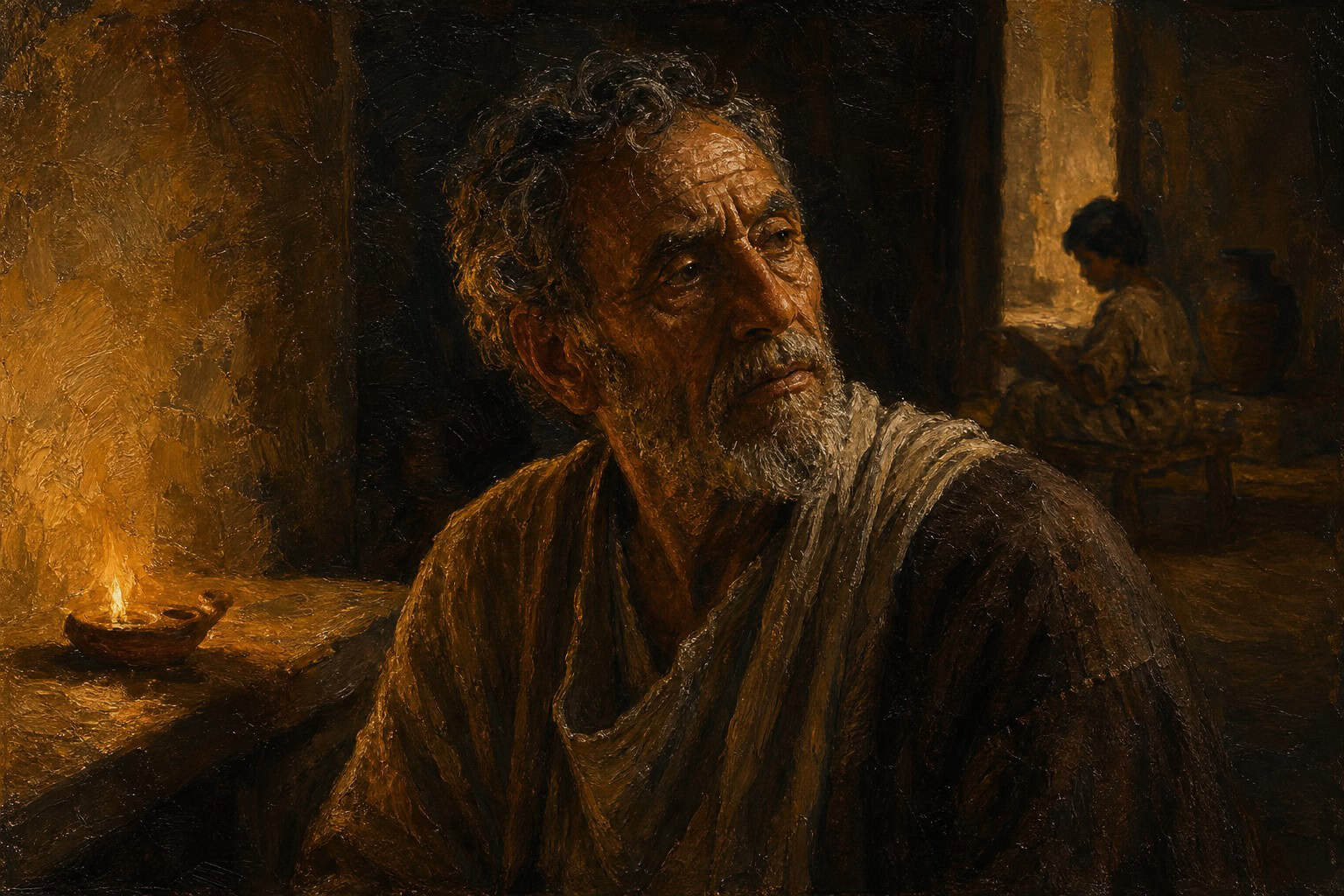
Why didn’t God protect me as a child? A reflection on a wound laid down before memory forms, an absence that felt like abandonment, and the God found walking inside the dark.
A Campaign Begun at Three Years Old
Why didn’t God protect me? The question sits under the skin of every child who cannot remember when the harm started, or when He seemed to leave, only that some door in the soul was already shut before he learned to speak. In the fourth chapter of Confessions to the Empty Chair, the narrator turns his gaze back across ten years to a boy of three, and he tells us something almost unbearable: that a campaign was launched against him then, coordinated, ancient, aimed at the small and defenseless. He was too young to consent. He was too young to comprehend. That is exactly why it worked. The dark ones did not wait for him to understand what a soul was; they moved against him while he was still incapable of naming the intrusion, while his hands were too small to close around anything and hold it. He describes it as a study of his weaknesses, a bloodline reviewed the way a general reviews terrain before he sends anyone across it. Somewhere in that early scene a teenage girl was sent to perform a rite over him, and the boy had no idea what was being done, no word for it, no way to refuse. That is the part that will not let a reader go. The child did not experience a campaign. He experienced a person sent to him, a feeling that had no name yet and would only later harden into a wound with a name. He felt whatever a three-year-old feels when something wrong is happening in a place he trusts, and he had nowhere to put it. The vastness of it is what stuns me first, before the horror even arrives. An enormous, patient malice bent low over a speck of a boy who could not see the shape of what leaned toward him. The older narrator, writing now, hands the boy the grammar the boy never had. He tells us plainly that the marks laid down in those first years became the very letters he would spell his later battles in. He is not inventing a nightmare for effect. He is giving a sober account of how contamination sinks into a life before memory can stand guard at the entrance. And here the searcher’s question lands and cannot leave: where was God when a child was reached for? If something began before I could remember, before I could resist, before I could even know I was being reached for, then whatever leaving I feel was never something I chose or earned. It was done to me in a place I cannot revisit, by hands I cannot picture, in a dark that closed behind me before I could turn around. And I have carried it since as if the fault were mine, as if the smallness had been a choice.
The Body That Remembers What the Mind Cannot Hold
The wound of it lives in the body long before the mind can find the file. The narrator confesses a reaction to women that split him down the middle: drawn and repelled at once, curious about their bodies, soured by their words, pulled toward what he also despised. He does not spare himself. He calls his own attraction a lust he hated, an appetite for those he judged beneath him, and then he turns and interrogates the judgment itself, exposing the pride hiding under the disgust. This is the honesty that makes the chapter hard to set down. He will not let himself off as a pure victim, even where he clearly was one. He watches his own heart contradict itself in real time. The flesh wants; the spirit recoils; the mind builds contempt to cover the wanting; and beneath all of it a three-year-old was reached for in a way that shaped how his skin would answer for the rest of his life. He describes girls his age with a cruelty he seems to know is a symptom, their giggles, their easy availability to other boys, an instinct he compares to a dog’s leg kicking under a scratch. The comparison is ugly, and he knows it is ugly, and he lets it stand because it is honest about who he was. The scene names the strategy plainly: the enemy could not touch his spirit directly, so it went for the physical, the fleshy, the appetites a boy inherits before he can weigh them. His body learned a habit of response before his soul had any vote. That is the terrible economy of it. His perception itself was colored at the root, so that when he looked at a woman he was not seeing cleanly. He was seeing through a stain laid down at three. He wanted to be taller, richer, stronger, more social, and he blamed his loneliness on the lack of these things. But the older narrator suspects the loneliness ran deeper than height ever could. The complications he found in other people may have been the complications planted in himself. He asks, without answering, whether the coldness he felt toward girls his age was really superiority or really fear, whether the contempt was armor bolted over the old violation. What did he refuse to see? That his disgust was not clarity but a symptom. That the very sharpness of his judgment was proof of how deep the campaign had reached. He carried the wound like a verdict against everyone but himself. Only years later, writing this down, could he begin to suspect the verdict had been filed under the wrong name. The body remembered what happened. The mind arrived late and kept trying to make the memory somebody else’s crime.
An Absence That Was Mercy in Disguise
Then comes the turn, and it does not arrive as rescue. The narrator recalls an encounter with the Lord that soothed and taught and comforted him in a measure small enough for a child to bear, because God held back His own power so as not to obliterate a boy who had no wings and had kissed no purifying coal. God came down to the size of a three-year-old’s understanding, penetrating the whole of that small world the way sunlight fills a room without breaking the walls. And then, after that, the Lord seemed to withdraw. The absence brought tears to the boy’s heart and cast a melancholy veil over the whole world he looked at afterward. Here the searcher’s question meets its hardest answer. Why didn’t God protect me, and why did He seem to leave? The narrator felt left. He felt the withdrawal as a warmth pulling back, a taste allowed and then eased away just as he began to know it. But the older self, writing, reads the same moment differently and refuses the cheap consolation. He suggests the perceived absence was itself a kind of protection, a severe grace that kept him from a worse ruin, that frustrated the demons and his own hungers in the same stroke. This is not a tidy comfort, and he does not offer it as one. The tears were real. The veil was real. The sadness did not lift because someone explained it. God did not remove the darkness; He walked into it. The closer the soul draws to that immense light, the deeper the obscurity it feels, because its own weakness cannot hold so much brightness at once. So the child, drawing near, felt only dark, and mistook the dark for departure.
Evil moves against the child precisely because the child cannot yet name what is being done to him.
The Veil That Would Not Lift
What settled over the boy after that encounter was not resolution but a permanent tension, two immense powers pulling him in opposite directions across a divided heart. Hell offered glory, riches, pleasure, everything the flesh could name and reach for. Heaven offered a secret path of struggle and change, an intimacy that had to be earned through wounding. The narrator does not pretend these were evenly matched or easily told apart in the moment. Lust pulled one way; Christ pulled the other; and the boy stood between them without the strength to declare for either. The melancholy did not go. That is what the searcher needs to hear, and what the chapter honors instead of erasing: the veil stayed on. God’s nearness did not wipe the sadness away. It soaked into it. Every tear the boy wept was a tear the Lord was somehow already inside of, present as company rather than as a hand that dries the face and sends the child back out to play. The fallout from that early encounter was a whole altered way of seeing, the world now viewed through grief, dimmed, slowed, tinted at the edges. And the narrator, turning this over, poses the question he cannot answer: was the sadness a wound or a gift? Did the veil shield him from the perverse glory Hell kept dangling, or did it simply mark him as a boy who would never again see the world without ache under it? He holds both at once and will not choose. He admits the melancholy made him vulnerable in fresh ways even as it guarded him in others. What he refuses to do is pretend the darkness was a phase he walked through cleanly and left behind. It became the air he breathed. The transformation Heaven held out was not a rescue from struggle but a deeper wading into it, a path where the reward was closeness and the price was suffering. He wanted deliverance. He got accompaniment. He wanted the world to grow bright. Instead he learned there was Someone already close in the dim of it, quiet, not leaving. Sitting years later with the empty chair the whole book keeps circling back to, the older narrator seems to grasp that some absences are the shape love takes when it will not let you have the thing that would destroy you. But grasping it did not dry the tears. It only taught him whose presence had been hidden inside them the entire time, keeping pace beside him in a dark he could not yet see through.
Walked With, Not Rescued
So where does the searcher stand at the end of it? Not on solid ground. The question, why didn’t God protect me as a child, does not close with a comforting answer stamped across it. The narrator hands over no verse that dissolves the ache, no lesson that ties the childhood shut. What he gives instead is a reordering of the whole event. The leaving he felt was real to the boy and false to the truth. Something did move against him at three, coordinated and ancient, and it marked him before he could defend a single inch of himself. That is not denied anywhere in the chapter. But the marking was not the last word laid on his soul. Beneath the campaign, branded deeper than the contamination, was the memory of an embrace, the encounter that shielded his spirit even while his flesh was being overrun. The enemy could reach the body and not the spirit precisely because that embrace had been pressed in first, before the darkness came. The searcher who feels marked by violations he barely remembers may find here not a cure but a companion. The chapter does not promise the darkness lifts. It insists on something stranger and harder: that God is found within the dark, quiet, walking, present in every tear, showing Himself by staying rather than by taking the pain away. This is the awe of the thing, that a Being vast enough to fill all space, soaking through the whole mass of the world like light through open air, should shrink Himself down to the size of a three-year-old’s mind, should sit inside a wounded child’s grief instead of obliterating it. The nearness is the miracle, not the erasure. Confessions to the Empty Chair refuses to hand the reader an ending to the campaign begun so early. It hands over a witness instead, a man who traced his oldest wound back past memory, who would not pretend it was only ever done to him or only ever his own fault, and who found, in the very absence that felt like abandonment, a Presence that had never actually gone anywhere. If you have wondered why God did not protect you, why you were left, this chapter will not tell you that you were not. It will tell you that being left and being accompanied are not always opposites. It will tell you the darkest room may already be occupied by the One you were certain had walked out of it, seated low in the dim, close enough to breathe. The rest of it waits inside the book, carried in the boy’s own trembling voice.