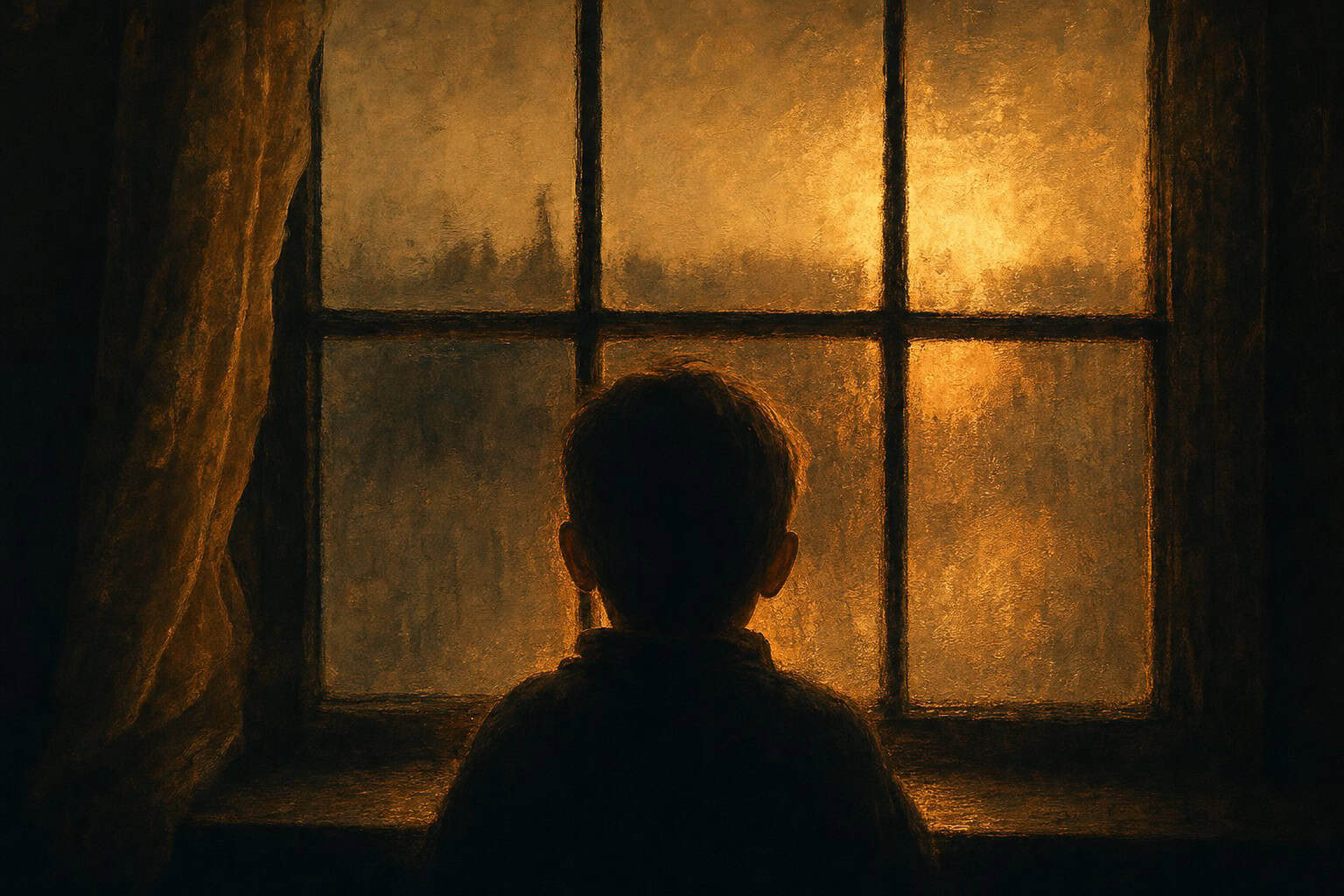
His breath clouds a soft circle on the cold pane while other children sprint across patchy grass outside, and he takes up the terrible bargain of the watcher: to learn love this well is to slowly forfeit the right to be held by it.
Fogged Glass and the Gravity of Play
Small lungs warm a cold pane until it clouds, a soft circle of breath framing the world he cannot touch. Outside, children sprint across patchy grass, shirts sticking to their backs, shoelaces slapping, a shriek of tag and capture. Inside, his socks grip linoleum as he leans closer, fingers spread against the chill, feeling the tiny sting of condensation dampening his skin. Nobody has ordered him to stay in; no adult has banned the game. He chooses the stillness, pulled by something he does not yet name, a longing older than his years and deeper than the yard. This is the first kind of research: not in books, but in bodies moving, missing, colliding, mending. He studies the way a hand on a shoulder can both claim and comfort, how one child’s absence tilts the entire circle. The scene belongs to early childhood in that first chapter, where Eden’s ache hums beneath scraped knees and plastic toys, and a boy learns that observation has its own sweetness and poison.
The Cold Science of Staying Inside
Distance hardens into method before he ever learns the word. He notices that when he stays behind the glass, nothing unexpected touches him: no sudden shove, no pulled shirt, no demand to run when he wants to stand still. From this remove, patterns emerge with cruel clarity. He can tell who will be called first when teams form, whose joke will land, whose mistake will be forgiven. The cost is immediate and bodily: his own name is never shouted from the yard, his muscles never burn with the same shared exhaustion. A lesson settles in like a stone—if he wants to read the map of human ties, he must step off the road. This passage presses on that trade: knowledge purchased with loneliness, control at the expense of communion. The boy is not yet accusing anyone; he is quietly counting. Every new insight about how people move toward each other is matched by one more step back from where they might have moved toward him.
Crossed Arms and the Silent ‘No’
He begins to see that bodies speak before mouths part. On the other side of the window, arms uncurl when certain faces appear, shoulders soften, feet angle inward like compass needles finding north. Others receive only tightened jaws, torsos turned slightly away, a half-step back that closes every invitation. He watches this choreography with ruthless precision, until he can anticipate the welcome or rejection before it happens. In the same moment, his own body writes a script he barely feels: arms cinched tight across his chest, spine fused to the inner wall, legs locked, as if bracing for a wave that never breaks. That posture becomes a silent shout none of the children can articulate but all of them obey. They glance toward the house, sense the hardness of his stance, and let their gaze skip past. The pressure here is not abstract; it lives in muscle memory. His vigilance trains his flesh to say no faster than his heart can whisper yes, and the gap between the two widens every year.
There is a terrible bargain in becoming the watcher behind the glass: to understand love so well, you slowly forfeit the right to be loved.
The Cost of Being Everyone’s Expert and No One’s Beloved
There is a grown version of this boy in almost every workplace, parish, and family. The one who can narrate any conflict from all sides, who spots the bruise beneath a joke, who predicts which couple will not last the year. People drift to them for counsel because they see so clearly where affection twists into control, where need masquerades as care. Yet when the birthday dinner ends or the group chat goes quiet, they walk home alone, holding coats but held by no one. The passage lifts this tension without softening it: you can train your mind and body to scan every room for hidden currents, to anticipate danger, to decode the faintest change in tone—and in doing so, you can make yourself relationally bulletproof. Bulletproof also means nothing pierces. For an ordinary reader, the mirror is uncomfortable: how often do you stand at your own kind of window, analyzing others’ ties instead of risking your own, mistaking sharp insight for actual intimacy?
Notebooks Stacked Beside an Empty Chair
Years pass, and the glass becomes interior. He no longer needs a literal window; the habit of standing just outside his own life has sunk into the marrow. What once was fog on a pane turns into ink on paper—spirals of notes about how bodies turn toward each other, diagrams of conversations, private theories on why some people are always chosen. The notebooks pile up on a desk beside a chair no one else ever uses, pages fluttering in the night air from an open vent. Each volume refines his grasp of human gravity, of the unseen aches that pull people into orbit or fling them apart. And still, his own orbit stays clean and spare. This passage refuses to tell you whether he ever steps away from that desk, or whether anyone ever sits in that second chair. It leaves you instead with the image of those stacked notebooks, weighty and mute, while somewhere a ball hits grass, and someone shouts a name into the fading light.