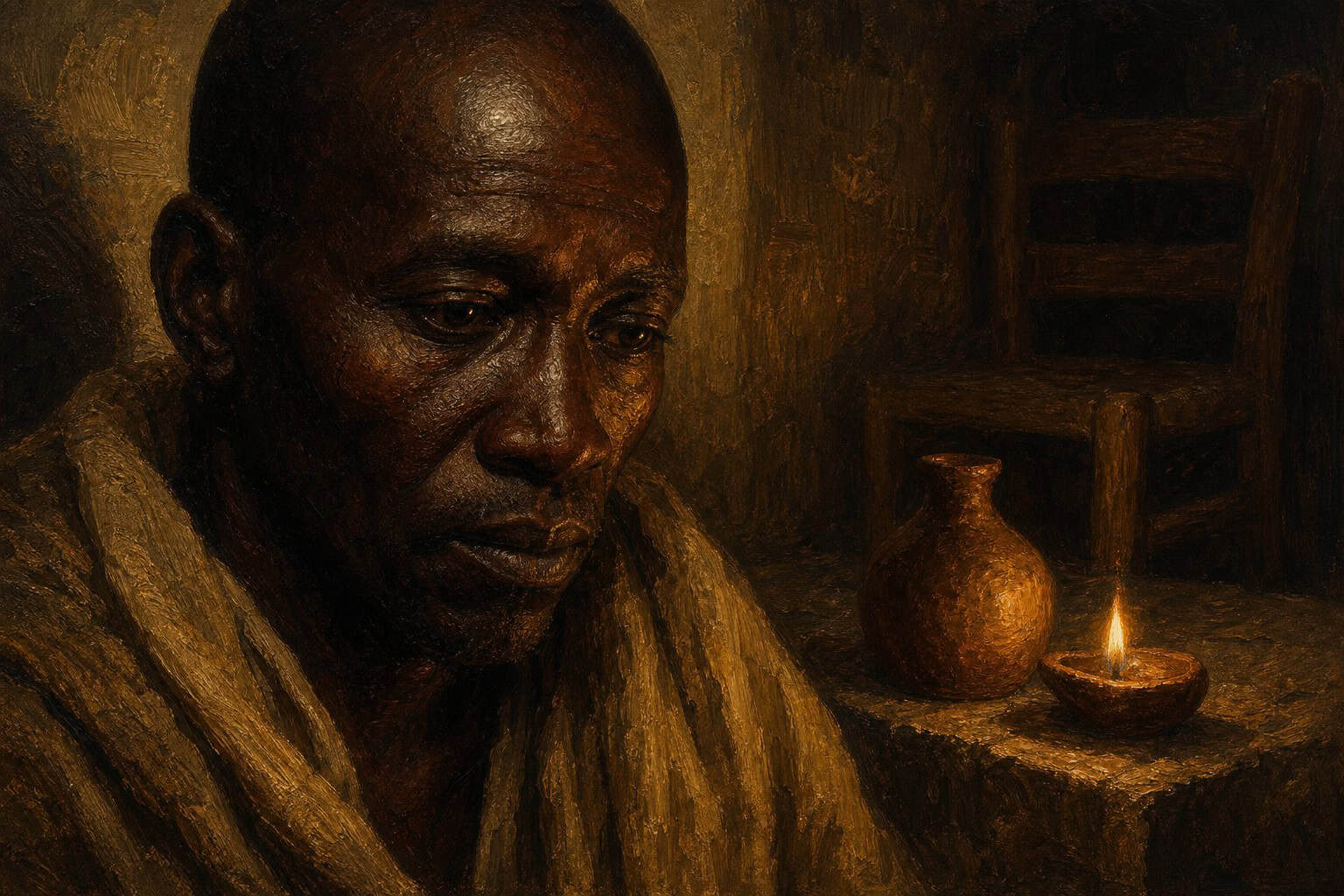
You want to hide the pain, and medicine offers a way. But what does it cost to reduce your grief to chemistry? A reflection on pain, body, and meaning.
The Same Small Pills in Two Trembling Hands
You reached for the explanation because it let you stop feeling for a moment. I remember the exact shape of that reaching, the way your hand found the bottle in the half-dark before your mind had fully surfaced from sleep. There is a page in Fractions of the Soul that lays it out without flinching: the believer and the unbeliever swallow the same small pills for their pain, and neither one escapes the ache by naming it. You wanted the ache to be simple. You wanted grief to be a slippage of chemicals across a narrow gap between nerve cells, a mechanical failure, a thing a tablet could correct on a fixed schedule with milligrams you could read off a label. It felt safer to say your sorrow was a shortage of some named neurochemical than to say it was your fault, or that it was love with nowhere left to go. I understand why. The material is the part everyone can point at. A doctor can measure it. A pharmacy can weigh it out into a plastic cup. You could hold the bottle in your hand and count the pills and believe, for one honest hour, that your interior life was under management, that the raw storm inside you had been reduced to a dosage and a chart. But even then, some quieter part of you refused the trade. You noticed that the sadness was not only a movement of tiny particles in the brain. You noticed that it meant something, that it was about someone, that it pointed beyond your own skull toward a face you missed and a thing you had done and could not undo. You do not experience the chemical directly; you experience its effect, and the effect had a name, and the name was a person. That noticing was the beginning of your reckoning, though you would not have called it that yet. You thought hiding the pain was the whole task. You thought if the chemistry could be adjusted, the accounting could be avoided, the ledger closed by force of medicine. I want to be gentle with you here, because you were exhausted, and you were frightened, and you had not slept in a way that felt like rest for weeks. But I also have to tell you the truth, the way an older man owes it to the younger one still inside the storm. The pill was real. The relief was real. And still it left the ledger open on the table where you could not bear to look at it. The body’s limits are the ground you stand on, but they are not the whole of what asks to be answered. You knew this. You simply did not want to know it yet.
When the Nerve Quiets and the Guilt Keeps Speaking
So you medicated, and something in you went still, and something else kept talking through the stillness. That was the tension you could not resolve no matter how many nights you lay there arguing with the ceiling. You accepted, and correctly, that your body sets the horizon of your whole life. Your height, your face in the mirror, the exact wiring of your brain, the tiredness that lived in your limbs like wet sand, the way sleep would not come and then would not lift. All of it was given, not chosen. You did not pick the material you were made of, and you were right, finally, to stop blaming yourself for the raw fact that you suffered at all. There is a real mercy in that, and I wish you had let it comfort you longer than a night. But you took the true thing and pushed it past its edge. You wanted the body to explain everything, so that nothing would be left over for you to answer for. If grief is only chemistry, then guilt is only chemistry, and if guilt is only chemistry, then you owe no one anything, and the empty chair across the table is just a piece of furniture, not a person you failed and cannot unfail. Do you see the move you were making down there in the dark? I see it now with a clarity that hurts to hold. You were not seeking truth. You were seeking an exit. And the strange thing, the thing that would not cooperate with your argument, was that the guilt kept speaking even after the nerve went quiet. The medicine dulled the panic that sat on your chest like a stone. It did not dull the memory of who you had hurt or the sound their voice made when it broke. It could loosen the grip on your throat, but it could not tell you that what you did was fine, because it was not fine, and some faithful stubbornness in you knew it and would not be argued down. You lay in the dark and felt both things at once: the sedated body and the wakeful conscience refusing to lie in the same bed peacefully. That was not a malfunction to be fixed. That was your humanity refusing to be reduced to a wiring diagram. The very freedom you wanted to explain away was the exact thing straining against the explanation, proving it thin. You could dim the feeling. You could not dissolve the meaning. And meaning, you were slowly learning, is what makes a life answerable to another. I ache for how hard you fought that lesson, how many hours you spent trying to prove yourself a machine so you would not have to be a man who had failed the people he loved.
The Body That Knows Before the Mind Will Admit It
Here is where the ground shifted under you, though you announced it to no one, not even yourself. You began to feel that your body itself was the lens, not the cage you had assumed. This is what that same chapter of the book turns on and will not let go: a person with a wound, a paralyzed leg, a missing arm, a lost sight, does not merely operate a broken machine. The whole world discloses itself to them along a different angle. Truth arrives through the flesh, bent by the flesh, colored by it before it ever reaches the mind. You started to understand that your own damage was not a sealed container you were locked inside but a window you were now forced to see through. And what you saw through it terrified you more than any sickness had. You saw that you had become, in your own perception, a kind of harm that walks and speaks and touches. Your body knew it before your mind would say the words. When you reached toward what you loved, you felt it flinch under your hand. When you crossed into a lit room, you felt something in the air contract, as if the space itself had learned to brace. This was not self-pity, and it was not a figure of speech you had chosen for effect. It was a felt reorientation of your entire relation to other people, as though your presence had turned to something corrosive, as though care had curdled in you into contagion. That is the revelation you had been medicating against all along, though you would have named your enemy as sadness. Not sadness. This. The recognition that you were not only one who suffered but one who caused suffering, that the accounting ran outward through your hands as well as inward through your chest, that other faces had been changed by the mere fact of yours. No pill could reach this ground. No dosage touches the knowledge that you have become someone your own hands recoil from meeting. And here, precisely here, in the place you least expected it and most dreaded, something else was present that you would not name for years afterward. Not a cure. Not a lifting of the dark, not even a dimming of it. Just a nearness. A companion in the very poison, seated close beside the self you were certain was untouchable and unlovable. You felt watched, and you assumed the eyes on you carried condemnation, because that is what you would have delivered. But the gaze was closer to grief than to judgment. It was closer to a love that would not leave even the corroded thing alone in the room with itself.
The same pill that quiets the nerve cannot answer the soul, and the pain you name as chemistry still asks to be seen.
Grace Did Not Pull You Out, It Sat Down Beside You
I need you to hear now what I could not have told you then, because you would not have had ears for it. The relief you begged for did not arrive as escape. You wanted to be lifted clean out of the dark, restored, corrected, leveled the way a chemical corrects a low reading on a chart. What came instead was slower and stranger: accompaniment. This is the thing that finally broke the false peace the medicine had bought you and set something truer and much harder in its place. You had spent so long trying to shrink yourself down to matter alone, so you could stop being responsible for anything, and the shrinking failed at every turn, and the failure was itself a gift, though it felt for a long while like the opposite of one. Because a machine cannot be forgiven. A machine can only be repaired or discarded. You did not need repair. You needed mercy, and mercy is only ever offered to someone free enough to have done real wrong and free enough to be met inside it. So the accounting stayed open on the table. The people you had hurt stayed people, not variables. The chair stayed a chair that a living person had once filled with weight and warmth. And into that unresolved, unclosed, undrugged reality, a presence entered without knocking. Not a voice that explained the whole thing away and sent you back to sleep. Not a sudden and merciful painlessness. Just a sense, quiet and persistent as breathing, that you were no longer doing your reckoning alone at that table. That the one who saw everything you had done and everything you had left undone did not turn His face from the sight of it. You had feared being seen above all other things. You had built the entire materialist scaffolding, plank by plank, to escape the eyes of another, to become an object that could not be judged because no one puts an object on trial. And when the gaze finally rested on you fully, without hurry, it was not the thing you had braced for through all those nights. It knew every particular. It knew the exact contour of your failure, the names, the specific dark hours. And it stayed anyway. I will not pretend the pain lifted. It did not lift for a long time, and some of it has never fully gone. But you were no longer hiding it, and that alone changed everything about the way you carried it forward. Hidden pain festers in the body like a splinter driven deep. Named pain, seen pain, pain held steady in the presence of another who does not flee the sight of it, becomes something a person can actually bear.
What the Tablet Could Never Weigh
You will keep taking the medicine, and I am not here to tell you to stop. The body is real, and its limits are real, and there is no shame in tending them with the tools that steady them. Tend them. Sleep when the tablet finally lets you sleep. Let the nerve be quieted when it will not quiet itself, when the panic climbs your ribs at three in the morning and only the chemistry can talk it down. I am not asking you to romanticize your suffering or to refuse the honest help of a doctor who cannot see into your soul but can steady your shaking hands and buy you an hour of rest. What I am asking is smaller and larger than that at once. Do not let the pill answer the question the pill was never built to answer. It can move the microscopic material across the narrow gap between one cell and the next. It cannot tell you what your life means or whom you still owe. It cannot sit across the table from you in the accounting and take your part. It cannot forgive you, and it cannot love you, and it cannot walk beside you through the dark it only manages to dim at the edges. Those things arrive from somewhere else entirely, and they arrive, when they do, without erasing the reason you wept in the first place. This is the discovery the book keeps circling back to and refuses to cheapen with a tidy ending: your pain is not less than chemistry, but it is more, and the more is the very place where you actually live your days. The passions, the guilt, the yearning, the loneliness that no dosage on earth dissolves, these are not errors in the wiring waiting for correction. They are the marks of a creature who chooses, who is bound to others by love and by necessity and by accident, who can wound and be wounded and be held to account for it. I would not take that from you even to spare you the ache, and I have earned the right to say so, having lived downstream of it. I have watched what the ache slowly made of you. It made you honest. It made you a man who could at last stop performing his own innocence and let himself be found, guilty and unhidden, by the one who had been in the room the whole time. You told yourself you wanted to hide the pain. I understand now, from here, that the deepest thing you wanted was not to vanish but to be seen and not abandoned in the seeing. That is a holier hunger than you had any way of knowing, and it was already quietly being answered in the very room you had sworn was empty. Keep the bottle on the nightstand. Keep the truth lying open beside it. And when the tablet has quieted everything but the meaning, do not be afraid of what is left awake. The meaning is where you are still a person. The meaning is where you are, even now, still being loved.