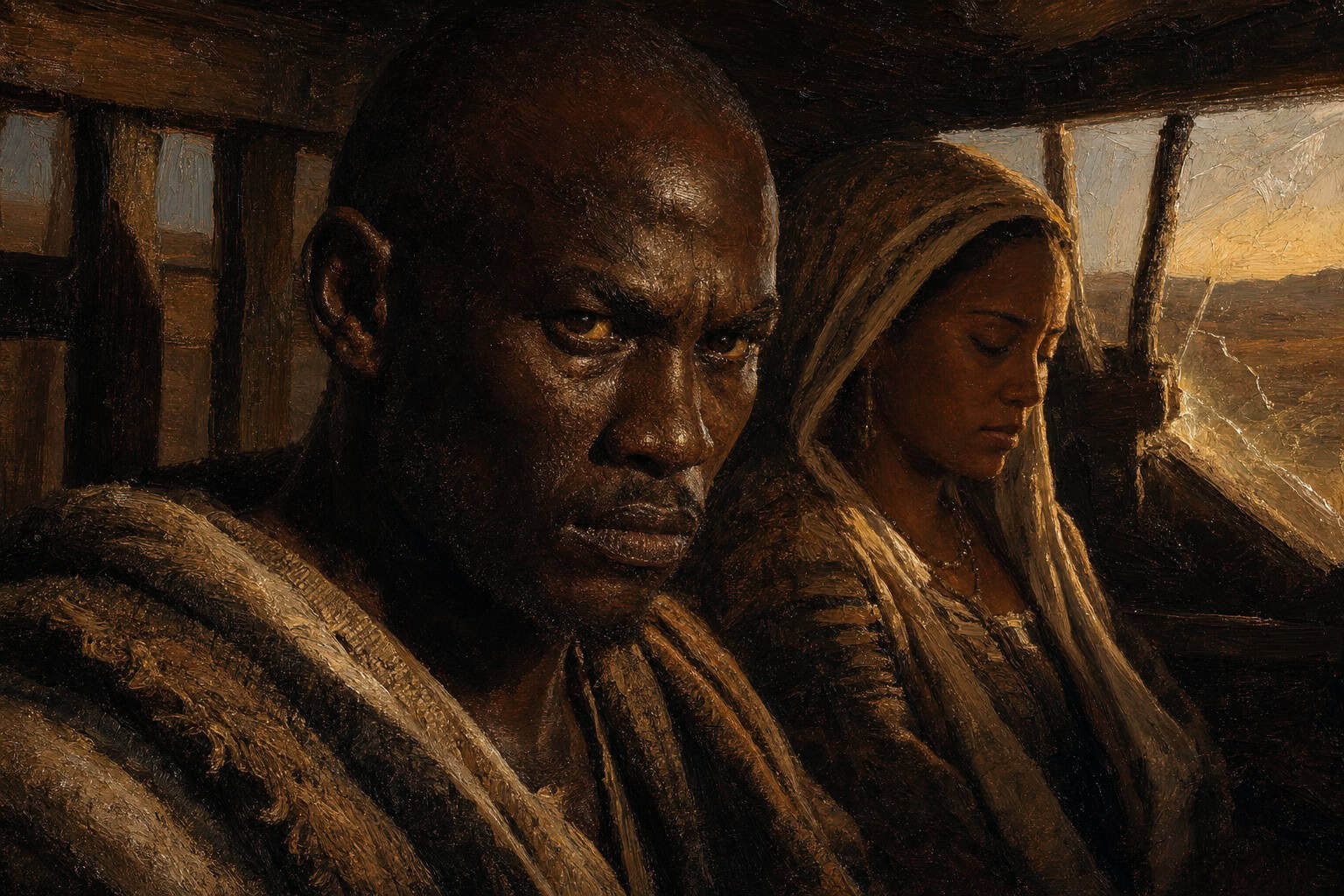
She screamed when the car crashed. Here is what that sound means for love, fear, and what it costs two people to move forward together.
The Sound That Came Before You Could Choose It
You heard it before you understood it. The scream tore out of her the instant the metal folded, and it was not a decision, not a word, not anything she had time to shape. It was the body confessing what the body always knows: that it can end, that it is fragile, that it rides in a thin shell of steel and glass over concrete that does not care. I want to sit beside you here, in that first raw second, because I know what you did with it later. You made it mean too little and too much at once. You told yourself she screamed because she was afraid of dying, and you were partly right, and being partly right is the most dangerous thing a young man can be. What you did not see, what I see now with the eyes age gives, is that the scream was also about you. It was about being in the wreck with someone. It was the sound of a person who had, without ever putting it in words, handed you her safety, and felt it slip. Think of what it means to get into a car with another person. You do not think of it as a vow. You think of it as an errand, a ride, a Tuesday. You buckle the belt without looking down. You reach for the radio. You say something about traffic or dinner and she answers and neither of you notices the enormous thing you have just done. But you have placed your body inside a moving thing they partly control, and they have placed theirs inside one you partly control, and neither of you signed anything. The scream was the contract becoming visible in the one moment it was being broken. She had trusted the road, the wheel, the man beside her, the whole quiet arrangement that lets two people move through the world without bracing every second for the end. And the arrangement failed. The road that was supposed to hold you both turned on you. So of course she screamed. You would have too, if you had let yourself feel how much you had already given away just by riding along. I am telling you this because you spent years treating that sound as an accusation aimed at you, a bill come due, a proof of some failure in your keeping of her. It was not. It was the most honest thing that happened that day, and it took me most of my life to hear it as honesty instead of blame. Sit with that a moment before you flinch from it. She was not indicting you. She was showing you, for one unbearable instant, exactly how much of herself she had already put in your unsteady hands.
Two People Cannot Move Without Both Agreeing to Break
Now let me press on the thing you kept avoiding. Long before the crash you had been circling a harder truth about her, about anyone: that you cannot go forward with another person unless you both agree to be undone by it. Mutual consent, the old teaching says, and mutual surrender to something larger than either of you. You heard that and you nodded and you did not believe it in your bones. You wanted the closeness without the surrender. You wanted her near without the terrible exposure of being someone she could scream about. And so you kept your hands on your own life like a man keeping his hands on a wheel he refuses to let anyone else touch. That is not love. That is chauffeuring. In a real bond, both people let go of the wheel at the same time, which sounds like madness, and is, and is also the only way anything grows between two mortal creatures. The apprentice and the master in the pages you were reading knew this ache from the other side. The teacher had poured his voice, his years, his very soul into the one who sat closest, the one who heard him think and matched the rhythm of his heart, and still that one could walk away as if none of it had bound them. Watch how the wound worked on him. His terror was not only grief for the person gone. It was doubt about his own perception, his own ability to see. If I chose this one, he thinks, and this one could leave me so lightly, was I ever perceptive at all? Was the potential I saw ever real, or did I invent it because I needed it to be there? You carried that same doubt out of the wreck like a splinter you could not find to pull. If she screamed with me, if fear was the sound she made beside me, then maybe I was never safe to be near. Maybe my nearness is a hazard to the people I love. You let one moment of shared fear become a verdict on your whole worth as a companion. But fear is not the opposite of trust. Fear is what trust feels like when the stakes are finally real, when the abstraction of loving someone becomes the concrete fact of a body that can be crushed. The scream did not prove she distrusted you. It proved she had trusted you enough to have something to lose. The consent she had given, wordless and daily, in a thousand small ridings-along, was still there underneath the noise, not cancelled by it. What the moment asked of you both was not less risk. It was more. It asked you to look at the fragility you had both agreed to share and to stay in the car anyway, morally, spiritually, with your whole freedom, choosing the same road together and the same possible end, hands off the wheel, eyes open.
The Crash Where I Finally Saw What I Had Refused
Here is the turn, and I will not soften it for you. The scream was never hers alone. You have replayed it a thousand times as her fear, her panic, her judgment landing on you like a hand across the face. But the reason you could not let it go, the reason it lodged in you for decades, is that it named something you would not say out loud even in the privacy of your own skull. You were afraid too. You had gotten into that car, into that whole relationship, telling yourself you were the strong one, the driver, the one who would keep her safe and therefore never have to be kept himself. That was the arrangement you preferred. That was the arrangement that let you stay hidden. And in the split second of folding metal you discovered you could not protect her. You could not even protect yourself. Your competence, your quickness, the whole careful self you had built to be the one who does the holding, was as thin as the glass that starred and buckled beside your head. That is what you could not forgive. Not her scream. Your own helplessness underneath it, exposed all at once, with witnesses. You had refused to see that love requires you to be as breakable as the person you love, that you cannot enter another life as a rescuer standing safely outside the wreck with dry clothes and a clear head. You have to be inside it, in the same crushable body, screaming your own scream if it comes to that, bleeding the same red. Grace did not lift you out of that car. I need you to hear that clearly, because you kept waiting to be rescued from your fear and your failure, and the rescue you imagined never came. What came instead was harder and better and slower. God was in the car. God was in the noise and the shaking and the sick drop of the stomach and the ringing afterward. Not stopping it. Not undoing it. Not turning the wreck back into an ordinary Tuesday. Present in it, riding with the two of you into your shared powerlessness, the way He rides with every soul that finally admits, sometimes only in the ruin of everything it built, that it cannot save itself or anyone else.
No one steps forward into love who has not first agreed to be broken open by it.
What the Silence After the Noise Kept Asking of You
After a crash there is a silence so total it has its own weight, a pressure against the ears where the scream and the shriek of metal used to be. It stops. The car stops moving. Something ticks under the hood. And into that quiet comes the question you spent years refusing to answer. You turned and checked if she was alright. You touched your own face, your own ribs, the way a stunned animal takes inventory. And then, in the stillness, you had a choice you did not recognize as a choice. You could treat what happened as proof that closeness was dangerous, that you had failed as the protector you cast yourself as, that the safest thing from now on was to grip your own separate life tighter. Or you could let the wreck teach you what it had come to teach. I watched you take the first road for a long time, and I cannot pretend otherwise. You started keeping a small distance in everything after that, a hand always half on your own wheel, ready to correct, ready to be the one who does not need. You told yourself this was maturity, this was wisdom hard-earned. It was fear wearing the coat of wisdom, and I knew the difference and let you fool yourself anyway. And it cost you, more than the accident did. Because a person who will not be helpless with another person cannot truly be with them at all. He can be near. He can be useful. He cannot be known. The teacher in those pages nearly made the same error, and it should have warned you. Wounded by the one who left, he began to think his insights should die with him, that a world which turned its back did not deserve his voice, that he should fold inward and let the whole thing go silent and unremembered. Futility, he told himself, everything is futile. The sun rises and sets and rises, the wind circles and circles, the rivers run to a sea that never fills, nothing new under the sun, no memory of what came before and none of us to come. You know that despair from the inside. You have said those exact words to yourself at three in the morning. And I will not lie to you and call it false. There is a real futility. There is a real limit written into everything. You will die. She will die. Every ride ends, every road runs out. But the answer to that is not to stop getting in the car. The answer is to get in knowing it ends, to consent to the fragile shared journey precisely because it is fragile, because the ending is the very thing that makes the choosing mean anything at all. The silence after the crash was not asking you to protect yourself better. It was asking whether you would stay, fully, in a body that can be hurt, beside a person who can scream.
Getting Back In With Your Eyes Open
So let me tell you where this settles, older self to younger, though it does not settle the way you hoped. You do not arrive at a place where the fear is gone. You arrive at a place where you stop mistaking the fear for a reason to flee. The scream she made was the truest gift of that whole wreck, because it stripped away the story you were living inside, the one where you were the untouchable driver and she was the passenger you would keep safe by the sheer force of your competence. That story was a lie, and God let it break the way He lets so many of our lies break, not with a lecture but with an impact. Not to punish you. To free you. You could not enter real love until you knew in your body that you were as breakable as she was, until you had felt your own competence dissolve in a single second and discovered that you were still there afterward, still breathing, still held, still His even in the ruin of the self-image you had polished so long. This is what the old teaching meant, the words you nodded at and did not believe. Mutual consent. Mutual surrender to the greater good. Two people letting go of the wheel at once and trusting the road and each other and the God over both. It is not a technique for a smooth relationship. It is a small dying, done together, again and again, at breakfast and in argument and in sickness, and it is the only ground on which anything living can grow. You wanted happiness, and you chased it head-on, and it fled you every time, the way it always flees a direct pursuit. Happiness only ever came to you sideways, as a consequence, when you stopped grasping at it and gave your soul instead to something true even when the truth cut. I cannot promise you the endings you keep rehearsing. I can tell you that God was in the car, and in the silence, and in all the guarded years after, walking beside you in the very sin of your self-protection, patient, waiting for you to grow honest enough to let Him near. The whole of it lives in Fractions of the Soul, this wreck and the man who took far too long to learn from it. And if you are the one still holding your own wheel with white knuckles, terrified of ever being someone another person could scream about, do not read this for comfort. Read it and then go find the person you have been chauffeuring at arm’s length, and take your hands off the wheel. It is not the end of you. It is the first honest thing you will have done.