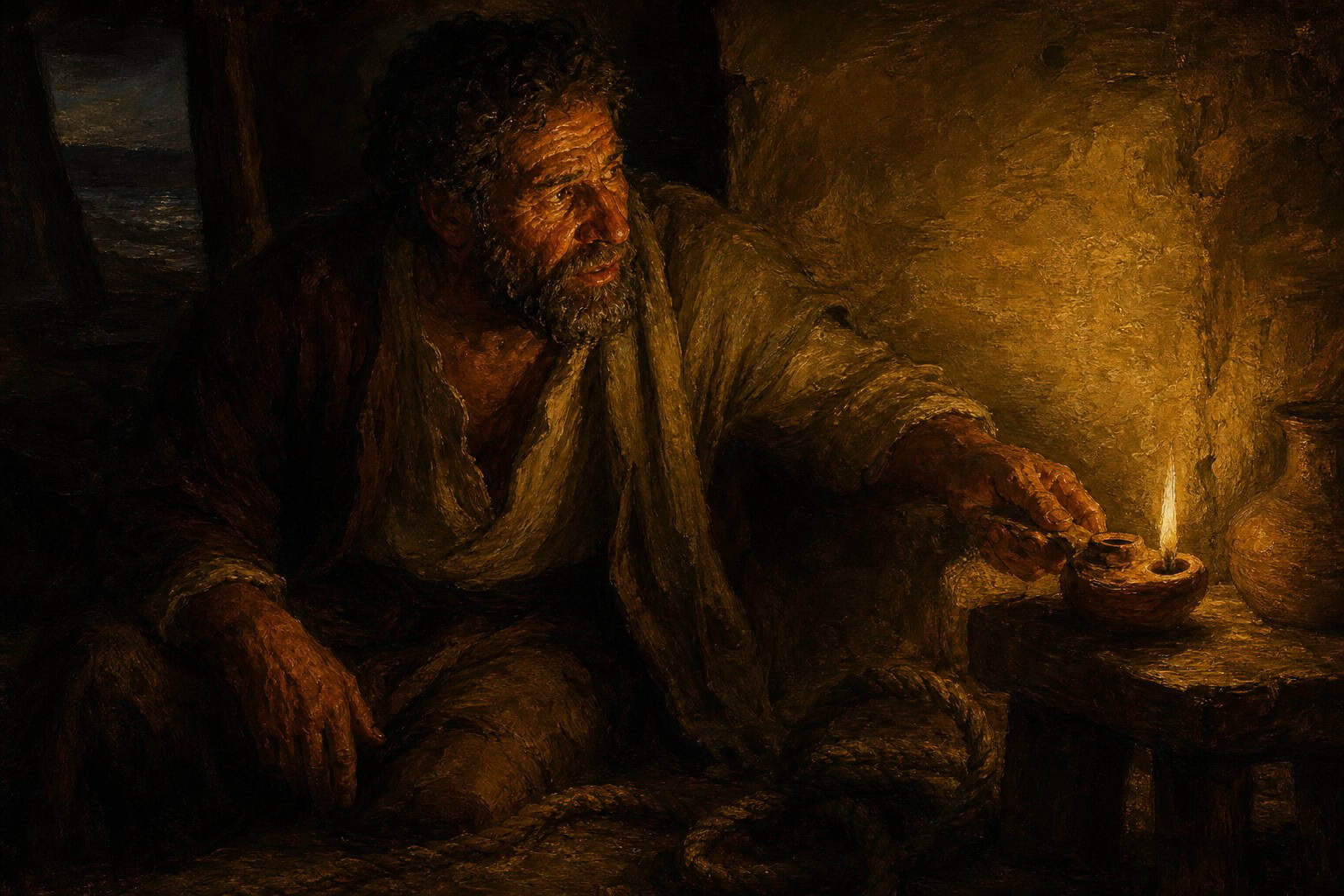
You want to forget the one you loved. A Catholic reflection on grief, idols, and the God who stays down in the dark with you.
A Boy Bent Toward a Speaker in the Dark
Before the woman, before the writing desk, there was the radio turned low. A boy leaned toward a small speaker the way you lean toward a fire, listening to strangers phone in their broken hearts. It was a classroom he never enrolled in, a clandestine grammar of loss he learned through a keyhole years before he needed it. The gentle voice on the air spoke to callers who wept about people who had left them, and he absorbed every word like dry ground taking a slow rain. Those late-night laments came in like scripture. Human love trembles, they said, and then it breaks, and it breaks hardest exactly where you mistook it for something holy. He kept a daily journal his teacher assigned, and the blank page became a private space to name the chaos churning in him, mapping his confusion in ink he did not have to explain. At night he logged onto a text-only network, hidden behind words, practicing becoming a kind of scientist of his own soul—all mind, no body in the room to shame him, no face for anyone to turn away from. This is where the sixteenth chapter of Confessions to the Empty Chair begins its slow accounting: not with the woman herself, but with the tools a wounded boy assembled to survive the simple, terrifying act of wanting anyone at all. You come typing that you want to forget your ex, and I meet you there, in the desperate hope a memory can be dragged into the trash like a file. But watch what he watched. A first kiss from a girl named Ann landed on him as uninvited grace, a message his body had never received: he could be wanted, he was not a thing to be pushed away. Then almost at once came a casual rejection from someone else, a flat indifference where he had just felt warm. That whiplash—chosen one moment, nothing the next—taught him faster and crueler than any radio. He learned to guard himself. He learned to stack the careful defenses he would one day mistake for holiness, calling his fear maturity and his caution strength. The music told him plainly: closeness is not safety. He did not pick that lesson. Truth does not wait for your consent.
The Idol He Crowned to Silence the Two Musics
Then came Jeannètte, and everything the boy had rationed for years poured out of him at once. She became, in his own severe word, his favorite idol—the Idol of Love, the fourth in a private catalog he keeps like a man counting the coins that ruined him. He had been living with what he names the two musics, a constant dissonance sounding inside him, and three older idols he lists without flinching: the mark of his earliest hurt, his hunger for acceptance, his hardened isolation. Jeannètte felt like the single cure for all of it. In her presence he set peace on a throne. He built a security made entirely of human affection and told himself he had finally reached somewhere the cold could not find him. The longing runs plainly through the body: the relief of being chosen by someone who stayed, the warmth of a gaze that did not turn to ice at dawn, the animal comfort of no longer being alone in the dark. Two years gathered between them like sediment. He crowned her. He made her the answer to a question no woman could answer. And here his own reflection drags the harder thing into the light—the man who had spent his life stacking barriers did not truly lower them even with her. He guarded. He tested. He withheld the words of love and used the silence as a calculated measure of her worthiness, treating the sacred space between two people as an exam she had to keep passing to earn him. A person you are secretly grading is a person you are already rehearsing to lose. He wanted union but kept one hand pressed against the exit. He wanted to be fully known and yet rationed, coin by coin, how much of himself he would risk. The very defenses that once shielded the boy from indifference now stood like cold rock between the man and the woman he swore he loved most. This is the trap of anyone who prides himself on needing no one: he renames his fear as wisdom, his self-protection as spiritual strength. When love finally arrives and asks him to stand undefended, he cannot manage it cleanly, because his whole structure was engineered so no one could leave him without first paying a toll. The forge burned hotter with every shovelful of that pride, and he warmed his hands at it, not knowing he was the thing being melted down.
Her Face in the Screen, Two Years in One Breath
He sets the moment in the empty chair, which is how this whole book makes its confession—speaking the memory aloud to a presence that will not talk back, an absence he addresses as if it were a face. Her face, framed by a screen. A calm voice. Two years ended in a single breath, the length of one exhale, the door of a life clicking shut without a raised voice. That is nearly all the scene gives us, and it is more than enough. The loss did not arrive as a hurt he could nurse in private and slowly outlast. It came as something absolute, a rehearsal for death itself, the total collapse of the very foundation he had chosen to stand his security upon. He prayed into the dark, and the silence that came back sounded to him like agreement—like heaven itself consenting to the cut, God stepping aside so the severing could finish its work. Sit inside how brutal that is, because he refuses to soften it. He does not pretend a warm reassurance drifted into the room to comfort him. There was only her calm face lit by the screen, his shattered anchor dragging along the floor of him, and a sky overhead that said nothing back. He heard her finish the sentence and felt the temperature of the whole room change, as if the air itself had been let out. He ties no lesson to it in the moment. He simply reports the whiplash of a man who thought he had found the cure for every old ache, watching that cure end him with one sentence delivered in a voice too calm to fight. And this is the turn the chapter presses toward, the thing he could only make out much later from the height he calls the ascent. The break did not merely carry her away. It exposed the idol underneath. It revealed exactly what he had done in the dark of those two years—that he had taken a living woman and made her an anchor meant to hold him fast through eternity, when no human devotion was ever forged to bear a weight like that. The nearer a person draws, the more of you they carry off when they go. He had let her all the way in, and so she left holding the largest part of him.
You do not forget the one you loved; you learn what you asked her to hold, and why no human shoulder was ever built for it.
Coal Enough to Melt the Man Who Would Not Bend
What follows the severing is not relief and not resolution. It is heat. He describes burning himself on the altar of her memory, coming back to the image of her again and again the way a tongue keeps finding the gap of a missing tooth, not understanding at first that the fire he felt was correction and not punishment. His refusal to surrender her, he sees now, worked like a hand fanning the coals—every night he spent rebuilding her in his mind fed the flame that was consuming him. He wanted her back so badly that he kept the loss alive on purpose, mistaking the pain of clinging for the pain of love. Here his honest self-questioning cuts deepest. Who was she really to him? A person he cherished for her own sake, or a solution he had assigned a face and a name, a device to quiet the two musics and heal the three older idols in one stroke? He does not let himself off. He admits he had enthroned peace and security and called it her. He admits the man in the shadows—the one her eyes turned toward when they closed to him—was not the cause of his ruin but the instrument that pried his fingers off the thing he would not release. The stripping was severe precisely because his grip was so tight. Every barrier he had ever raised, every private tool he had trusted, every wall he mistook for virtue now stood revealed as an idol of self-sufficiency, a quiet refusal to lean on anything but himself. The command he had broken was almost embarrassing in its simplicity: to trust with the whole heart and not to lean on his own understanding. He had leaned on his understanding until it caved. He had trusted his defenses until they became the walls of a small, airless room he had locked himself inside and called safe. And into this bare place an old weary voice arrives, the ancient teacher who says everything is breath, everything runs and returns, the rivers pour into the sea and the sea is never filled, the sun climbs only to hurry back and climb again. He does not argue with it. What lingers here is the terrible mercy of being disarmed against your will—of losing the thing you clutched so that you might finally have your hands free, though you would never have opened them yourself.
The Rope Gone Slack, and Someone Still Beside Him
Where the chapter settles is not on forgetting her, and this is why your search, honest as it is, asks for the wrong thing. He never forgets Jeannètte. He does not scrub her from memory or file her away as a lesson learned and closed. Instead he arrives, slowly and from a great height, at what the memory was for. All human devotion evaporates over time, he writes—it is meant to pass away, built by design to be temporary, a warmth that cannot be made permanent no matter how hard a frightened man wills it to stay. He had asked a woman to be eternal for him. He had asked her body, her voice, her steady presence to hold a weight only God can carry, and when God closed her eyes to him He did it not out of cruelty but to sever the rope tied to the wrong anchor. This is where the reading turns quiet and strange. God does not appear here to haul him out of the dark. There is no lightning, no sudden comfort, no tidy mending. There is only a presence walking beside him inside the fire, near even in the sin of his clinging, closer in the loss than He had felt in the having. The severing itself was the accompaniment. The mending of a soul, this chapter insists, is not a single flash of change—it is slow, gritty work, each flaw worked away with a patient hand, the way you draw metal across stone again and again until a true edge comes back. It asks a firmness that can cut into what is rotten and a tenderness that knows exactly how much to leave standing. So if you came wanting to erase the one you still love, the man in this book offers something harder and better than forgetting. Your grief is not a malfunction to be deleted. It is the exact cost of having loved someone up close, and there was never a cheaper price to pay. Confessions to the Empty Chair does not hand you her exit or his healing wrapped in a bow. It leaves you at the moment the rope goes slack, the man who would not bend finally undone, the coals cooling into something he can barely name. You will want to know where he goes from the ascent, what he learns to hold instead. The chapter will not tell you here. It only turns your face, gently, toward the shape of the hunger you have been trying to bury—and lets you feel how long it has been waiting to be answered.