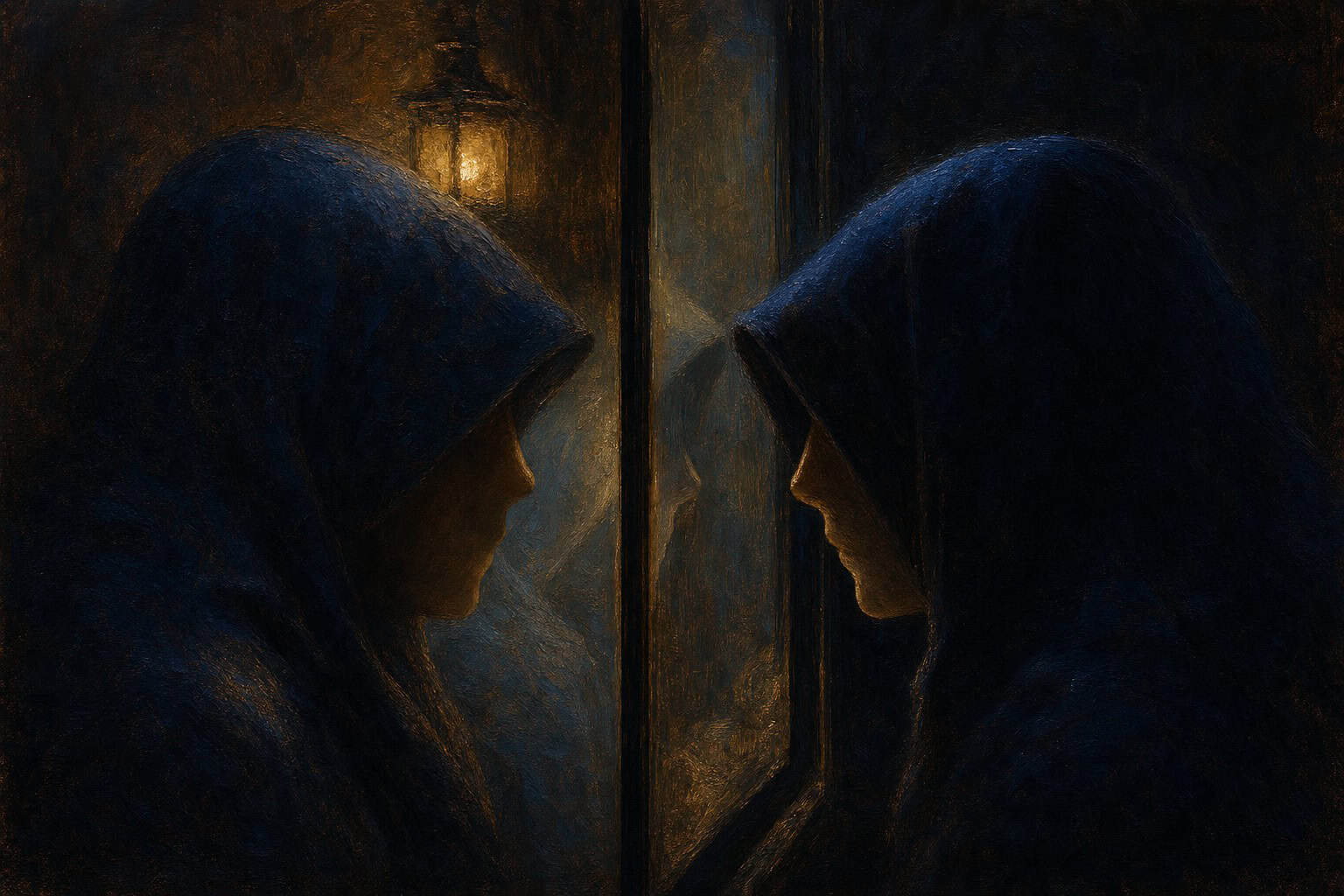
A small body wrapped in cotton looks up at the only sky it knows, a face bending close, and from that first mirror a whole legion is gathered that he will carry, in fragments, to every love.
The Tiny Tongue Reaching Toward a Face
A small body lies on its back, wrapped in cotton, staring up at the only sky it knows: a human face bending close. Lips part. A tongue slips out, bright and wet, then disappears again. Without instruction, the infant’s own tongue pushes forward, then vanishes back into the warm cave of the mouth. Muscle answering muscle, flesh answering flesh. No one explains this lesson. There are no words, only a rhythm of reaching and retreating, the first liturgy of self and other. Before there is boy or girl, before there is any name, the child learns: I appear when you appear; I move when you move. That tiny tongue becomes a kind of script, teaching the body how to mirror, how to become real by echoing what it sees. Years later the mouth still remembers this first choreography, still extends and withdraws in front of other faces, still tries to secure existence by repeating a movement older than memory.
The Table Where Only Leftovers Are Served
In another scene, years have passed, but the same body now sits at a table, fingers around a glass, watching a lover speak. No crib, no nursery light—just two adults and the strange quiet arithmetic between them. She feels it as he laughs: how much of him is already spoken for, how many unseen figures sit with them, each having taken a slice of his trust, his wonder, his readiness to risk. He senses the same in her, though he would never phrase it. Whole corridors inside her have been shut and locked by others who walked through first. What reaches across the table are portions, measured offerings, careful slices of what remains. They name it a fresh start, but their chests know better. The heart does its silent accounting, feels what has been carved away, and still extends a plate. This is the cruelty of the moment: both know they are offering scraps and are hungry enough to call it a feast.
Hands Pressed to Invisible Glass
Later, skin touches skin, but something else stands between them. She chose him because he is soft-spoken, unable to rival the storm she keeps chained inside her ribcage. Now his body rests over hers, his breath warm on her neck, and still she feels as if her palms are flat against a clear, cold sheet. He cannot see it. He believes he has reached her because her body responds on cue, the way that infant tongue once did. But her chaos, dense and untamed, stays back behind the glass, watching. This is the treachery the passage names: not the lie of false words, but the cruelty of never letting the true darkness step forward where it might be known or refused. He senses only an outline of absence, a faint resistance in her muscles when he grows too earnest. She performs closeness; her deeper self stands three inches away, perfectly safe and utterly untouched.
Before words, we learned to exist through another’s face; now we bring that whole legion to each new love, offering fragments and receiving fragments in return.
Tuning Forks Struck on Old Wounds
The body does not forget that first tongue, that first face. It carries those early lessons into every choice, like a tuning fork humming in the chest. When she keeps choosing gentle men she can secretly outrun, when he keeps finding women who live behind glass, it feels like fate, like some script written in the stars. But this scene insists on something harsher: the flesh has been calibrated by history. It vibrates at a particular pitch of lack and strain, and it recognizes the same note in another person with frightening speed. That strange pull across a bar, across a church aisle, across a screen, is often nothing more glamorous than damaged frequencies lining up. Two people mistake the comfort of the familiar ache for love. Their bodies lean toward the pattern they already know how to endure. Desire, then, becomes a kind of self-punishment: a search for the perfect partner in repeating what has always hurt.
The First Lessons Etched Before Memory
Before any word like love or freedom ever forms in the mind, the flesh has been schooled. The infant lying under that bending face absorbs the mother’s tight jaw, the father’s distance, the sudden absence in the cradle’s field of vision. Those wordless lessons sink past thought and lodge in muscle, breath, heartbeat. Years later, adult mouths speak about honesty, vulnerability, commitment, but the body often refuses to follow. It extends and withdraws on an old schedule, offers only the fraction it believes is survivable, chooses partners whose own fragments match its shape. No argument can fully reach what was carved in the wet clay of early days, when a tongue’s tiny movement meant, I exist because you answer me. The passage does not promise escape; it simply drags this hidden schooling into view. Somewhere between the tired hunger of two lovers and that first mirrored motion in a crib, the question waits like a held breath: what would it cost to let the next movement break the pattern instead of repeating it?