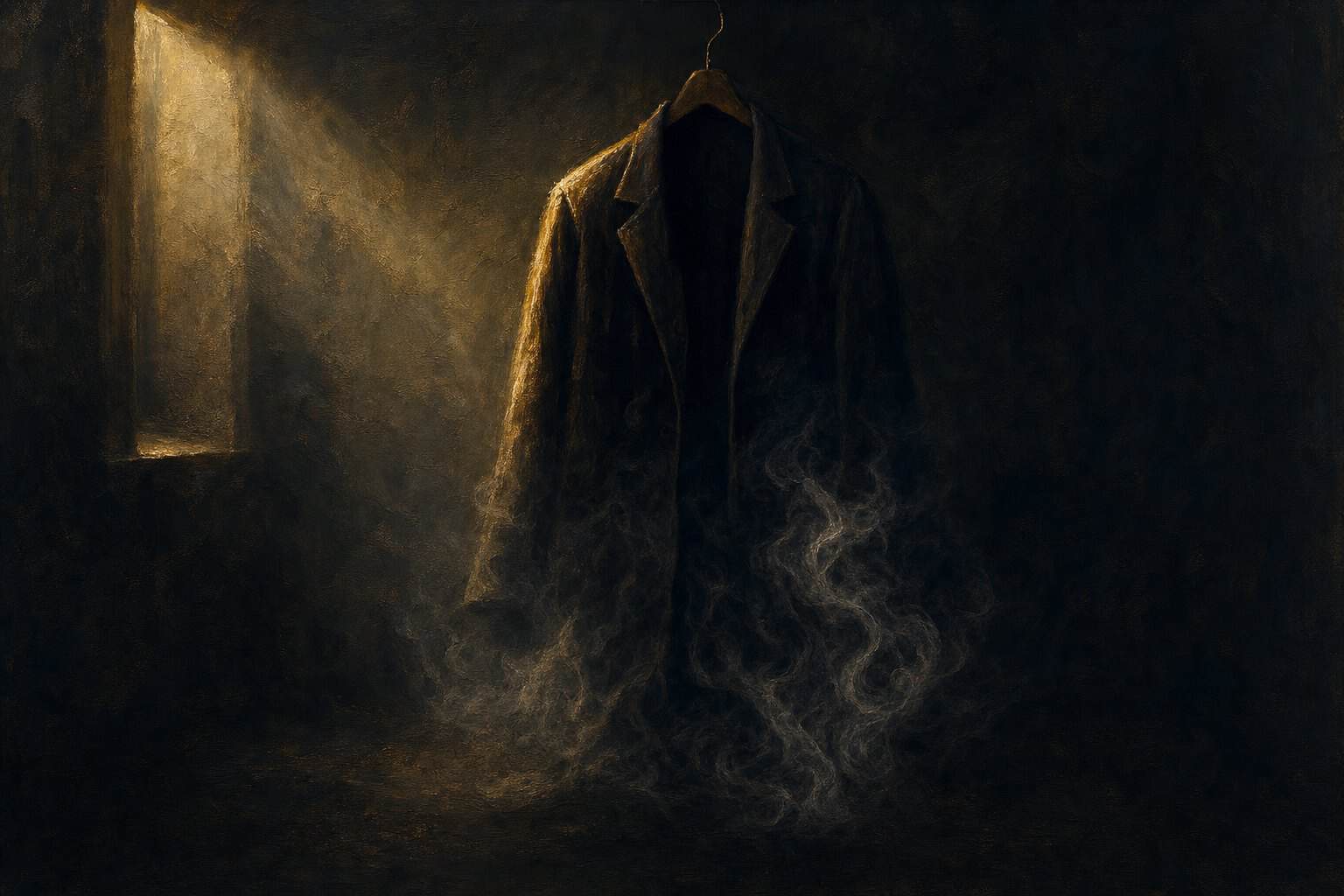
Kierkegaard names the sickness that hides in the well-mannered soul: not the loud despair of collapse, but the quiet despair of refusing, again and again, to be oneself.
The Diagnosis Beneath the Composure
Kierkegaard, in The Sickness Unto Death, offers a definition that seems at first a riddle and reveals itself, on the second reading, as a mirror: the self is a relation that relates itself to itself, and despair is the misrelation within that relating. Despair is not primarily a feeling. One can be in despair and never weep; one can smile across a dinner table, keep every appointment, answer every email, and be sick unto death the entire time. This is the terror of Kierkegaard’s account — that the most composed man in the room may be the most despairing, precisely because his composure is the instrument of his refusal. In the world of the Confessions to the Empty Chair, this is the man who disturbs more than he consoles and who therefore learns, early, to erase himself before he can be erased by another’s flinch. He calls this the redacted self. Kierkegaard would recognize it instantly, and would give it its true name: despair. Not despair at circumstance, but despair as a posture toward one’s own existence — the refusal to stand as the self one was given to be.
The Despair That Does Not Wish to Be Itself
Kierkegaard maps despair with unnerving precision. There is the despair of one who wishes desperately to be some other self than the one he is — the self of borrowed armor, assembled from the expectations of others, from the roles that draw approval, from the mask that will not provoke. And there is the deeper, quieter despair of one who does not, in defiance, will to be a self at all, but simply lets himself be dissolved into the crowd, into what Heidegger would call das Man, the anonymous ‘one’ who does what one does and feels what one feels. The redacted self is a hybrid of both. It refuses the given self out of fear that the given self is dangerous — too much, too disturbing, too visible — and it manufactures in its place a diminished, agreeable, edited version, cropped to fit the room. This is mauvaise foi wearing the vestments of humility. It looks like modesty. It is, in fact, a refusal of the terms of one’s own existence, a quiet ‘no’ whispered to the Sorge one was meant to carry.
Borrowed Armor and the Weight It Cannot Carry
The tragedy of borrowed armor is that it fits perfectly until the moment it is tested. David, in the tent of Saul, put on the king’s bronze and found he could not walk in it, and laid it down for five smooth stones and the self he actually was. The redacted self never reaches that decision. It keeps the armor on, and mistakes the numbness for peace. Here the corpus portrait of MacQuarrie becomes illuminating: anxiety, he insists, is not an empirical emotion to be managed but a fundamental disclosure of the human condition, ‘the basic way one finds oneself’ — the vertigo that reveals both the possibility of falling into inauthenticity and the possibility of awakening. The redacted self has resolved this vertigo prematurely. It has chosen the fall dressed as safety. Every time you edit yourself down to what will not disturb, you are not sparing others; you are performing a small liturgy of despair, confessing with your silence that the self God established is a self you would rather not be. The armor does not protect the wound. It seals it in the dark, where it festers into the sickness that does not kill and does not heal.
The most dangerous despair wears the face of humility: to edit yourself into someone acceptable is to refuse, quietly, the self you were given to be.
The Self Grounded in a Power Not Its Own
But Kierkegaard’s diagnosis is not a sentence; it is the ground of a cure, and the cure is theological to its marrow. The self, he writes, cannot heal itself, because the misrelation runs deeper than the self’s own resources — the self did not establish itself. The formula for the eradication of despair is exact and famous: in relating itself to itself and in willing to be itself, the self rests transparently in the Power that established it. This is not self-acceptance in the therapeutic key, the modern gospel that asks you to embrace the self you have curated. It is stranger and more demanding. It asks you to become transparent — to let the light pass through the whole self, redactions and all, down to the Power that made it — and to consent, there, to be the very self you have spent your life editing. In the language of Anthony’s post-edenic ontology, the self is always-already fallen, always-already fractured; there is no unfallen version to recover. What Kierkegaard offers is not restoration to innocence but rest in the Power that holds the fallen self without flinching — the unseen Listener in the empty chair who does not require the edited version to remain in the room.
Transparency Before the Empty Chair
So the empty chair changes meaning. For the redacted self, the chair is the seat of the one who might flinch, and so it is always half-empty by design — you have already removed the parts of yourself you assume would drive the listener away. But if the chair holds the Power that established you, then transparency is not danger but the only rest available to a self. You cannot edit yourself before a God who knows the unredacted text. The whole labor of the redacted life — the vigilance, the anticipatory self-erasure, the exhausting management of how much of you may safely appear — is revealed as what it always was: a refusal to be seen by the only gaze that could bear the whole of you. To rest transparently in that gaze is to lay the armor down at last, not because the self is safe, but because it is finally held. The sickness unto death is healed not when you become a self that no longer disturbs, but when you consent to be the disturbing, given, fractured self you are, transparently, before the One who established you and calls you, still, by name.