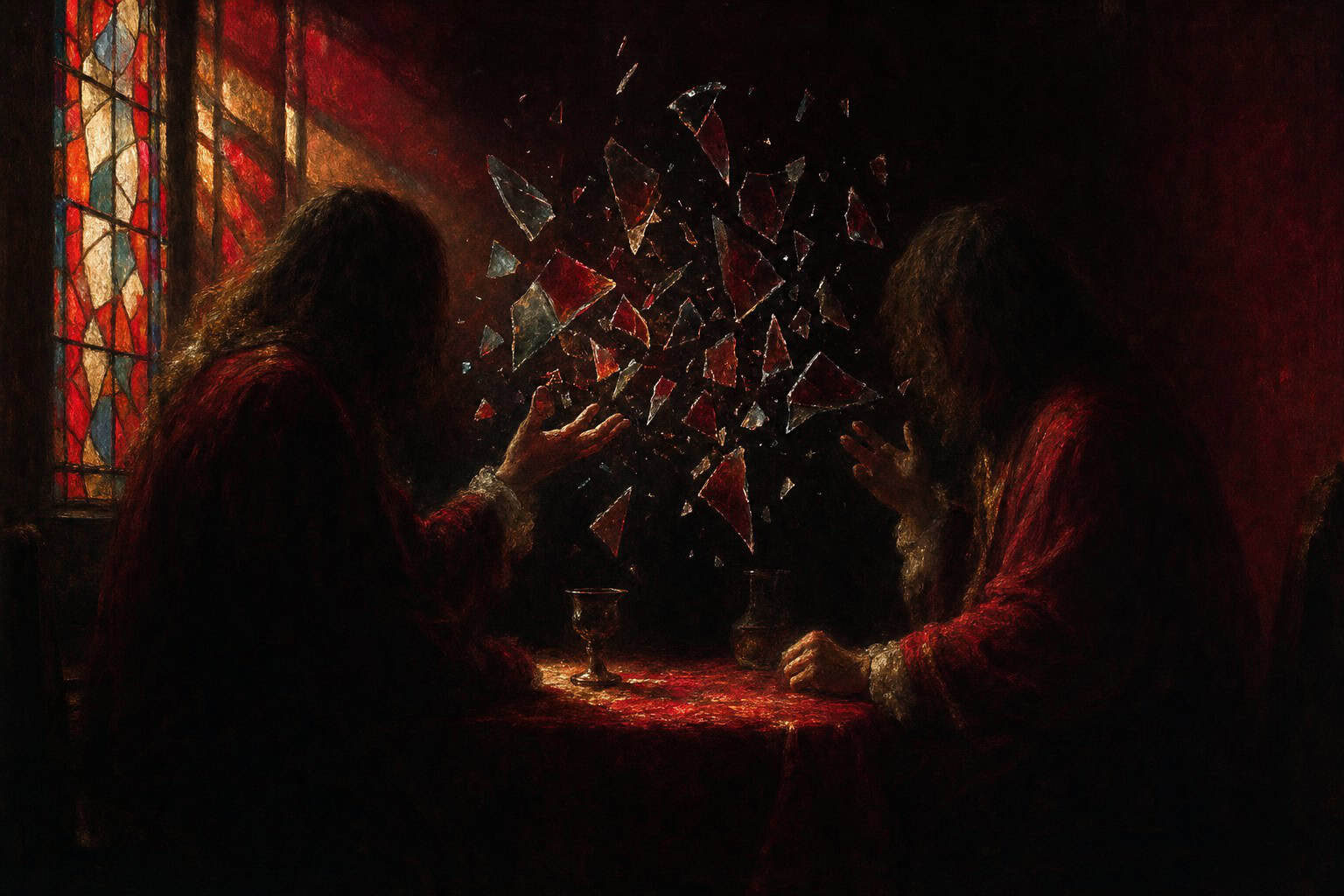
A man and a woman sit at some ordinary table, mouths moving, syllables falling, and yet each carries Eden’s old wound into the space between them, so the words arrive already broken, already meaning something neither intended.
Two Mouths, One Shattered Sound
A man and a woman sit across from each other, some ordinary table between them, hands near a sweating glass or a chipped mug. Their mouths move, air shifts, syllables fall, yet what crosses the space is not what either intends. Each face calling to the other passes through a packed gallery of older faces: a mother’s tightened jaw, a lover’s bored eyes, a teacher’s smirk. The man shapes a sentence with care, feeling the muscles of his tongue and jaw work to get it right, thinking precision will save him. By the time the sound reaches her, it has already been ground through the sediment of every past voice that used the same words to wound, dismiss, seduce, abandon. She is not hearing him; she is hearing a chorus stacked inside his tone, the weight of it pressing against her skin. He watches her flinch from a meaning he never sent and feels, in his own body, the helplessness of watching his language break apart midair like glass dropped between their mouths.
The Blade Hidden in the Open Palm
When he decides to speak honestly, his chest tightens the way it did as a child before confession, that thin tremor in the ribs that says, This could end me. He does not shout or dramatize; he leans forward a little, exposes the soft underbelly of an ordinary sentence that carries his real need. On the table, his fingers uncurl as if setting down a harmless object, yet inside that small gesture he is placing a blade into her open hand. The sharper his truth, the cleaner the edge she now holds against his throat: here is how to ignore me, here is how to laugh at me, here is how to prove I never mattered. She did not ask for this weapon; it arrives wrapped inside the gift of being loved. The more clearly he names himself, the more precise her power becomes, until every additional word is like turning the knife so that it fits her grip exactly, even if she has no intention of striking.
Eden’s Echo in a Coffee Shop Chair
Her body leans back a few centimeters, almost nothing, just the faint scrape of the chair legs against tile. Still, in that minimal retreat an entire garden contracts: approach, exposure, recoil, as old as the first hiding in the trees. His hand, resting near hers, twitches forward then stops, muscles remembering before his mind does that this exact distance has been reached and refused countless times in other skins. Neither speaks of any of this. They talk about work, childhood towns, favorite films, while their shoulders carry out an older choreography—one tilts in, one angles away, their knees avoid brushing. Underneath their personal histories, something buried and ancient is rehearsing its steps through their nerves: the drawing near to a promised “with,” the sudden knowledge of nakedness, the instinctive cover, the new gap. What feels like this night’s awkwardness is also the replay, in small domestic gestures, of an exile that left its tremor in every future reaching hand.
We carry Eden’s wound into every first meeting, so that two strangers can undo each other’s meaning before a single word has even landed.
Your Lips, Their Ghosts, Our Shared Script
You know this terrain in your own body: the way your throat tightens when you try to say something unguarded, the way your stomach drops when someone says a familiar phrase in an unfamiliar voice. A friend says, “Calm down,” and your skin hears the old belittling, not the present concern. You pull your hand back from a kind touch and only later realize you weren’t protecting yourself from them but from someone who is no longer in the room. What this passage names, without mercy, is that every time you try to speak cleanly, your words must travel through a crowded hallway of ghosts in the other person’s mind—and theirs must pass through yours. The repeated collapse of conversations you meant to go differently is not a private defect, not only your poor choices or their bad faith. It is the ordinary way this species now moves: each of us lip-syncing lines we never consciously agreed to, feeling the shame of failure while an invisible script keeps feeding us the same scenes.
Standing in the Crossfire of Old Sentences
Between two chairs, a small field opens where voices that never met still collide. His careful promise meets her father’s broken promise midair; her quiet fear bumps against his mother’s contempt before either reaches the ear it’s meant for. The book lingers here, not to excuse the harm, but to show how much freight rides on a single exchange, how every new attempt at honesty drags the whole archive of human mishearing into the room. If this is true, then your next confession, your next risk of saying what you actually feel, will not be a clean experiment. It will happen inside this same crossfire, inside the storm of sentences that have been wounding and missing their mark since we first learned to hide from the One voice that named us good. The question this passage leaves humming in the nerves is not whether contact is worth it, or whether you should stay silent instead. It is simpler, rougher: how you will stand there next time, heart in your mouth, knowing the sky above your words is already thick with falling shards of other people’s speech.