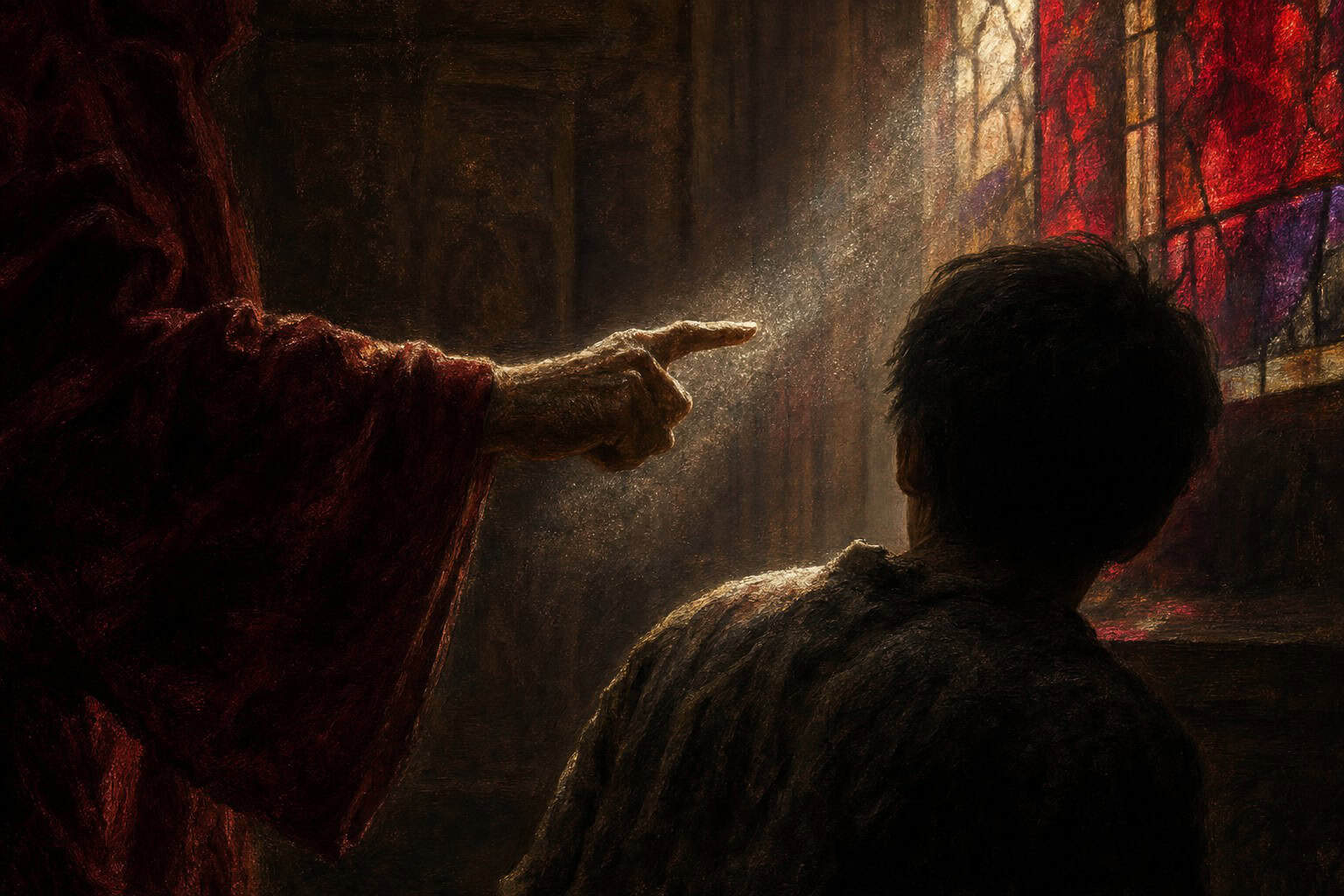
Dust hangs in the sunlight as thirty small bodies go quiet and the teacher’s finger crosses the room and settles on him — not for punishment, not for praise, but to be set apart for a watch no one else can see.
Chalk Dust in the Air When the Finger Finds Him
Dust hangs in the sunlight when her hand rises. The hum of thirty small bodies goes quiet as the teacher’s finger cuts across the classroom and settles on him. Not for misbehaving, not for a wrong answer, but for the way his mind moves. She announces it before everyone: there is something in his thinking that does not match the others. Desks creak as necks twist to see the specimen she has named. His skin tightens; he feels his careful smile stiffen like dried paint. All the practiced nods, the timed laughter, the mimicry of normal boyhood collapse under that thin, pointed line of flesh. Her gesture lifts him out of the crowd the way a hook lifts a fish out of water: clean, efficient, merciless. In that stretch of seconds, the child learns what it is to have his inner life turned into an object on display, a puzzle laid on the teacher’s desk without his consent.
The Tremor in His Wrist as Flesh Refuses Finality
On the surface, it is only a boy at a desk, pulse jumping in his wrist where it rests against the wood. Under that skin, something harder is being worked out. He knows there are beings who chose once and were done forever, creatures of clear sight and irrevocable will. He is not one of them. His body will not let him be. The same nerves that carried the cold from the Stickman’s touch, the same gut that knotted under unfair scoldings, now throb under the teacher’s gaze. Yet that throb means time. His hand sweats, his heart races, his thoughts skid; nothing in him is fixed. He feels, dimly, that his ignorance is both danger and shelter. He can be tricked, terrified, pushed into hiding—but he cannot be sealed. Flesh slows everything down. Even the fall stretches out over years, like a stagger instead of a single plunge, and that stagger leaves room for hands, human and divine, to reach in.
When Love Steps Off the Safe Path
Somewhere behind the multiplication charts and bulletin boards, another scene rises in his mind: a garden, a man, a woman holding fruit she should not hold. He has heard the story many times, but today it lands differently. The man was not yet in trouble; he stood on the safe side of obedience. The woman had already crossed over. To stay loyal to the command would mean leaving her there, altered and alone. The boy senses, in his small chest, the weight of that choice. He knows what it is to watch someone beloved walk into danger and to feel a pull, not toward virtue, but toward not abandoning them. His own strange marking—the night visitations, the bent justice at home, the hum of female warmth always out of reach—begins to feel like an echo of that garden choice. Perhaps his path will not be about staying clean, but about standing close to those who have already fallen, even when the cost is his own quiet.
To be chosen is not always to be blessed; sometimes it means being set apart to keep a watch no one else can see.
For the One Who Thinks the Line Is Already Crossed
This moment in the classroom is not unique to him; it mirrors a fear many carry tucked behind the ribs. A woman at a kitchen sink, hands in dishwater, remembers the abortion clinic hallway. A man in a parked car replays the affair, the lie that protected his secret. Someone else hears again the words thrown in anger at a dying parent. They replay the instant and decide it was their one clear choice, their final no to God. This passage whispers something harder and kinder: your choices were not as clear as you think, and that lack of clarity does not excuse the harm but it does keep the story from being finished. You were tired, scared, half-knowing, wrapped in old wounds and bad teaching. Your body was not a clean instrument of will; it shook, flinched, reached. That doesn’t erase the sin. It does mean the sentence is not yet read out. As long as your chest still rises, the verdict is in motion, not in stone.
The Child at His Desk, Listening for a Different Voice
He stays very still after her comment, as if movement might smear the moment into something even worse. The pencil between his fingers has left a gray streak on the side of his hand; he rubs at it with his thumb until the skin reddens. Around him, the lesson resumes, numbers and words floating over a boy who has just been told his mind is an oddity. Inside, another lesson is starting. If he is a riddle, who is meant to read it? The dark visitation of the Stickman, the broken fairness at home, the strange comfort of sandwiches and cartoons at night—all of it presses against the teacher’s naming. Will this mark become a curse, an excuse to drift further into isolation, or can it be received as a call to stand watch for others who cannot name their own strangeness? No answer comes in that hour. Only a child at a scarred desk, heart drumming against his ribs, waiting to see what his difference will cost and what, if anything, it might one day be for.