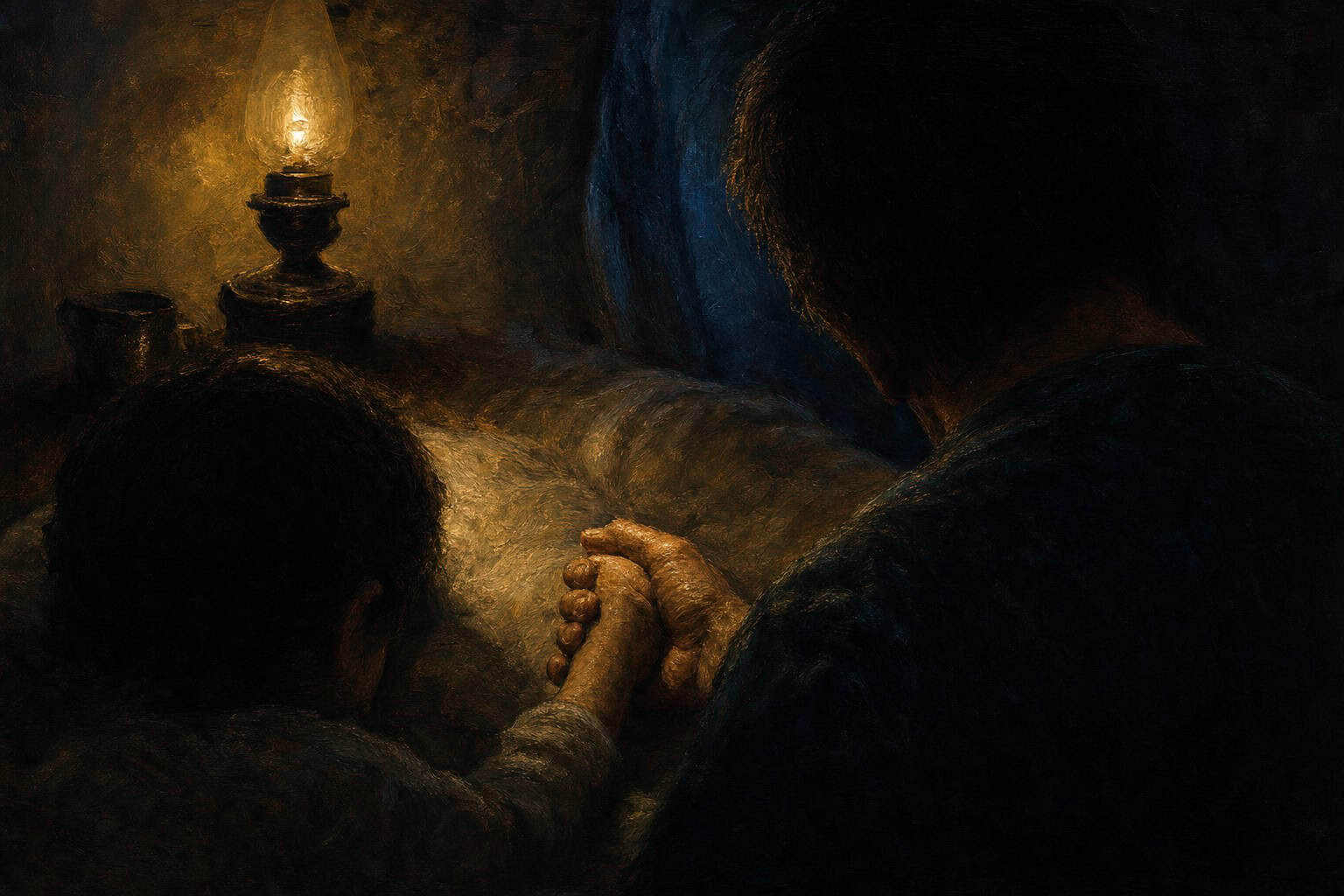
Night presses close around a narrow bed thick with the stale warmth of a room that has held too many tears, a child’s damp hand inside his mother’s palm, learning that the first touch of evil comes not as horror but as a small, mocking sound.
A Small Hand Damp with Sweat
Night presses close around a narrow bed, and the air has that warm, stale thickness of a room that has held tears too long. A child’s hand lies inside his mother’s palm, slick with sweat, the skin of both sticking together every time either of them shifts. She keeps whispering prayers she learned as a girl, words that move out of her mouth by habit while her attention drops into the contact of skin on skin. Something in the dark has changed; the shadows feel crowded now, as if another presence has leaned in. She does not see anything, does not hear a voice, but her fingers clamp down hard without asking her permission. Bone presses into bone. Her forearm tenses. There is a current coming through the tiny hand she holds, a shudder that does not match the rhythm of his breathing. Later memory will not store doctrines or explanations from this night, only the raw fact that her own flesh flared like a warning siren before her brain could form a single clear thought.
Tears for People Still Breathing
Hours or days before that grip in the dark, the same boy has already worn himself out crying over faces that are still alive. He sobs for a grandmother who is, at that moment, stirring sauce at the stove, for a father who sits in the next room watching television. No one has been buried. No diagnosis has been spoken. Yet his chest burns as if earth is already closing over the people he loves. His body cannot respect the calendar; it drags tomorrow’s funeral into today’s playtime. This is not childish drama but a real crushing in the ribs, a choking that feels like betrayal because the voices he is mourning can still call his name from the hallway. Each imagined loss steals the present twice: he cannot enjoy the living face before him, and when the real goodbye comes, it arrives already stripped of its proper shape, worn thin by years of rehearsal.
The Sound No Adult Believes
Into this already twisted sense of time, something crude and stupid breaks in: a wet, mocking noise blown from nowhere in particular. Not a roar, not a whisper of temptation, but the same noise children make on playgrounds to tease one another. It cuts through the whispered prayers and the thick dark, hanging in the air with an almost comic vulgarity. The boy freezes. His mother’s hand, still wrapped around his, jolts again, every tendon pulling taut. This is the first open intrusion, the first time the invisible crosses the line into the audible, and it does so with a gesture so petty that to speak of it aloud would sound like a joke. That is part of the violence: he is marked in a way no one will honor as a wound. There is no blood, no broken object, only the certainty that something ancient and malicious has just reduced him to the butt of a cruel, unseen joke.
The first touch of evil often comes not as horror but as mockery, and the questions it leaves behind outlast the fear.
Your Own Body’s Silent Alarm
You may never have heard that same obscene little sound in your own dark, yet the pattern around it might feel uncomfortably familiar. Perhaps you have lain in bed rehearsing the death of a parent who is still strong, feeling your own stomach twist as if you had just hugged them for the last time. Maybe your chest has tightened when your child walked into a certain house, or spoke of a certain friend, and you could not explain why your back went rigid, why your jaw clenched. People around you called it anxiety, melodrama, overprotectiveness, but your muscles knew something your words could not carry. The body often receives what the mind is too slow or too proud to name: the wrongness of a situation, the approach of a loss, the presence of something that wants to feed on weakness. This passage does not romanticize that sensitivity; it shows its cost. To feel out of sequence, to be alarmed before any visible danger appears, is to live chronically out of step, with no easy way to prove you are not simply making it up.
Mockery That Never Stops Echoing
That one childish noise in the dark does not resolve into a clean story by morning; it sinks in like a splinter no one else can see. The boy grows, reads, prays, learns big words about spirit and freedom, yet the first lesson of evil he carries is not grandeur or terror but humiliation. He was not overpowered, he was laughed at. The mark left on him is not a dramatic scar but a permanent unease, a gnawing need to interpret every movement inside his own chest because he knows now that the unseen is not always solemn. In that sense, the raspberry becomes a lifelong teacher: nothing in his inner life can be left on autopilot again. Whether he is kneeling in a church or sitting at a school desk, some part of him is still straining to hear if that stupid, obscene sound will return, or if another presence has finally dared to answer it with a different voice.