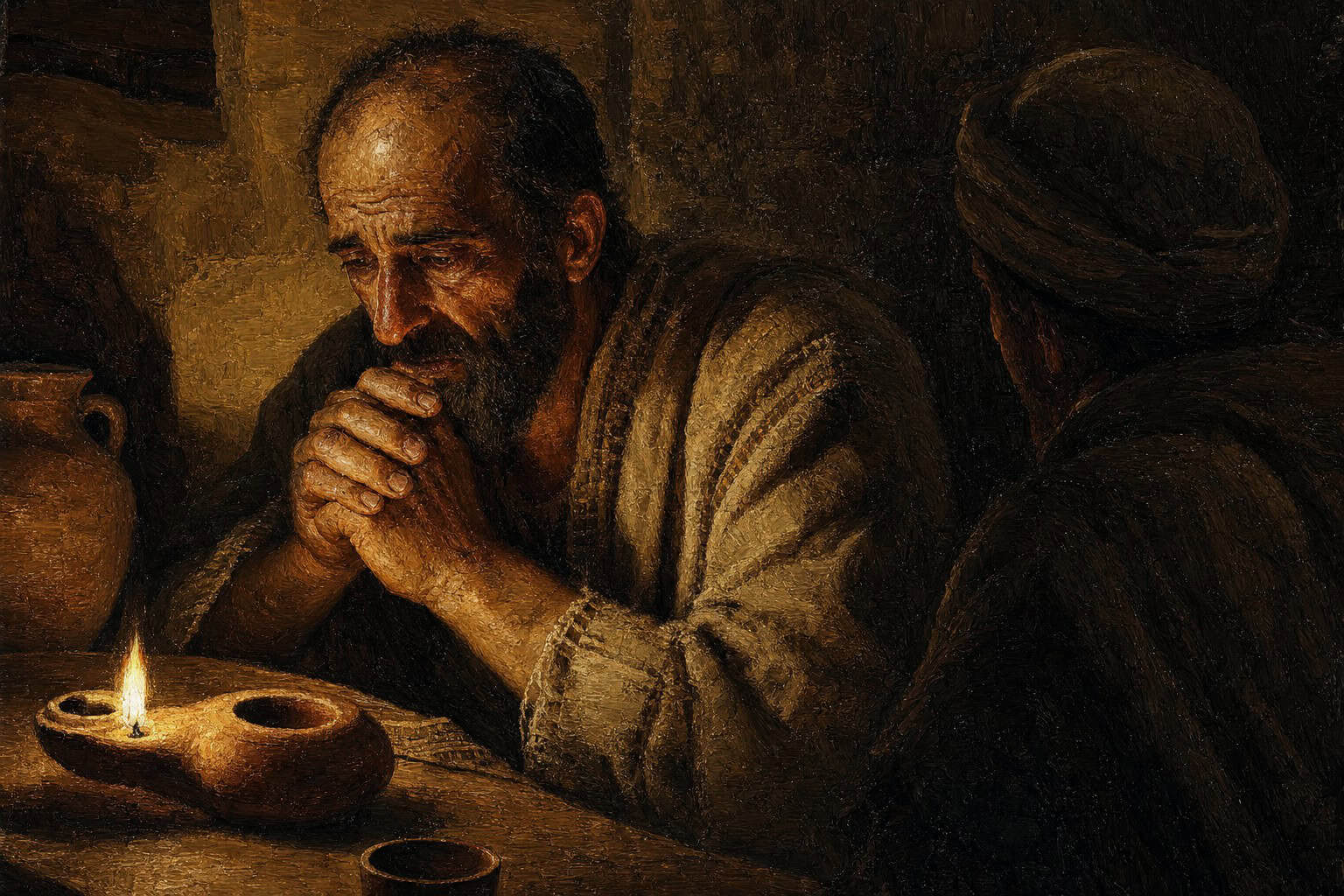
You typed ‘God abandoned the world’ at your worst hour. Here is what silence from heaven really meant when love ended in a single breath.
Her Face Framed in the Screen, a Calm Voice Ending Two Years
You are sitting in front of a screen, and a voice you love is being calm. That calm is the worst part of it. Two years fold shut in the time it takes her to breathe once, and you feel the loss land as if the floor under the chair has been pulled clean away. Her face is framed in the glass, lit and steady, and there is no crack in her voice to grab onto, no tremble to prove she is losing something too. I know this room because I was you in it, staring at that framed face and waiting for the sky to object. It did not object. That is the thing you keep circling now, years later, typing your accusation into a machine at some late hour when sleep will not come: God abandoned the world, God abandoned me, God stood by while the severing happened and said nothing at all. I will not tell you the silence was small. It was not small. It sounded exactly like consent, like heaven nodding along while everything you had propped your peace against walked out of the frame and did not look back. You had made her the antidote. She was the cure you had picked for the old ache, the mark you carried from a childhood that shamed you, the isolation you had dressed up in the clothes of strength and called maturity. When her voice went even and final, you felt God agree with the ending, and that agreement felt worse than the ending itself. It felt like being handed over. But hear me now, from the far side of that chair, where the older man sits who is still you. You were reading the silence wrong. Not because your pain was lying to you, your pain was telling the truth, but because you could not yet tell what quiet nearness looks like when it comes without rescue. You wanted the kind of God who arrives with thunder and stops the loss mid-sentence. What was actually in that room was smaller and stranger and far harder to bear. Someone was sitting in the dark with you, not to halt the severing, but to keep you company inside it, tear by tear, breath by breath. You could not feel Him because you were scanning the dark for the thing that fixes. He was doing the other thing, the thing that does not lift the grief but lowers itself down into it and stays. You were not abandoned in that chair. You were accompanied, and you called the accompaniment absence because it refused to do what you demanded. That is the first lie I want out of your hands. Heaven’s quiet was never consent to your ruin.
The Journal, the Glowing Text, the Walls You Called Holiness
Before her, you had already built the machinery, and I want you to look at it plainly with me. I watch you, younger self, opening the daily journal your teacher gave you, bending over the blank page in a private space where the chaos could finally have a shape, because a page never studied your face and found it wanting. I watch you hunched in the glow of the message board late into the night, learning to speak while completely hidden, calling yourself a scientist of the soul because behind the text no one could see the mark, no one could catch the child who had been mocked. You told yourself these were tools of growth, and in one sense they were. They also happened to be walls. Every honest thing you wrote instead of saying to a living person, every connection you kept disembodied on purpose so the shame could stay covered, was another brick laid neatly in place. You listened to Delilah’s heartbreak from a safe distance, a clandestine classroom where you learned what love’s sorrow tasted like without ever standing close enough to be scalded by it yourself. Then Ann’s kiss arrived like grace you had not earned, uninvited, telling you in one plain second that you could be wanted after all. And almost in the same breath Alex’s flat indifference answered it, teaching you just as plainly that you could be dropped and no one would flinch. That whiplash between being wanted and being nothing at all did exactly the work you feared. You laid more brick. You grew proud of the wall. You began to mistake the wall for virtue, the isolation for devotion, the needing of no one for a kind of faith. Here is what I need you to hear across all these years. The command was to trust and to lean not on your own understanding, and you were leaning your whole body weight on the very defenses you were certain made you holy. You erased yourself before anyone could reject you first. You staged a quiet disappearance and dressed it as humility. But a wall does not guard a soul, it only makes the soul harder to reach, and that includes the One reaching hardest for it. The shame kept whispering that if they ever saw the real you, the marked and mockable child underneath, they would look and find you wanting and turn away, so you decided never to be seen at all. And every refusal to be seen was, without your knowing, another shovelful of coal onto a forge you were building against your own life. You wanted no hand near your soft places, and the God who is jealous for you would not let that fortress keep standing. Not from cruelty. Because a soul sealed off from love is a soul sealed off from Him, and He wanted in. The tools that saved the child would have to be broken in the man. That breaking would feel like abandonment as well. It was not that either.
The Anchor He Cut So You Would Not Drown Holding It
Here is the turn you could not make while you sat in that chair, and so I make it for you now, carefully, because it is a hard one to hold. When her eyes closed to you and opened to the man standing in the shadows, it was not a punishment aimed at her, and it was not indifference aimed at you. It was a cut. A clean, terrible cut. You had thrown your anchor down into a person, and a person is not the seabed, a person is water like you are water. All human love passes. It is built to pass. It is a real gift that runs out precisely because it was never meant to be the solid ground you stood on for eternity. You had lifted her peace and her security up onto a throne, the fourth idol and the crowning one, the blazing core of the whole arrangement, and you were fanning that fire yourself with your two-fisted refusal to let her go. God did not stoke those flames. Your grip did. What felt like heaven severing you was heaven cutting a rope tied to a stone you were already sinking with, hand over hand, into the deep. I know how monstrous this sounds while the loss is still warm in your chest. I am not asking you to be grateful in the chair. I would not dare. I am only asking you to see, someday, later, that the severing was mercy wearing its most severe and unrecognizable face.
He was never in the thunder you demanded. He was in the tear.
That is what the older man knows and the younger man had no way to know. The nearness you begged for was never withheld from you. It was present the whole time in a form you had trained yourself, brick by brick, not to recognize, because you only counted love as love when it fixed the thing that hurt. He did not fix it. He stayed. He walked with you into the very heart of your idolatry, into the ruin of the thing you had loved too much and loved in the wrong order, and He did not get up and leave when the screen went dark and the calm voice stopped. The proof of Him was not a miracle. Miracles are rare, they break in like exceptions and then the ordinary dark closes back over the room. The proof was the accompaniment itself, so quiet that you spent years calling it absence and building your whole accusation on the mistake. God abandoned the world, you typed into the machine. But an abandoned man does not weep with company beside him. He weeps entirely alone, and you were never once alone in that room, not even at the exact instant you were most certain you had been left to go under.
Silence from heaven is not consent to your ruin; it is the hand that will not hold the anchor you were never meant to keep.
Burning on an Altar You Mistook for a Grave
So the anchor was cut, and you did not float free. You burned. I watch you in the long aftermath, refusing to surrender her memory, tending it the way a man tends a fire he cannot afford to let go out, as if devotion to a lost love were the same holy thing as faithfulness. You did not know the heat was correction. You were sure it was grief, only grief, endless and clean grief, and you fed it deliberately because letting it die down felt exactly like letting her die a second time. That is the particular cruelty of an idol once it is broken. It does not stop asking to be worshipped just because it is gone from the frame; it asks louder, from the ash. You kept the shame close through all of it, because shame and grief braid together so easily in the dark. The old voice came back, the one that had followed you since the mark, whispering that you were marked and unwanted and this loss only confirmed the verdict, that the severing was simply the sky agreeing at last that you deserved to be left behind. I want that reading out of your hands too, before it hardens. The break did not expose your worthlessness. It exposed your anchorage, the secret stone you had been standing your whole soul upon instead of standing on God. There is a real difference between being punished and being pressed with a question, and heaven was pressing a question into you: where is your ground, and will you keep sinking to clutch a stone, or will you open your fingers and let the rope run out. You could not answer it gently. You answered it by burning, by scrubbing your rooms sterile because genuine human touch terrified you, by turning devotion into a fortress and calling the whole grim project love. The forge only got hotter. And still, even inside that self-inflicted fire, even in the pride and the refusal and the bleached and controlled little spaces where you fled from anyone getting close, He was in it with you. Not applauding you. Not standing off at a distance with His arms crossed. Present the way a companion is present at a deathbed, saying nothing that repairs anything, doing the one thing that actually matters, which is refusing to leave the room. The fallout of a shattered idol is that you finally learn what you had really been trusting all along. It is a humiliating schooling. You discover you had leaned the full weight of your soul on something that was always going to pass, and worse, you discover that some part of you had known it and had refused to know it. That refusal was the pride the whole wall was mortared from. And the older man, watching, cannot spare you the fire, because the fire was the one thing that could bring the wall down. He can only hand you the truth you needed and could not yet take: you were not burning on a grave. You were burning on an altar, and the smoke was rising toward Someone.
What the Cut Rope Finally Set Free
Let me tell you where all of this settles, though not neatly, because nothing here settles neatly and I will not lie to you to make the ending sit still. The idol had to break so the eye could open. The very wound you carried out of that shamed childhood, the mark you spent your whole life covering with your hand, became in time the organ through which you began to see what cannot be seen. This is the strange arithmetic of it, and it never stops surprising me. God does not waste the humiliation. He puts it to work. The shame that ordered you to disappear becomes, in His hands, the exact place where sight begins, because a man who has been found wanting and then stripped of every last wall has nothing left to guard and therefore nothing left to hide behind. You wanted, more than anything, to vanish from your own gaze, to not be there to be looked at. He would not let you vanish. He made you look. And then He looked with you, and being seen by Him turned out not to be the annihilation you had braced for your whole life. It was the beginning of being known, which is a different thing entirely, and the thing you had been starving for behind all that brick. I cannot promise you the dark lifts on any schedule you would choose. It rarely does. The company in the dark is the mercy; the exit is not the point and often does not come when asked. But I can tell you this much from where I stand, older now, still unsettled, still catching myself asking what I refused to see and how many years I mistook my isolation for holiness. The anchor He cut was drowning you. The love that passed was made to pass. And the God you accused of abandoning the world was, the entire time, sitting in the wrecked room beside a man who could not yet tell the difference between silence and desertion. If you want to know how the severing became a severe mercy, and how a broken idol cleared the altar for something that does not pass away, you already know which room to walk back into. It is the same chair, the same screen gone black, the same salt on the same face. The only thing that changes is who you finally admit was sitting there with you. That admission is the way out of your accusation, and it is the confession waiting for you in Confessions to the Empty Chair, told not from any safe distance but from down inside the fire itself, where the one thing more real than the loss was the One who refused to leave it.