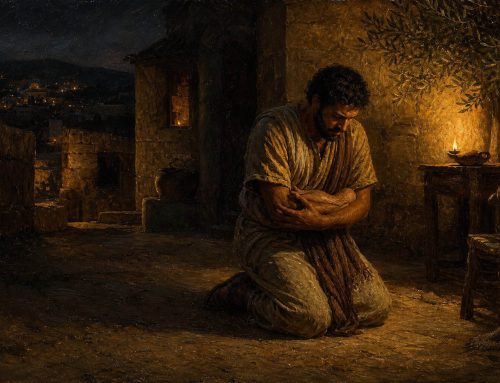
A knee shifts and a pale crescent of skin appears, and suddenly nothing is abstract — only the actual body across from him, and the terror of being seen and not fled from.
That Pale Strip of Vulnerable Skin
Knees shift, fabric pulls, and there it is: a small, startling crescent of white inner thigh. Not an idea, not a symbol—the actual soft flesh of the priest seated opposite, caught where the cassock rides up. The penitent feels his gaze snag there for a second too long, and in that second years of practiced distance buckle. Prayer-words keep moving in his mouth, but his body has already lurching ahead, confessing in heat and pulse what the tongue has not yet named. This exact patch of skin, this awkward, tender place where muscle thins and veins run near the surface, mocks his careful theology. He has trained himself to believe in ordered desire, in clean divides between spiritual longing and carnal pull. Yet this one stuttering look reveals that his hunger is not abstract. It lives in his eyes, his throat, his hands suddenly aware of their own emptiness.
When Honesty Starts to Draw Blood
Words turn sharper once that thigh has been seen. He leans harder into confession, not out of humility but to regain control. If he can name every darkness, drag every sordid impulse into language, then maybe the body’s betrayal can be contained. Truth becomes a scalpel he grips too tightly. He starts slicing at himself in front of the priest, offering brutal details, daring the man to flinch, to cough, to shift that leg and cover the exposed skin. Each admission is less a plea for mercy than a test: can you still sit there once you know this? He watches the priest’s jaw, the set of his shoulders, the unguarded places in his eyes. Honesty, here, is not gentle. It dissects. It separates the supposedly strong from the secretly weak, and the penitent discovers how easily confession can slide into a controlled vivisection of two souls at once.
Two Men Held in the Same Pulse
Somewhere in the middle of this self-directed cutting, the balance shifts. The priest does not flee, does not scold, does not cover his leg in panicked modesty. He stays. His face changes—not into outrage or holy distance, but into something quieter, heavier, as if a hidden weight has just been placed in his hands. The exposed thigh that first shattered the penitent’s composure now becomes proof that the priest, too, is made of breakable parts. Whatever authority he carries sits on top of bone and flesh that can be bruised, touched, desired. The penitent realizes, with a kind of cold wonder, that his darkness is no longer bouncing off a blank wall of office and collar. It is landing on a man who must absorb it. Two bodies share the same drawn-out heartbeat across the space between them, and the relation that begins here cannot be undone by tidy doctrine.
The rarest grace is to be seen in your actual darkness by someone who does not flee, a mercy that cuts both souls open at once.
Where Your Own Defenses Go Limp
Most people know some version of this collision, even if it never happens in a confessional. You sit across from someone—a spouse, a friend, a pastor—and a small, unguarded detail undoes you. It might be the way their hand shakes as they pour coffee, the scar beneath a rolled-up sleeve, the crack in their voice when you push too hard. Suddenly your carefully managed story about yourself feels childish. The mask you meant to keep in place slips, and raw material shows through. Maybe you talk faster, over-share, weaponize your own honesty to stay in charge of the scene. Or maybe you go silent because your body has already confessed something your mouth is not ready to grant. Either way, you discover how easily truth can turn cruel when used as armor, and how terrifying it is when the other person does not retreat, does not tidy things up, but simply remains within reach.
Learning Not to Maim with the Blade
By the end of the exchange, nothing visible has changed in the room: two men, a chair, a strip of cloth that still fails to cover quite enough. Yet both carry out of that space a new knowledge of what truth can do when married to flesh. The penitent has learned he can lash with his revelations, keeping love away by making himself unlovable on purpose. The priest has learned his body is part of the sacrament whether he intends it or not, that his own hidden fault lines are implicated in every soul he agrees to hear. Neither of them yet knows how to consent to divine love without cutting themselves or each other on the way. That work stretches beyond this scene, like a muscle trembling after being forced too far, waiting to learn what it can bear without tearing.