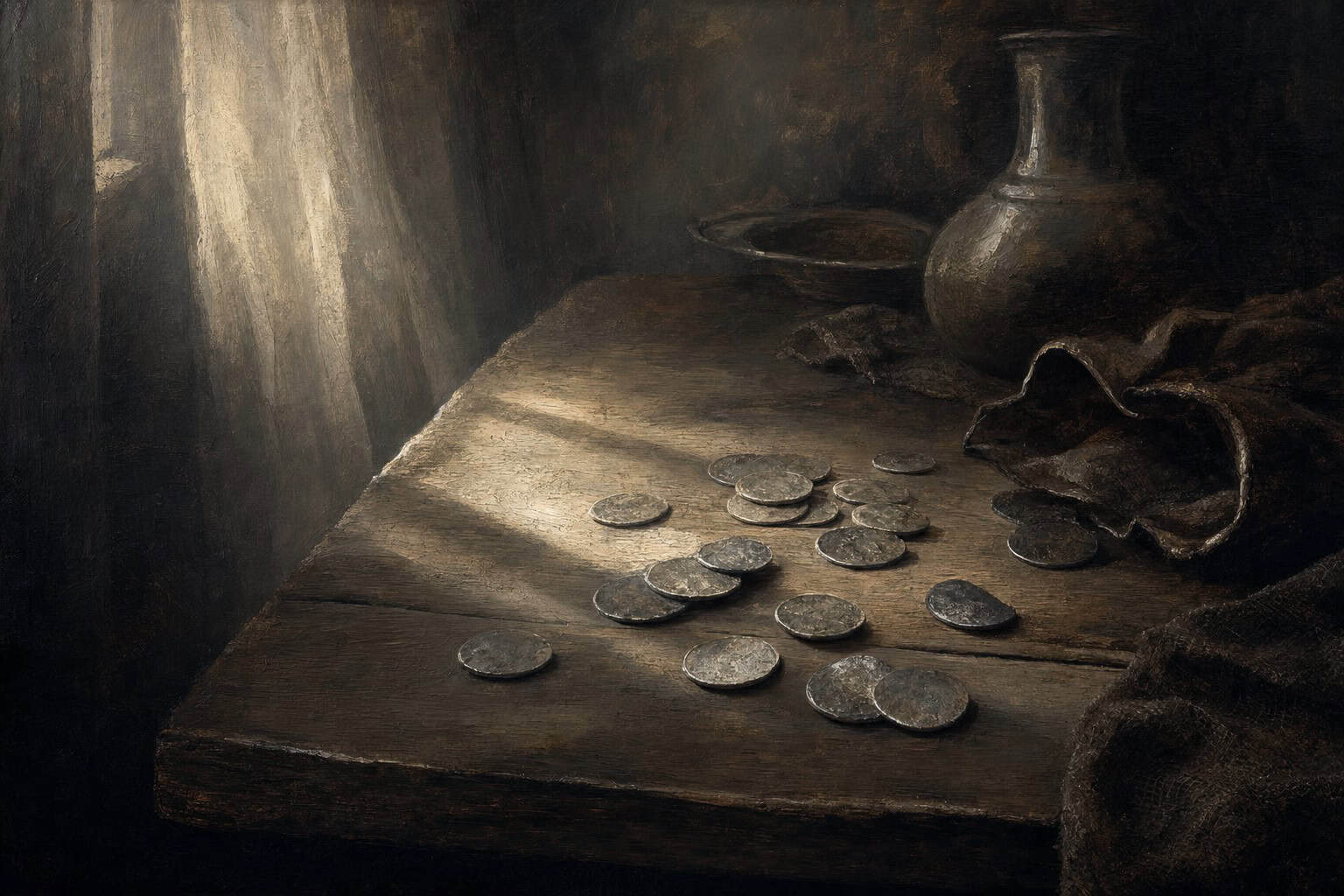
He never gives himself in one clean gesture but spends himself in coppers, a dark word here, a cruelty there, waiting to see how much the other can hold before they go.
Copper Coins on the Table
He does not hand himself over in one generous gesture; he spends himself like small change. A comment here, an opinion there, each one a copper piece dropped between coffee cups or beside the glow of a phone screen. This chapter lives inside those exchanges, where a man who has learned to ration his soul uses words as a testing ground. He knows from long practice how quickly interest turns to boredom once talk moves from bodies to spirit, from flirting to judgment and mercy. So he lays his pieces down slowly, watching for the familiar shift in a woman’s posture, the dimming in her eyes, the polite drift toward other topics. But Leigh sorts through the coins instead of leaving them on the table. She turns them in her fingers, senses the weight under their surface, and keeps coming back for the next handful. Around this simple act—words laid down and not dismissed—the whole chapter gathers its tension.
The Man Who Refuses the Altar of Flesh
Running beneath every conversation is a single, hard reckoning: he will not be ruled by beauty, no matter how much he delights in it. He names his place in a long, dangerous line of men who loved women and ruined kingdoms, then draws his own boundary in sharp relief. Murder, idolatry, bending the knee to any god of skin—these are off the table. His devotion to the One who marked him becomes a kind of weather system around him, a steady wind that dries manufactured tears and scatters rehearsed performances. Women arrive with familiar strategies: curated charm, crafted personas, the assumption that sex still holds the trump card. He stands there, un-moved, and watches what falls away when their usual tools fail. That refusal is not coldness but judgment: either a woman meets him where God remains enthroned, or she walks. In this chapter, that line in the sand organizes every test, every word, every retreat.
Straws Laid One by One
The chapter travels like the slow piling of hay onto a waiting back. After years of watching women buckle under the weight of his unfiltered spirit, he adds each new confession to Leigh as if placing another dry stalk on a beast he assumes will eventually collapse. He starts with thoughts others already found too sharp, then moves toward darker, holier ground. Each disclosure carries memory: past lovers who fled when talk turned inward, friends who shrank from scrutiny, the quiet contempt of those who wanted pleasure without truth. As more of his inner weather spills into words, he braces for the familiar pattern—irritation, distance, silence. Instead, the pressure tilts a different way. Her responses do not erase his fear or soften his severity, but they complicate the script he trusts. By the time she finally says she has never met anyone like him, the reader can feel how many earlier backs broke under less weight, and how much risk he has placed on this small, steady frame.
We test the ones who stay by handing them our darkness in pieces, half-hoping they will finally break, half-praying they never do.
A Voice of Reason Meeting Its Echo
What begins as another filtering exercise becomes something stranger: recognition moving in both directions. Leigh admits that his words give shape to thoughts that have lived in her for years without language. She is used to being the rational one, the friend who steadies other people’s storms, the person whose counsel never finds a match. Now she hears, in his ruthless clarity, a pattern that sounds like her own interior monologue spoken aloud. For him, this is not just flattering chemistry; it cuts into the book’s central wound. A man marked by early violation, who built complex codes to control access to his soul, suddenly faces someone who can read the code without flinching. The chapter stitches this moment into the larger journey: the dark melody of suspicion and judgment does not vanish, but it finds an answering tone in another person. Their dialogue becomes a live experiment in whether a soul can be fully seen without needing to amputate its harder music.
Stars Only Visible in the Dark
By its end, the chapter promises less a romance than a field of vision that widens under night. The man who thought honesty worked mainly as a weapon to drive people off discovers at least one person who treats his severity as light, not shrapnel. Conversation here is not small talk; it is a sky chart, mapping the fixed points that quietly govern how each of them moves through the world. For a reader, the lure is not that everything softens, but that intensity finally meets a witness capable of bearing it. The text holds out the possibility that God, who once allowed blindness in so many faces, might permit clear sight in one. No cures are offered, no guarantees that this connection will hold. What is offered is a moment when the darkness he carries stops being only a fog to choke in and begins, briefly, to behave like a firmament pricked with patient, watching lights.