He does not tear the last thin strip away; he waits, and when she raises her hips just enough to help, the gesture reads less like desire than a contract signed to keep a heart from opening.
The Lift of Her Hips Like a Signed Contract
A thin band of cotton, the last thin strip between them, becomes the scene’s whole courtroom. He does not tear it away in frenzy; he waits. Then she raises her hips, just enough to help him slide the fabric down. That small lift is quiet, almost shy, but in his wounded logic it roars like a verdict. He seizes it as legal proof that what happens now is allowed, that her body’s cooperation can excuse his heart’s refusal to show up. While his hands move, something inside him steps back, folding its arms, observing rather than belonging. The bed smells of sweat and detergent, skin and borrowed courage. Her gesture, meant maybe as trust or simple consent, hardens into a talisman in his mind: she agreed, he tells himself, so he is free to remain cold. In that tiny movement of her pelvis, he finds a way to turn shared flesh into a shield against responsibility.
Counting Touches Like Coins on the Mattress
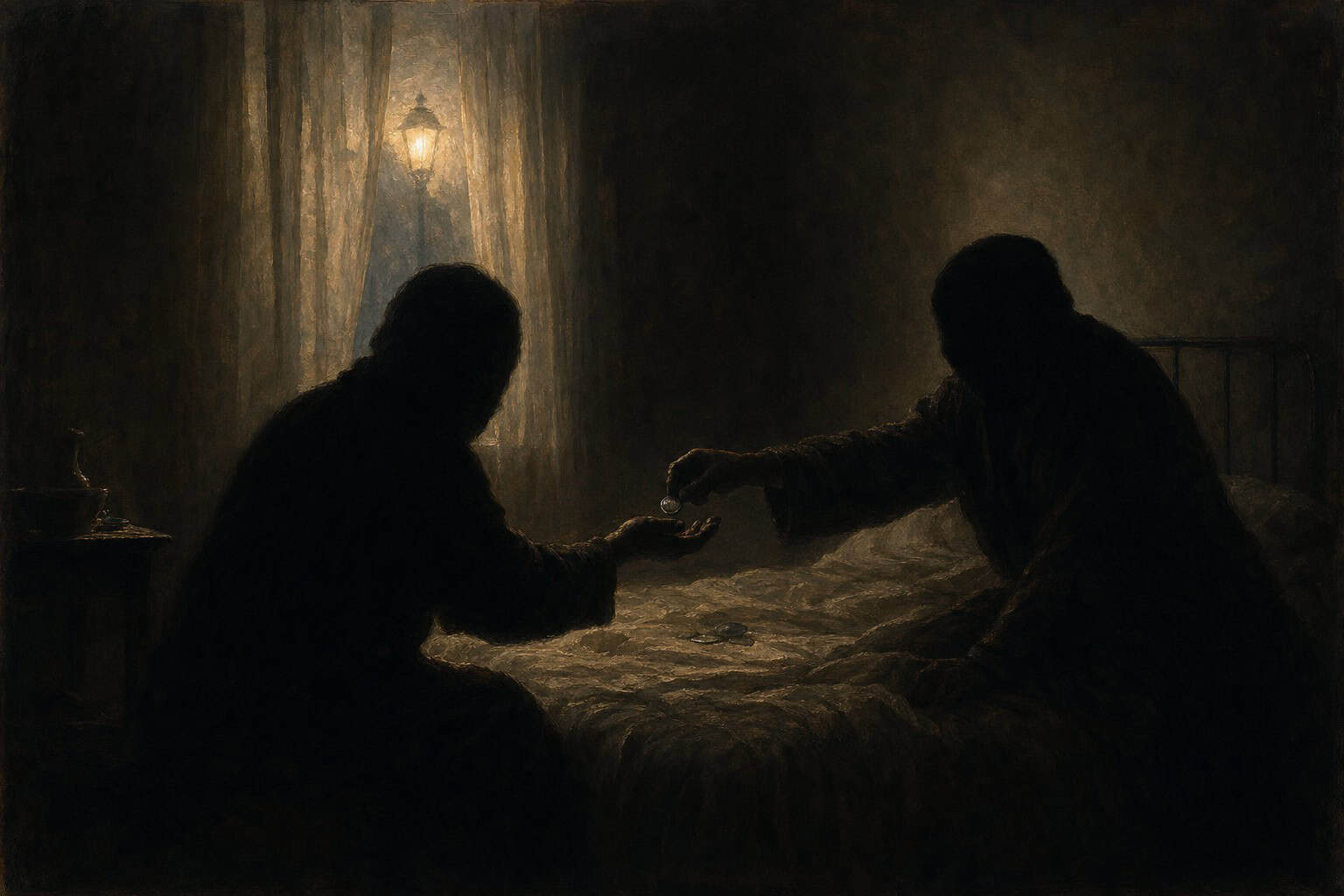
Once that cloth slides away, everything turns into arithmetic. Every kiss, every thrust, is weighed against an invisible balance sheet he keeps in the back of his skull. He offers just enough intensity to keep her responsive, just enough warmth to avoid suspicion. The rest he hoards, like a miser guarding the last coins after a robbery. Her sighs and soft sounds become data points, proof that the transaction is working: she is getting something that looks like desire, so he owes her nothing more than performance. The bed creaks under them like an old cash register, tallying movements that never quite become love. In this late scene of the chapter, sex is no longer a language of gift but a controlled exchange of services—her body for his attention, his body for her fear of being left alone. No one names the terms. They simply spend themselves without ever paying with their hearts.
Her Invisible Gallery of Men in Glass
Even as their bodies meet, he can feel the others in the room—not in flesh, but as a pressure, a faint crowd behind her eyes. He knows about the messages, the half-finished conversations, the men kept hovering in her phone like birds trapped behind clear panes. They are not ex-lovers; they are reserves, kept alive with crumbs of affection, ready to be summoned if the loneliness grows too loud. This awareness does not sting him into jealousy; it cools him further. If he is one shard in her glittering cabinet of maybes, he will polish himself only enough to outshine them for a night, never enough to be breakable. Her need to be surrounded by potential admirers becomes his excuse to stay unclaimed, unsoftened. Two bodies move in the dark, while around them a silent museum of unfinished stories gleams. He lets himself be cataloged, tagged, and placed on her inner shelf, because display feels safer than devotion.
After betrayal, the body learns to charge admission; intimacy becomes a transaction whose only aim is to keep the heart from ever opening again.
Breaking Rules Feels Holier Than Keeping Them
All of this plays out under the low ceiling of religious expectation, where her modest clothes and careful speech were once meant to keep nights like this from ever happening. In that world, desire was fenced in with rules and warnings, especially for women. Now, as she arches toward him, he feels a different thrill than simple arousal. It is the dark pride of having become dangerous enough that she will cross her own lines. Her lifted hips are not only consent; they are trespass. He measures his worth by the strength of the walls he can help someone climb over, not by the tenderness he can offer on the other side. Each broken rule shines like a medal pinned to a chest still chafed by childhood powerlessness. Seduction becomes a kind of bitter liturgy: he does not lead her toward God, but away from the safety of her vows, and confuses that power with intimacy.
Learning to Live Behind the One Safe Gesture
From this narrow scene—a bed, a strip of cotton, a small lift of the hips—a whole future strategy hardens like cooling metal. He discovers that if he can point to one clear sign of consent, he can justify keeping everything tender sealed away, not only here but with anyone who follows. The lifted hips become a pattern: as long as the body agrees, the soul may be absent, and he can call the resulting emptiness safety. For an ordinary life, this is the quiet danger. We begin to treat every partner’s yes as permission to stay armored, to use touch as anesthesia instead of offering ourselves. Years can pass in that posture, hands busy, hearts never unclenched. The chapter does not resolve this yet; it only lets the image linger—a man building his entire way of loving around a single remembered movement, like someone trying to live an entire winter warmed by one fading match.