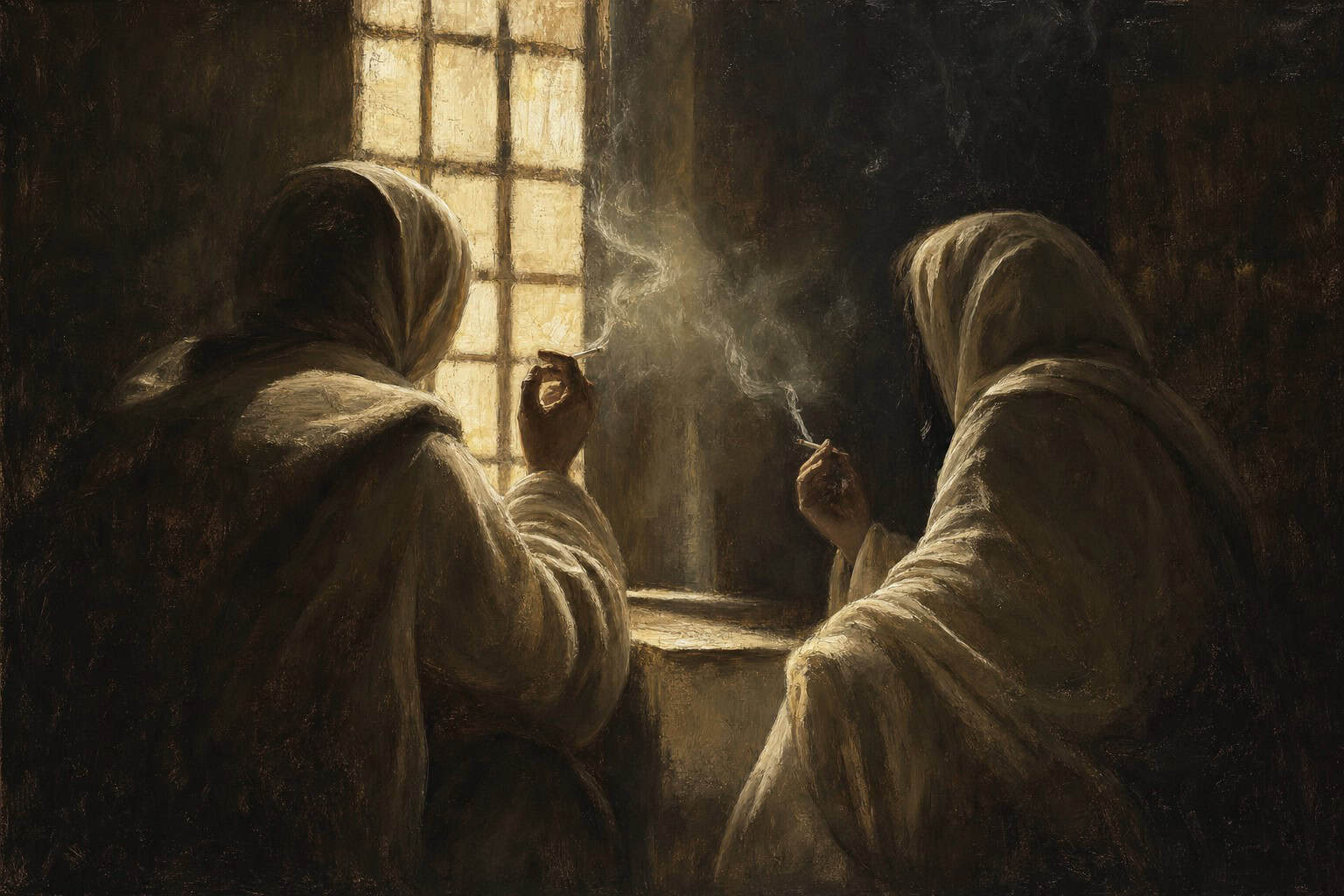
A low table, an ashtray, a bed still warm from a body that already feels gone — and a thin line of smoke rising between two people who share every ritual of closeness and arrive nowhere.
The Ashtray Between Their Bodies
A low table, an ashtray, a bed still warm from a body that feels already gone—this is the whole stage. She lies on the mattress, eyes turned somewhere he cannot follow, while a thin line of smoke rises from the cigarette he lit for her. Her scent clings to the sheets and his clothes, that sharp floral trace that says she is here, even as everything in her posture insists she is not. He moves around her with the small, fussy motions of a nurse: straightening a corner of the blanket, placing a glass of water within reach, adjusting the pillow under a head that does not lean toward him. The ash grows longer, then breaks and falls, a gray tower collapsing into the dish between them. Her breathing is steady, almost bored. His, shallow and watchful. Flesh is not the problem—her body is inches away. The cruelty is that he can touch skin that will not meet him back.
Food Cooling Under the Weight of Her Refusal
In the next room, a meal waits that no one has blessed. He has laid it out like an amateur priest: plates aligned, candles lit, wine breathing on the counter. He meant it as a bridge—a way to say, without saying, I choose you, stay. When she sees the effort, something hardens instead of softening. She will not sit, will not play the role he has written for her in this small domestic drama. His careful staging exposes itself as strategy, not gift, and she can feel the hook buried in it: be moved, be grateful, be mine. Her refusal is simple and devastating. A shrug, a turned shoulder, a few flat words, and suddenly the table is not a sign of welcome but a bright-lit cross-examination of his motives. As the food goes cold, he feels his own heart cooling beside it, realizing that every fork and folded napkin now testifies against him.
Counting Her Silences Like Beads
Back in the bedroom, he retreats into numbers. If he can count it, maybe he will not have to feel it. Three seconds between his question and her non-answer. Two centimeters of space she has added between their legs since last week. The angle of her spine, just off from the curve that once leaned into him without thinking. He tracks it all like someone fingering a rosary made of data points: the way she inhales before saying no, the steady speed at which she scrolls her phone while he talks, the exact distance from her hand to his on the sheet. This arithmetic of detachment becomes a shelter from the raw fact that she does not want him. Calculation feels safer than begging. If he can diagnose the pattern—her caution, her contempt, her fear—perhaps it will hurt less than naming the simple word: unloved. The more precise his measurements grow, the more brutal their answer becomes.
Two people can share every ritual of closeness and still meet nowhere; some intimacies are only the elegant management of distance.
The Child of the Dark Learning the Wrong Lessons
What plays out in this small, smoky room is not rare or exotic. It is the rehearsal so many carry from childhood into adult desire: if I serve well enough, anticipate sharply enough, erase myself cleanly enough, someone will finally stay. For a soul trained early to distrust joy, this kind of scene feels almost holy. Pain means it must be real. Her withdrawal confirms his oldest catechism about himself: you are too much and not enough at once. So he doubles down on effort, corrects his posture, softens his tone, tries to become the version of himself she might tolerate. The tragedy is that he mistakes self-erasure for love and her coldness for truth. Anyone who has ever set a table of gestures before an indifferent guest knows this burn. The ache here points to a deeper hunger: to be received not for performance, not for usefulness, but as the whole knot of light and shadow that will not come untangled.
Smoke Rings Where a Blessing Should Be
They end up at the window, shoulder to shoulder, sharing a cigarette instead of a kiss. The meal is untouched behind them; the bed holds the hollow her body left when she swung her legs to the floor. Here, the only liturgy they can manage is this: inhale, exhale, pass the thin white stick from one set of fingers to the other. The glow at its tip is the closest thing to a candle they will share tonight. Each drag scrapes the throat, burns the lungs a little, leaves a faint buzz under the skin. It is honest in a way their bodies in that bed were not. This will hurt you, the smoke says, and still they draw it in. For a moment their breaths mingle in the hazy air, their chests rising and falling to the same rhythm, two wounded animals marking time with poison. The cigarette burns down to the filter, and in the small, singed butt between his fingers, he feels both the cost of his hunger and a question that has not yet learned how to pray.