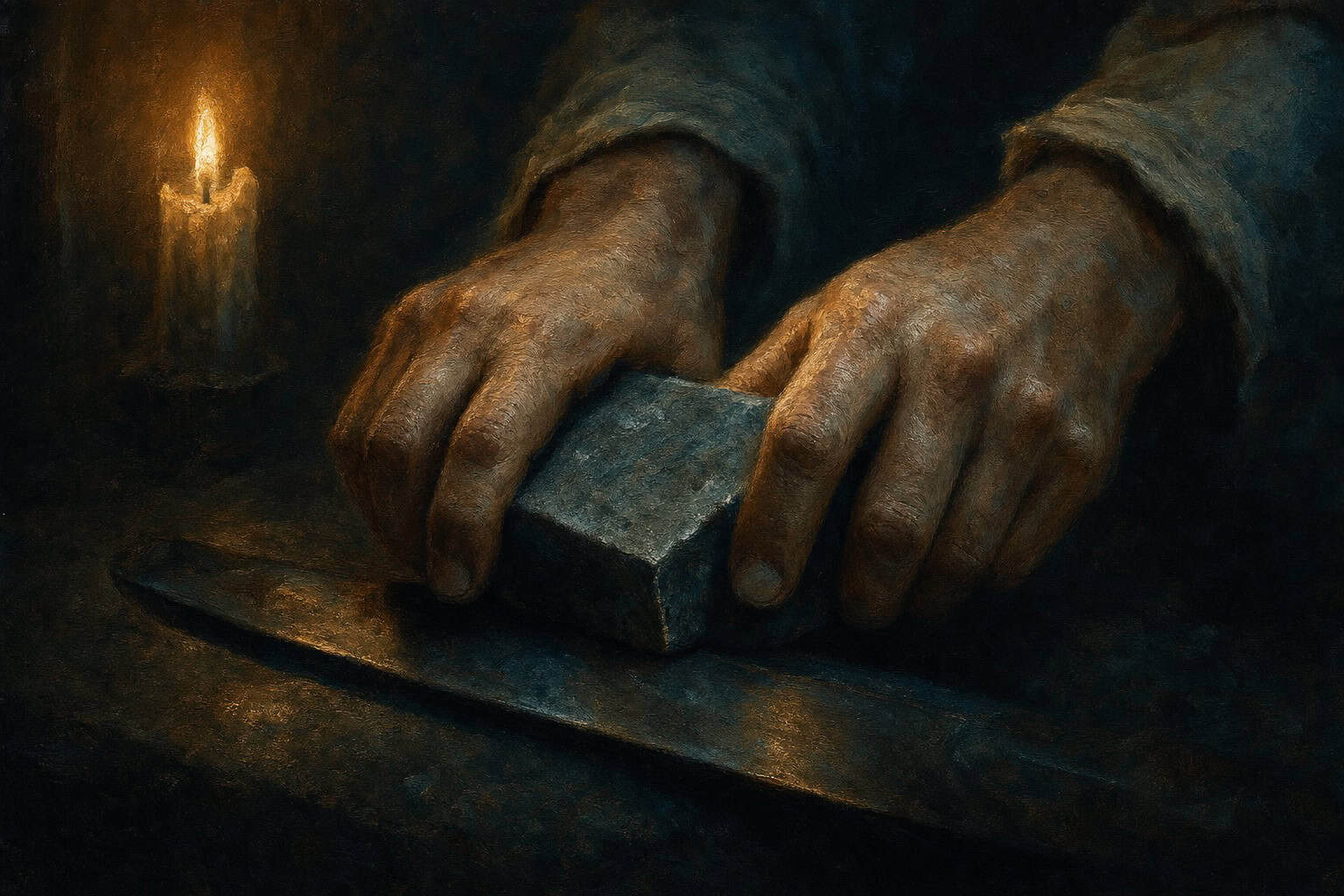
He leans over the table like a craftsman over his work, his questions coming with the hard rhythm of steel on stone, never asking what right he had to hold that grinding edge against her.
Sparks Jumping from the Edge of a Blade
He sits across from her at the table, body angled forward like a craftsman over his work, and his questions come with the hard rhythm of steel against stone. The dominant image here is the grind: not gentle shaping, but pressure and heat, as if every careless word from her mouth throws a visible spark into the air between them. Her shrug is not just a shrug; in his reading it is proof, a bright shard flying off the edge of a blade that refuses to hold form. When she lets an “I don’t know” slip out, he tightens, shoulders drawing up, jaw set, as if the metal has skipped across the stone and left an ugly groove. This is not a drift of conversation; it feels like a sharpening session that never asked the knife’s permission. The kitchen around them fades under the harsh light of his attention, until all that remains is edge and surface, pressure and resistance, and a woman shifting in her chair as if the grindstone had been pressed against her bare skin.
Her Mind Laid Out Like Tools on the Bench
What he wants from her in this moment is not simple honesty, but exposure that has no shadow left. He treats ambiguity like rust, something that must be scraped until the metal underneath is bare and gleaming. Every time she hesitates, groping for words, he calls her to account, insisting that she choose, define, pin down; confusion is, to him, a moral failure, not a normal state of a wounded mind. The scene hangs on his demand that she become the full author of every inner motion, as if a heart could be diagrammed like a machine on a workbench. He will not allow “I don’t know” to stand, because that phrase leaves room for mystery—and mystery, to him, feels like betrayal. She feels the weight of that gaze the way a body feels cold metal laid along the spine: a shiver, a reflexive tightening. Between them, the simple act of speaking has turned into a forced inventory of the soul’s toolbox, each piece dragged into the open and labeled under his unforgiving light.
The Rock That Will Not Turn Fully Against the Wheel
He has named himself her whetstone, but in his hands the metaphor grows violent. Every time she withholds a detail or fails to match his intensity, he pushes harder, turning up the imagined speed of the wheel, certain that more friction will finally make her shine. Her body tells a different story: shoulders drawn in, arms crossed half-defensively, legs angling away under the table as if to protect some last unground corner of herself. He interprets that recoil as proof that her very flesh stands against him, that her closed posture is not fatigue but treason. The more he leans in, the more she becomes stone in another sense—heavier, less responsive, a rock that cannot quite be clamped to his device. This is where the pressure builds: his hunger for a partner who consents to total reshaping colliding with her instinct to remain at least partially opaque. In the sharp air between them, neither will name it yet, but the grind has reached a pitch where something must crack—edge, wheel, or the rock that refuses to surrender its last roughness.
We demand that those we love be ground down into something sharper, never asking whether we had any right to hold the stone against them at all.
When Your Lover Holds You Like a Knife That Must Be Fixed
This is not only their scene; it is the pattern that plays out whenever someone sits across from a beloved and decides, secretly or aloud, that the other must be improved. Many recognize that sting of being handled like a dull blade: the partner who will not accept a simple “I’m confused,” who needs every feeling justified, every hesitation cross-examined until it fits their story of what real intimacy should look like. The passage names how that stance turns desire into a workshop, where one person becomes the tool and the other the self-appointed worker. We tell ourselves it is for their good, that harsh questions are a form of care, but beneath it often lies our own terror of being with someone whose inner world we cannot control. Sitting in this scene, an ordinary heart can feel both sides: the temptation to grind and the exhaustion of being ground. The text presses a question without spelling it out: what happens to love when we treat the person in front of us like a repair project rather than a presence whose very limits are part of the gift?
Shavings of Self Curling on the Floor
By the end of this passage, no resolution has arrived—only the sense that their talk has left small, invisible filings on the ground, thin curls shaved from both of them. His certainty still hums, a tight current in his limbs, but underneath it a hairline doubt begins: if this is love, why does it feel like work done with gritted teeth. Her “I don’t know” still hangs in the air, not erased by his demands, and in that unpolished phrase there is a stubborn remnant of her own authorship. The whetstone image, which once flattered him as noble helper, now reveals its edge: tools sharpen, but they also wear away. The narrative voice lets us stand right at that workbench with them and feel, in our own bodies, the heat of overused friction and the chill that comes when we see how much of ourselves we have already ground off for someone else’s vision. The scene does not tell us which of them will bend first; it leaves us staring at those silent shavings of self scattered across the floorboards.