The apprentice who sat beside you, learned your voice, suddenly vanishes—and with them, your faith that words can reach anyone at all.
Sparks Leaping From the Grinding Wheel
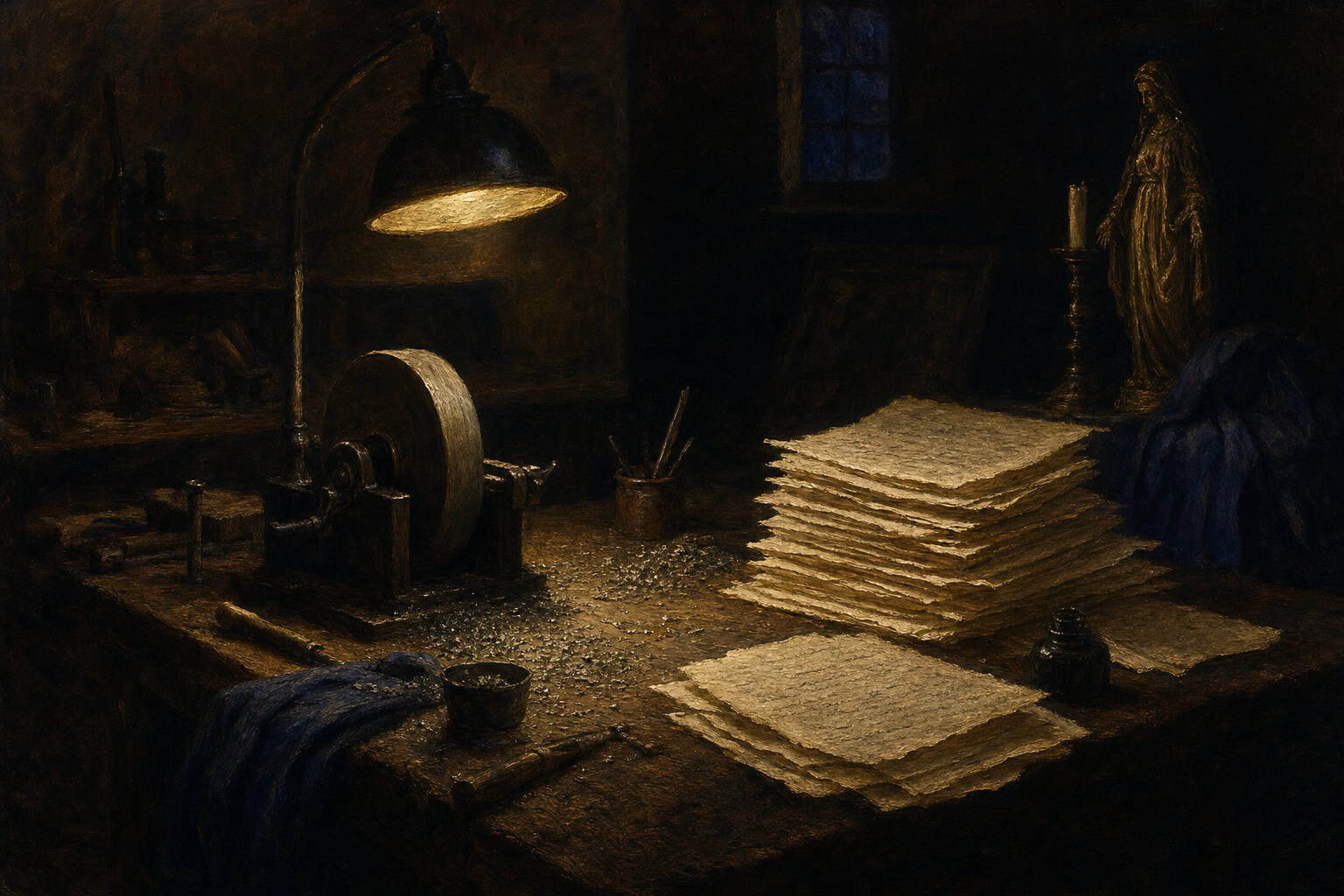
Metal against stone screams before it sings. In this passage, the work on the soul is pictured like a blade pressed hard to a spinning wheel, the air tasting of iron, the smell of scorched dust rising as sparks leap and die on the floor. This is not a gentle polishing but an act that borders on violence, each pass stripping away what has quietly invaded the steel. The narrator names his own limitations as if they were foreign growths, cancers in the metal that have to be ground out before they spread any further. He consents to this harsh discipline, yet feels the risk in his own bones: lean too hard and the blade shatters; ease up and the corruption remains. The moment sits late enough in the chapter that we know this is no theory lesson but hard-won practice—years of being worn down now being met by a chosen abrasion. What frightens him most is not the pain, but the question of substance: when the wheel has done its work, will there be any true edge left at all, or only filings on the shop floor.
The Apprentice’s Voice Gone From the Workshop
Into this raw, grinding interior comes a quieter loss: the simple fact that the other stool in the workshop is empty. There was once an apprentice at his side, close enough to smell the same metal dust, close enough to absorb the pattern of his speech almost without effort. This student had leaned in over the same table, repeated his phrases, asked the right questions, seemed to let his instruction soak into muscle and memory. Then, without scene or ceremony, that presence is gone. The absence is not abstract; it shows itself every time he turns to speak and finds no one there, every time his hand gestures toward a listener who has already walked away. This, more than any enemy’s dismissal, cuts into him: the one who knew his tone, his silences, his quirks of thought, has decided they are not worth staying for. The workshop feels different now, the tools laid out the same, but the living witness who once confirmed his voice has vanished like breath in cold air.
The Sound of Words Hitting the Far Wall
From that empty stool, a harsher suspicion grows: maybe his words were never as strong as he believed. He replays old conversations with the apprentice, the nodding, the flash of recognition in another’s face, and feels them sour in his memory. If that understanding could dissolve so easily, perhaps it was thinner than it looked, like paint that never truly bonded to the surface beneath. Standing now before the page, he hears an inner echo as if he were speaking in a bare hall, each sentence traveling out, hitting the far wall, and sliding to the floor unheard. The passage refuses to comfort him with easy lessons about “some people not being ready.” Instead, it lets the doubt swell until it crowds the space around him: if speech, given in person, seasoned with shared hours and corrected misunderstandings, could not hold one soul close, what can these inked lines possibly do at a distance? The pressure here is not just sadness; it is a creeping conviction that his voice itself might be hollow metal, ringing loud but never cutting in.
Yet the image of metal and stone offers another angle: maybe this very humiliation is one of the impurities being worked out of you—the belief that you can save, fix, or secure another by the force of your own clarity.
Your Own Hands On the Wheel
This is where the scene reaches out and takes an ordinary reader by the wrists. Most people know what it is to pour themselves into someone—a child, a student, a friend—only to watch them drift, sometimes without a word. The passage will not let that ache stay vague. It invites you to feel your own version of the grinding wheel: the late-night replay of conversations, the stab in the chest when you see their name and do not recognize the life attached to it anymore. It suggests that such abandonments can infect our sense of vocation itself. After all, if the one who had every advantage of your presence could not stay, why bother trying to speak to anyone else? Yet the image of metal and stone offers another angle: maybe this very humiliation is one of the impurities being worked out of you—the belief that you can save, fix, or secure another by the force of your own clarity. The stakes are not only emotional; they are moral and spiritual. How you carry this loss will shape the edge of your own heart.
Pages Stacked Beside the Cooling Wheel
And yet, in the same space where doubt growls and metal screams, pages quietly pile up. The narrator keeps writing, even as he half-believes that each line will skid out and die against some unseen surface. The manuscript grows beside the imagined grinding wheel, as if laid on the bench where the filings collect, stained by the same labor that strips him down. He does not receive any sign that these pages will reach further than his failed instruction once did; the passage withholds any soothing vision of future readers whose lives are changed. What we are given instead is this stubborn pairing: refinement and expression, loss and continued speech, ashes on the floor and fresh ink drying on white paper. The unity he cannot secure with another person is not yet restored here; it is still a question hanging in the air of the workshop. For now there is only the rhythm of the stone, the faint tremor in his hands, and a growing stack of paper that waits like a tool whose purpose he has not yet seen.